Rambo Lambo - a Historical & Technical Appraisal of the Lamborghini LM002
/
BACKGROUND
After the Mimram Group headed by brothers Patrick and Jean-Claude acquired Automobili Lamborghini in mid 1980, a plan to expand the firm’s one-car model range was immediately embarked upon.
When the company had been placed into administration during 1978, production of the Urraco, Silhouette, Espada and the original narrow-bodied Countach LP400 had all been discontinued as the firm focused its efforts exclusively on the recently introduced Countach S.
However, while this may have seemed an an appropriate course of action to keep the slimmed-down firm ticking over while a suitable buyer was found, the Mimrams wanted to offer three different models to deliver greater financial stability.
With this in mind, the ill-fated Silhouette (a V8-powered Targa-topped two-seater) was transformed into the significantly updated Jalpa. Alongside, work began on reviving the expensively developed Cheetah military fast response prototype that had exemplified Automobili Lamborghini’s prior mismanagement.
In addition to these big projects, the Mimrams sanctioned the creation of an enlarged V12 engine for use in the Countach while also instigating a programme of much-improved build quality for all Lamborghini products.
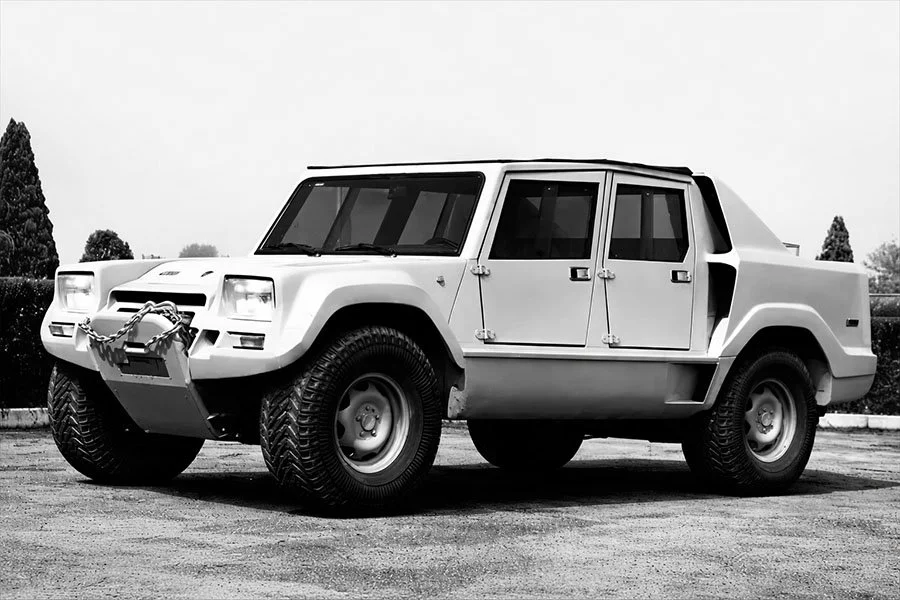
The first new machinery to emerge under Mimram Group ownership went on display at the Geneva Motor Show in March 1981 where, alongside the latest iteration of the four-litre Countach S, Lamborghini unveiled prototypes of the Jalpa and LM001.
At this stage, the LM001 (as its Lamborghini Militare moniker suggested) was still intended for military use much like the Cheetah had been. Aside from a revised body with conventional opening doors, the LM001 was little changed retaining both a rear-engined layout along with a Chrysler-sourced V8 and three-speed automatic gearbox.
Unfortunately, it quickly became apparent that, because of its rear-engined layout and underpowered engine, the LM001 was blighted by the same poor handling, wayward steering and lacklustre performance as its predecessor.
To address these issues, Lamborghini’s next prototype proved a radical departure.
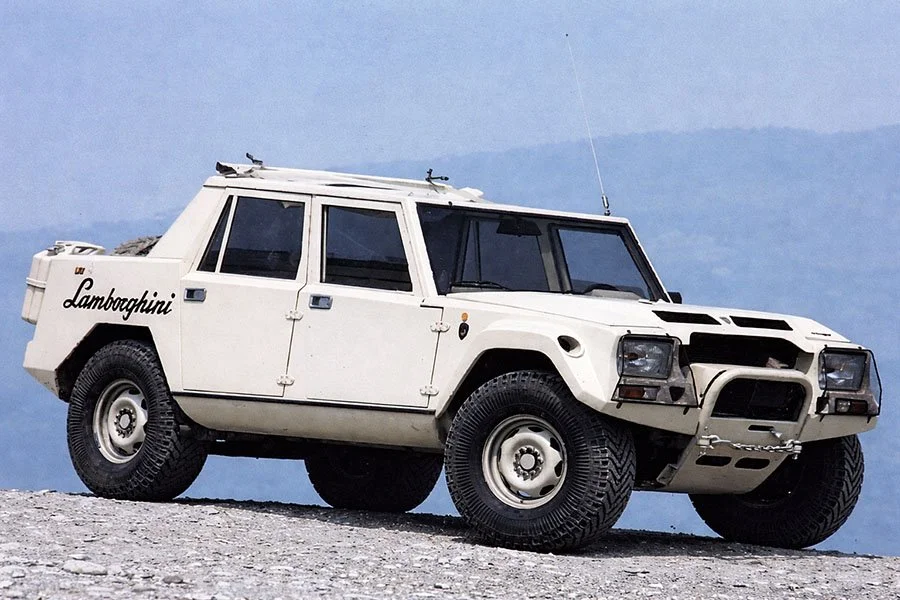
The resultant LMA002 switched to a more conventional front-engined layout and adopted a 332bhp version of the 4.8-litre Lamborghini V12 created for the Countach 5000 S. Hooked up to a heavy-duty five-speed ZF gearbox, the engine and transmission were dropped into a new tubular steel spaceframe chassis as opposed to the reinforced tubular steel safety cage with integral bulkheads used by the Cheetah and LM001.
Also ushered in for the LMA002 was a much-needed power steering system which, combined with the better layout, meant the often scary handling tendencies of earlier prototypes became a thing of the past.
The LMA002 made its debut alongside the Countach 5000 S at the Geneva Motor Show in March 1982, but Lamborghini yet again failed to generate the desired orders.
Thinking perhaps the lack of appetite was perhaps down to the presence of the LMA002’s complicated Lamborghini engine, a turbocharged 3.6-litre straight six diesel engine from VM Motori was installed in the subsequent LM003 to no avail.
At this point, Lamborghini decided to take an entirely different approach for its expensively developed white elephant and, instead of a military offering, tsubsequent LMs would be pitched as the world’s ultimate luxury sports utility vehicles.
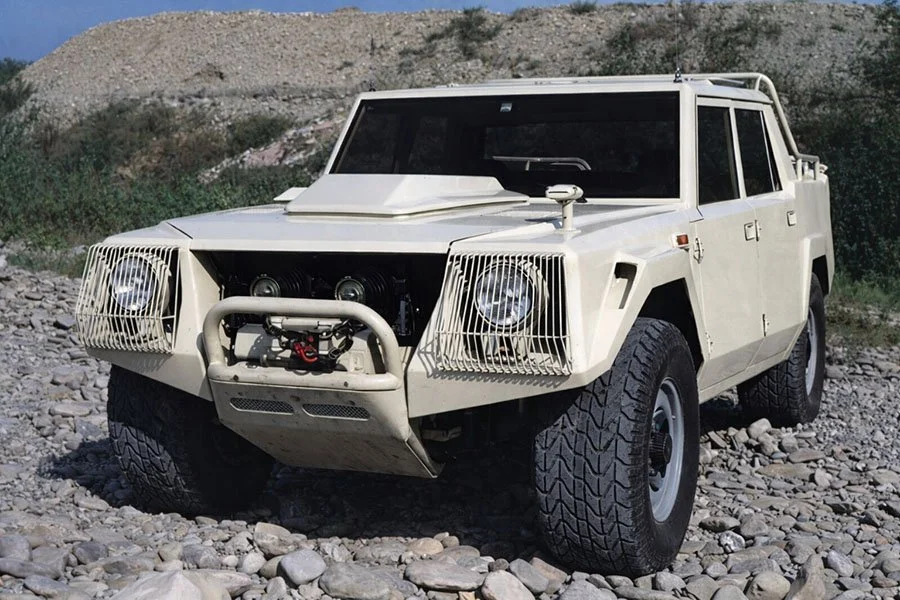
The LM004 that emerged in early 1984 set the blueprint for Lamborghini’s wild new machine. Based around the same chassis as the LMA002, it featured a seven-litre Lamborghini marine engine and a subtly revised body.
However, it was the LM004’s interior that best illustrated Lamborghini’s changing aspirations for the car; no longer intended exclusively for military applications, the cockpit had been completely redesigned to attract civilian buyers. Kitted out with leather upholstery and luxurious carpet, the LM004 also featured air-conditioning, an audio system, a satellite radio-telephone and refrigeration unit.
On test, the LM004’s seven-litre marine engine was found to be too heavy so Lamborghini reverted back to a Countach-derived unit for production.
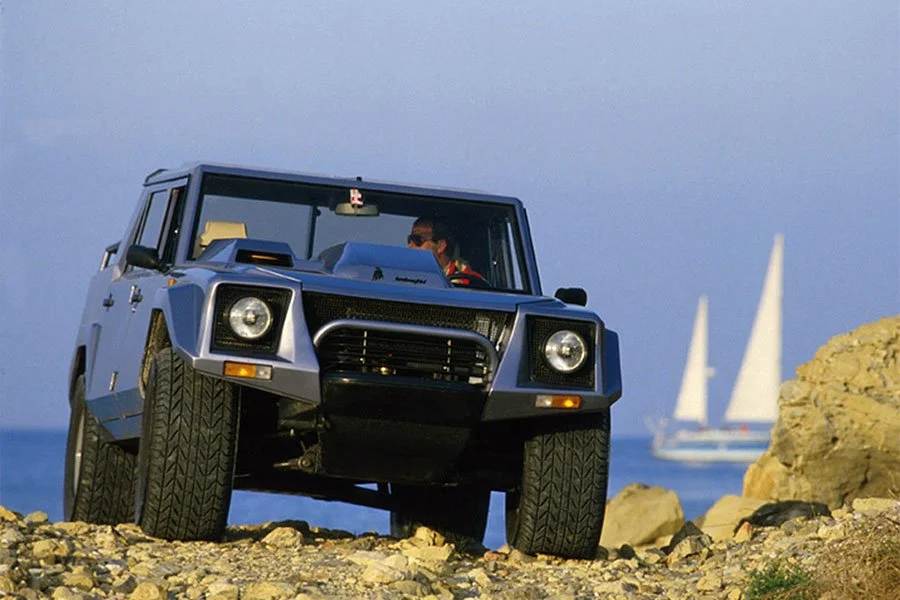
A prototype of what became known as the LM002 emerged at the Brussels Motor Show in January 1986. The production version arrived three months later and went on display at the Turin Motor Show in April. On both occasions, the LM002 generated a huge amount of publicity – never before had anything like it been offered.
CHASSIS
As per every iteration of the LM theme since 1982, the LM002’s chassis comprised heavy-duty tubular steel tubes welded into a spaceframe. At 3000mm, the wheelbase was 350mm longer than an Esapada. A 169-litre fuel tank was installed behind the rear seats.
Independent suspension was via control arms with coil sprung telescopic shocks (two per side at the rear).
Up front, 330mm diameter ventilated brake discs with twin piston calipers were installed while out back Lamborghini used 280mm diameter drums.
Enormous 11 x 17-inch pressed steel wheels were shod with 345/60 VR17 Pirelli Scorpion Zero tyres with semi run flat capability.
ENGINE / TRANSMISSION
In the LM002’s engine bay was a lightly de-tuned version of the Countach Quattrovalvole motor able to run on lower quality fuel.
Designated Tipo L510, this was another iteration of the all-alloy DOHC Lamborghini V12 that had been around in one shape or another since 1963.
As per the Countach Quattrovalvole, displacement came in at 5167cc thanks to a bore and stroke of 85.5mm and 75mm respectively.
Similarly, four valve cylinder heads with pentagonal combustion chambers were fitted. The heads featured two 36mm inlet valves and two 32mm exhaust valves for each cylinder whereas the older 4.8-litre engine from the Countach 5000 S had used single 48mm and 38.2mm valves respectively.
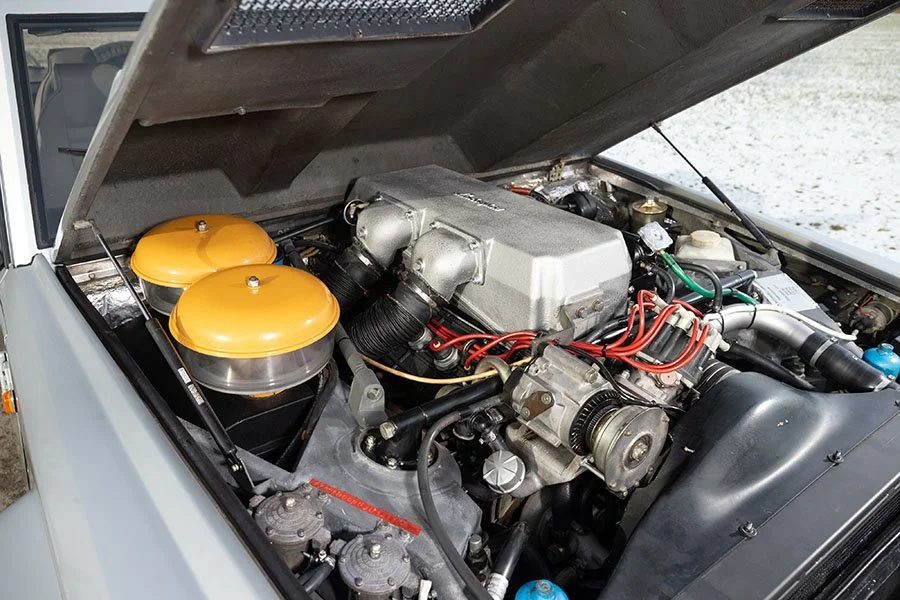
Also new on these engines shared by the Countach Quattrovalvole and LM002 were downdraught instead of sidedraught carburettors. In both cases, six twin-choke 44 DCNF Webers were used. For the LM002, the fuel supply system was equipped with two filters (in-line and in-series) while the carburettors were configured to burn less than perfect fuel. An oversized radiator with two high-speed fans kept the engine cool, even in the hottest desert environments.
A 9.5:1 compression ratio was again carried over from the Countach Quattrovalvole. In this configuration, Lamborghini quoted a peak output of 444bhp at 6800rpm and 369lb-ft at 4500rpm.
For comparison, the Countach Quattrovalvole pumped out 455bhp at 7000rpm and 369lb-ft at 5200rpm.
Transmission was through a heavy-duty ZF S5-24/3 five-speed manual gearbox (mounted behind the engine), a centrally-mounted two-speed transfer case (that offered high and low all-wheel drive ratios plus rear-drive only), a trio of locking differentials (with 25%, 100% and 75% locking factors respectively) and a single-plate clutch.
BODYWORK
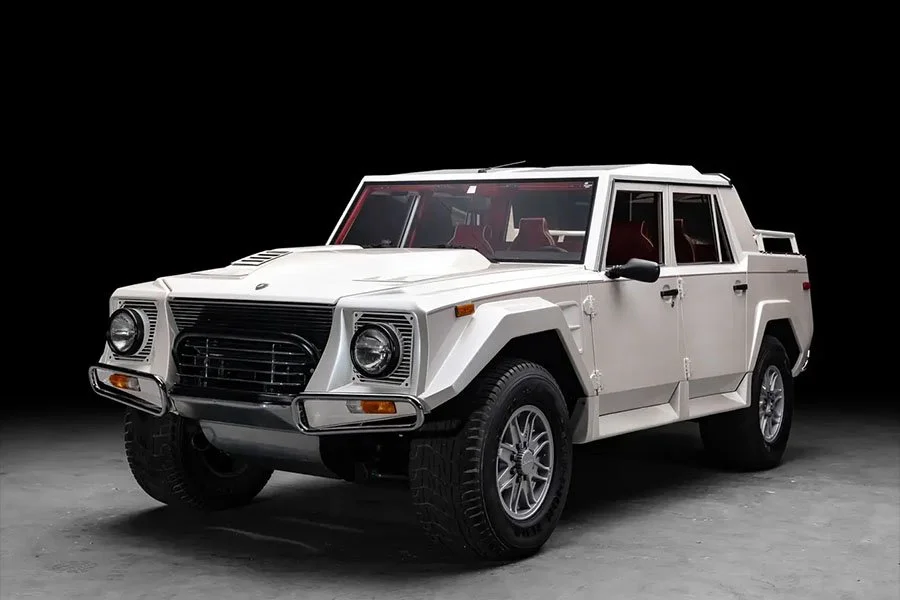
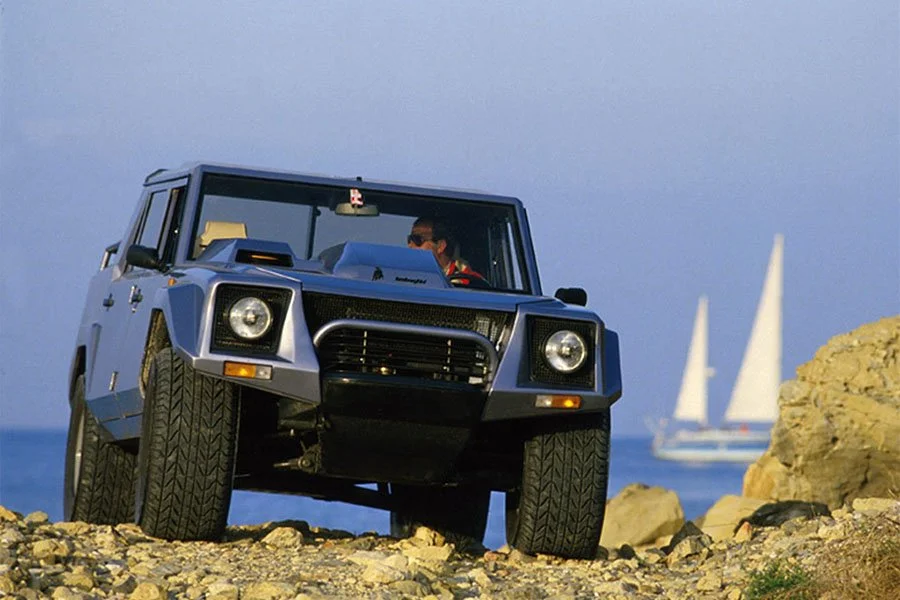
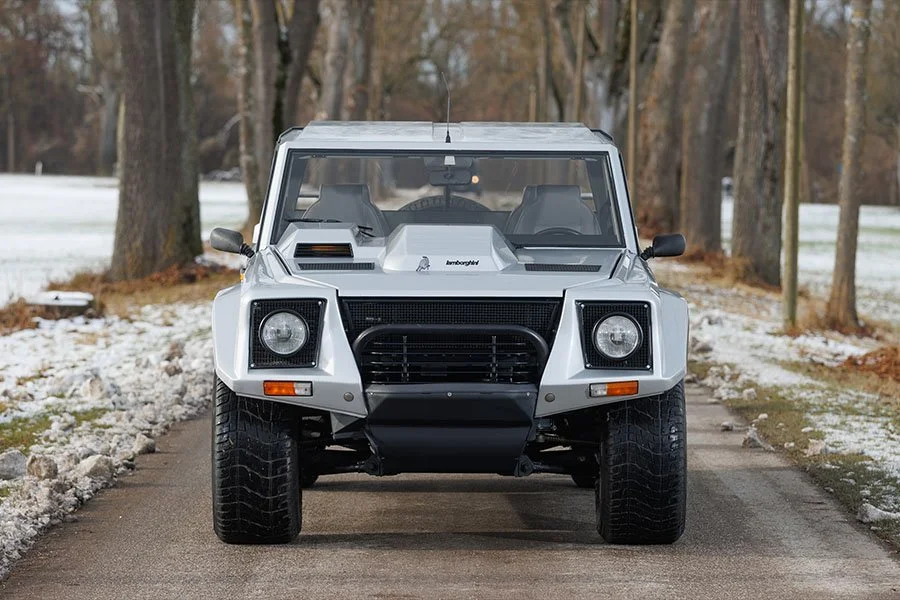
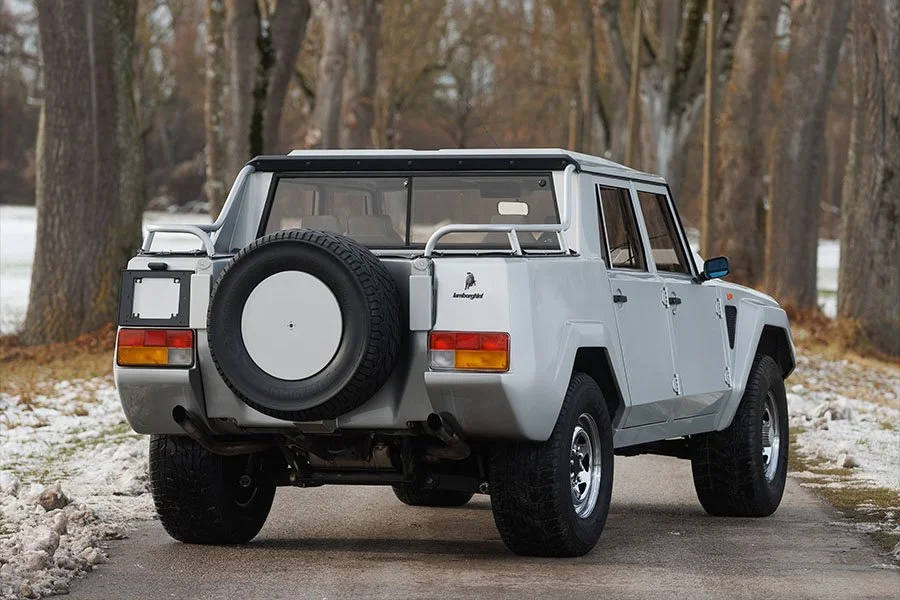
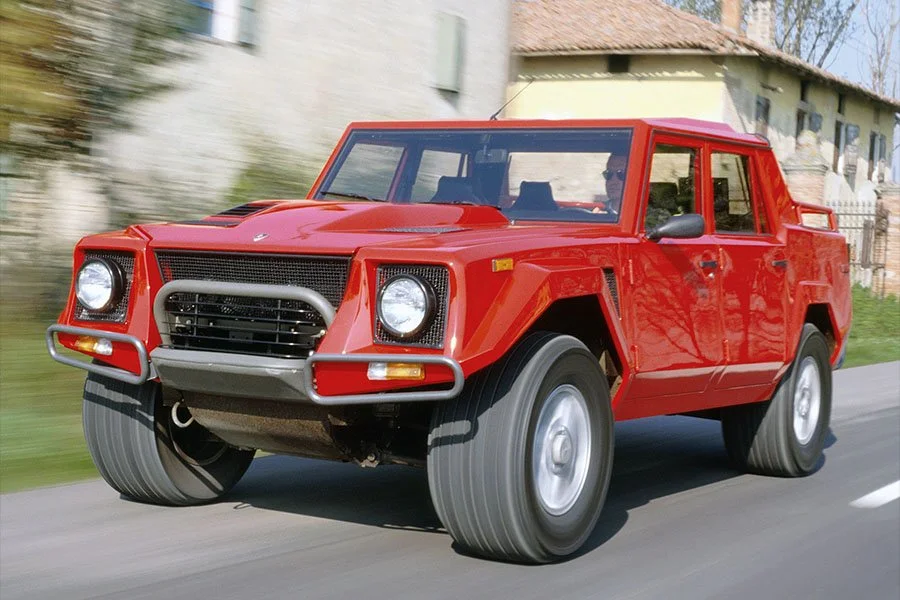
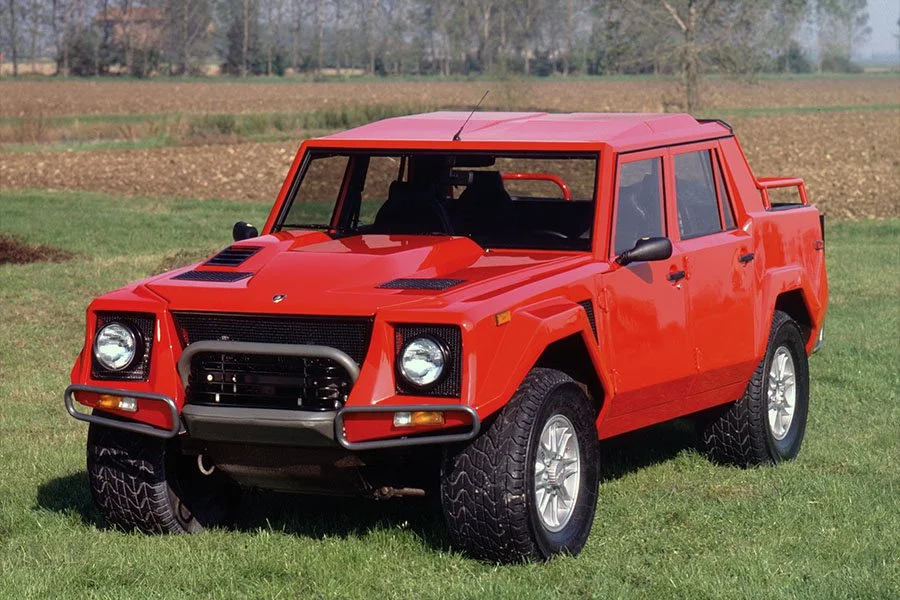
Externally, the LM002 followed a largely similar blueprint to the LM004; with little curvature, none of the aggression of Lamborghini’s early military prototypes was lost in translation to civilian plaything.
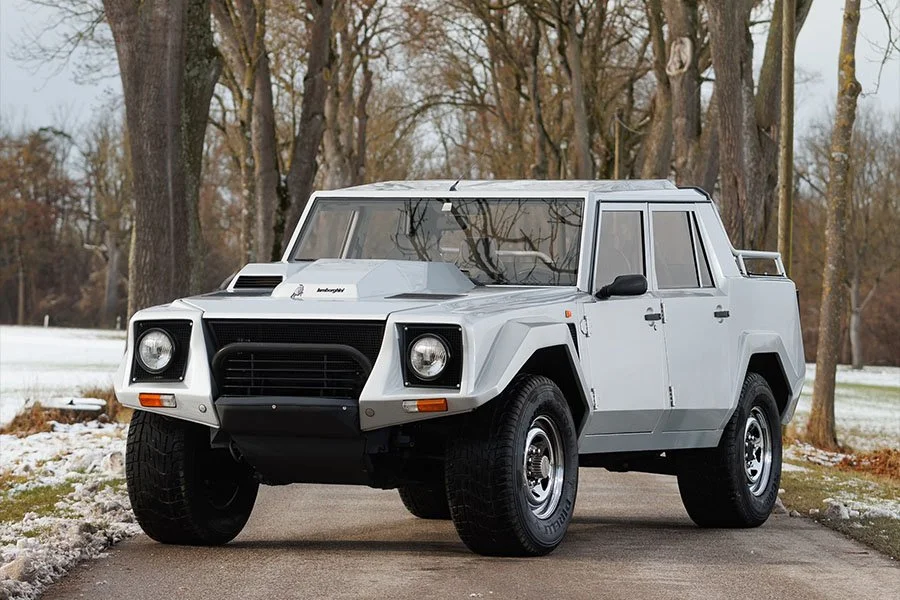
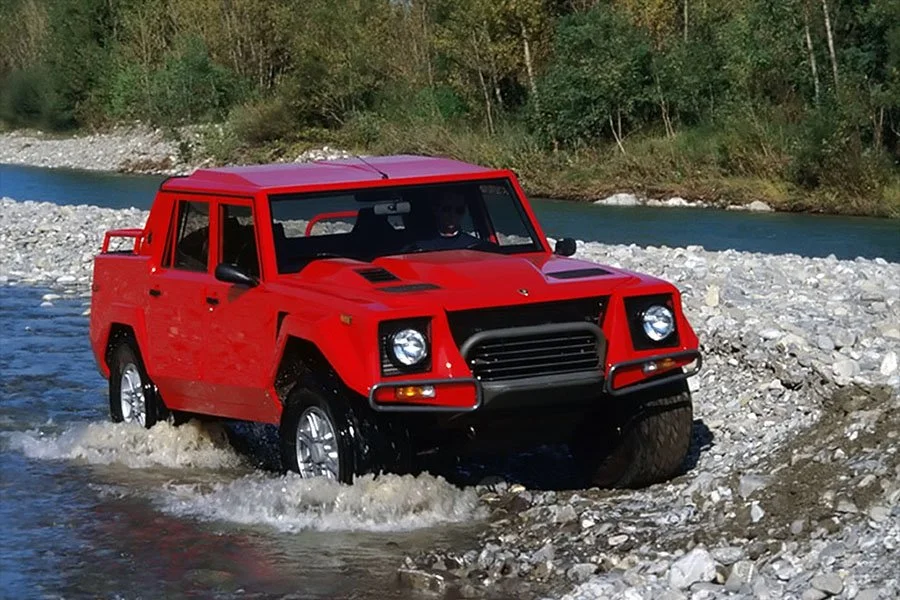
Up front, single headlights per side were housed in square-ish openings either side of a primary aperture that was also home to an inverted U-shaped body coloured protection bar. Lower down, a massive bash plate served to protect the front differential. Up top, the otherwise plane-like front hood was home to a brace of enormous blisters necessary to clear the engine and air cleaners.
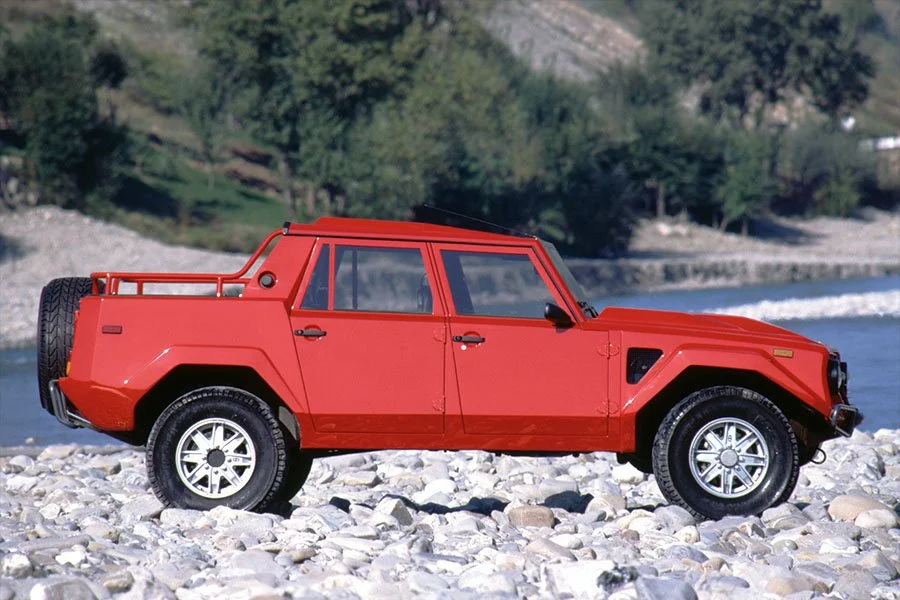
Down each flank, angular wheelarch extensions provided cover for the massive wheels and tyres. Doors with exposed hinges further hinted at the LM002’s utilitarian nature.
Aside from a forward view obscured by the aforementioned hood blisters, visibility out of the cockpit was good thanks to a large glass area and slim pillars. A pair of slanted box sections on the roof helped increase headroom.
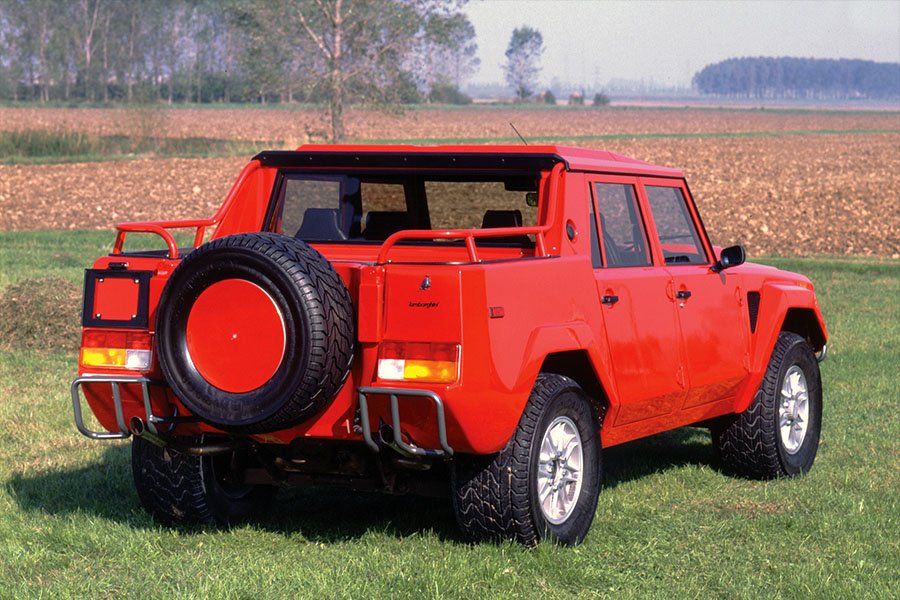
At the rear, an open bed was home to bench-type jump seats, access to which was via a drop down central door that normally had a spare wheel / tyre mounted behind it.
Body panels were primarily fashioned from aluminium with fibreglass used for the fenders, hood and roof. The panels were manufactured in Ormaiztegi, Spain, by Irizar (better known for its bus and coach building) and shipped to Sant’Agata for final preparation.
INTERIOR
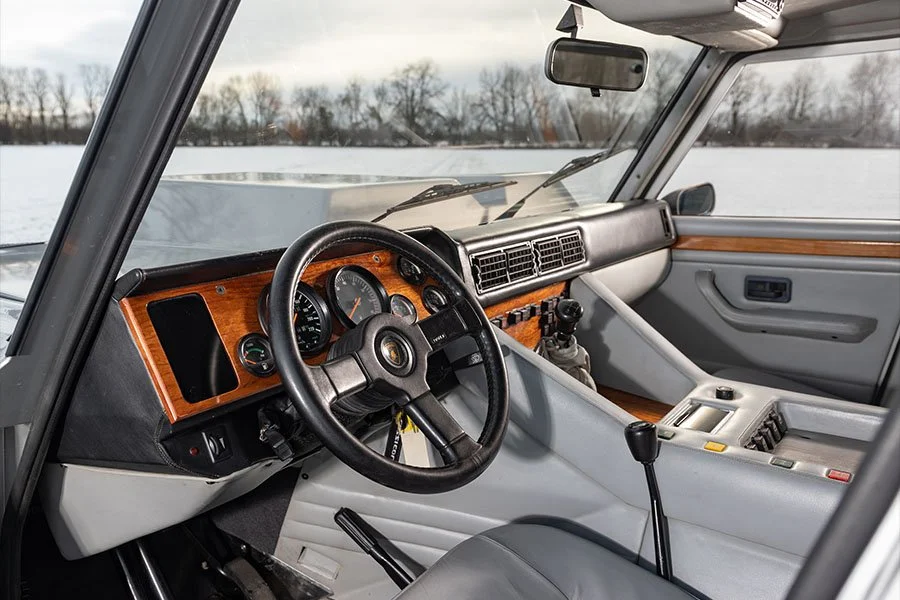
Inside, the LM002’s angular design theme continued with a cabin that was dominated by an enormous transmission tunnel that ran the entire length of the cockpit making the car a four as opposed to five-seater.
The seats themselves were identical front and rear with the fronts adjustable and those at the back fixed in position.
Directly behind the leather-rimmed three-spoke Nardi steering wheel was a sloping instrument binnacle that housed large read outs for road and engine speed. Flanking these were smaller gauges for fuel, battery voltage, oil pressure and water temperature. The instrumentation was set within a teak insert to match those found on the central control panel, transmission tunnel and doors. Located off to the right-hand side of the dash was an analogue clock while the audio system was mounted in a separate roof-mounted console.
Positioned on the transmission tunnel between the rear seats were fresh air blowers for the ventilation system and a decent-sized storage bin.
Aside from the roof inlays (alcantara) and floors (deep-pile carpet), pretty much everything else was upholstered in high quality leather. Included as standard equipment was air-conditioning, electric windows and the aforementioned audio system.
OPTIONS
Offered exclusively in left-hand drive, the LM002 could be ordered in practically any colour combination.
Optional extras included front and rear bull bars, polished wheels, a winch, a detachable luggage compartment storage bin, a black or body coloured tubular structure for the rear bed and a stripe kit.
WEIGHT / PERFORMANCE
At 2692kg the LM002 was easily the heaviest Lamborghini yet.
Top speed was 125mph and 0-62mph took 7.7 seconds.
SPECIAL BODIED VERSIONS
For those customers that wanted to commission a specially configured LM002, Lamborghini could have a car dispatched to Salvatore Diomante’s Autocostruzione SD in Nichelino. Here, on the outskirts of Turin, practically any request could be indulged given sufficiently deep pockets.
Numerically the first LM002 coachbuilt by Autocostruzione was chassis JLA12098 built for the Saudi Royal Family. Conceived for falconry, JLA12098 was manufactured with a two door, two-seat sunroof cab and extended rear bed that housed two rows of bench seating. Other special details included telescopic cab seats that could be raised to allow occupants to sit at just below roof height, a cold water tap, A-pillar-mounted spot lights and a long-range fuel tank.
Another LM002 Speciale to emerge from Autocostruzione was chassis KLA12162 commissioned as a Station Wagon by the Brunei Royal Family. In addition to an extended rear end that housed U-shaped bench seating, KLA12162 featured a raised roof line, custom seats, ruched leather upholstery, mahogany cockpit inlays, a matching wood-rimmed Nardi steering wheel, a unique control panel between the rear seats that housed a TV and other high end electronics, an electric sunroof, custom bull bars and a long-range fuel tank.
A second, even higher roof LM002 station wagon also emerged from Autocostruzione a few years later.
LM002 AMERICAN
At the Detroit Motor Show in January 1990, Lamborghini unveiled a fuel-injected LM002 sometimes referred to as the LM American. At its heart was a V12 equipped with the same LIE digital multi-point fuel injection system developed by Lamborghini, Marelli and Weber as subsequently fitted to the Diablo. Without the need for giant air cleaners, the LM American featured a hood with smoother, lower profile, less obtrusive blisters.
Peak output was officially unchanged although in Federal US market trim the LM American was said to produce 414bhp at an unchanged 6800rpm (down from 444bhp) and 369lb-ft at at 5000rpm (up from 4500rpm).
New options included chromed bull bars and headlight bezels, front spot lights, a unique stripe kit, deep side skirts, body coloured grilles, contrast seat piping and a Lamborghini-branded tonneau for the rear bed.
Fitted as standard were a set of OZ eight double spoke alloy wheels shod with 345/60 VR17 tyres that could also be ordered for carb-fed variants.
END OF PRODUCTION
LM002 production ended in 1992 by which time 328 copies had been built. Around 60 of these are believed to have been fuel-injected LM American variants.
In 1993, a unique right-hand drive LM is understood to have been assembled from leftover parts.
Text copyright: Supercar Nostalgia
Photo copyright: Lamborghini - https://www.lamborghini.com & RM Sotheby’s - https://rmsothebys.com/