Turned Up to Eleven - a Historical & Technical Appraisal of the Lamborghini Diablo 6.0 GT
/
BACKGROUND
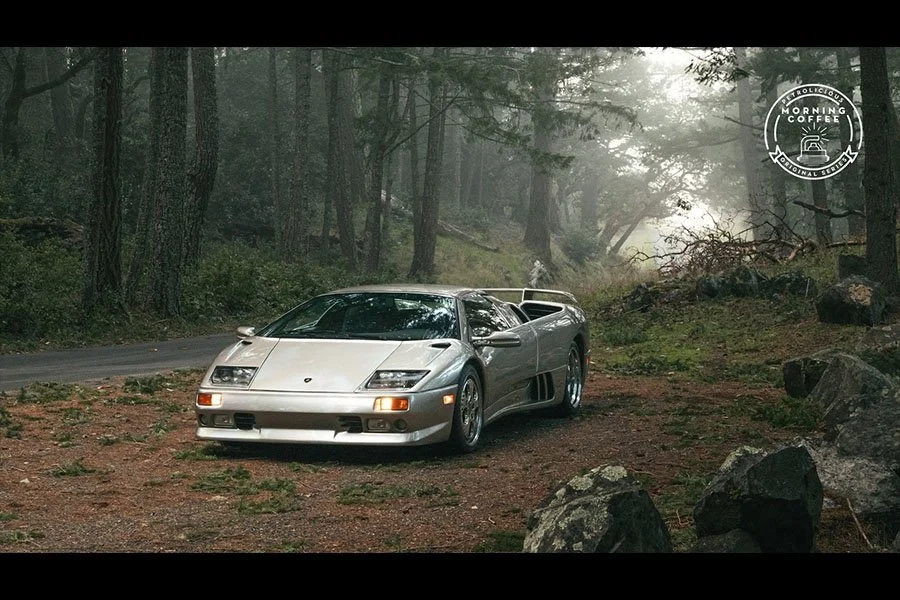
Although the heavily revised 1999 model year Diablo VT and SV launched in late 1998 were the first new models to arrived since the Volkswagen Audi Group’s acquisition of Automobili Lamborghini, the bulk of development for these face-lifted iterations of the Diablo had actually taken place during the Megatech era.
The first Diablo commissioned by Lamborghini’s new owners followed a few months later and was not what anyone had been predicting.
With the Canto (which had been conceived to replace the Diablo) put on hold owing to VAG’s dissatisfaction with certain aspects of the new car’s design, Lamborghini’s German overlords ordered the development of a substantially modified car that went down as the most extreme road-going Diablo yet: the GT.
Envisaged as a run of just 80 units, the GT ushered in several new features that would ultimately find their way into a last-of-line Diablo that followed soon afterwards.
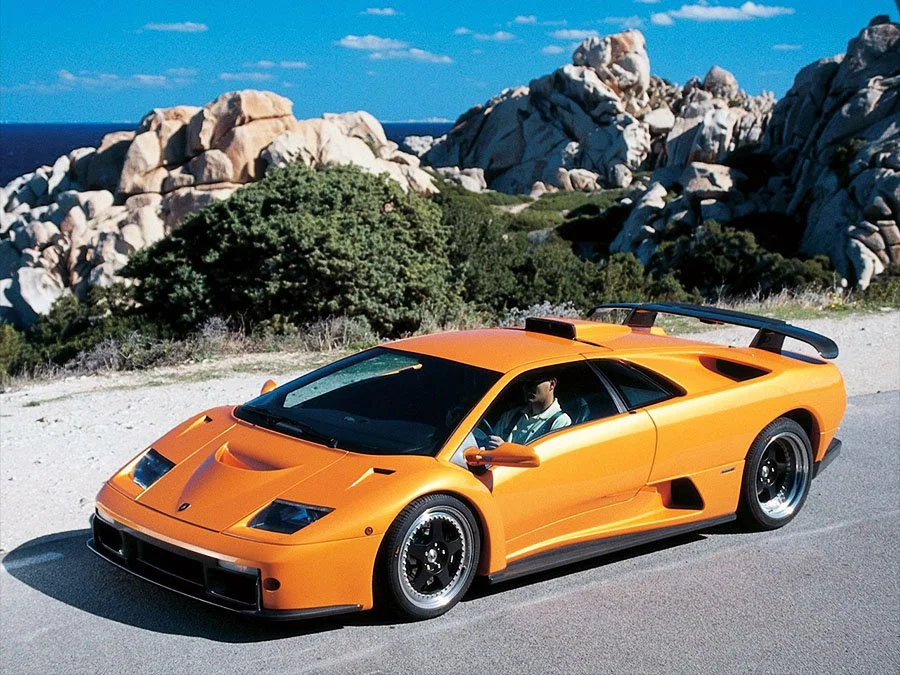
Unveiled at the Geneva Motor Show in March 1999, the Diablo GT followed a broadly similar approach to the legendary SE30 launched five-and-a-half years prior.
Accordingly, the rear drive-only GT was lighter, stiffer, faster and more focused than the existing SV. However, as a consequence of its new all-bells-and-whistles six-litre engine (the first time a Diablo road car had used anything other than a 5.7-litre lump), this track-inspired limited edition proved the biggest technical jump yet seen for the Diablo.
As its moniker would suggest, the hardcore new model was ostensibly inspired by the burgeoning GT racing scene which, since the implosion of the World Sportscar Championship over the winter of 1992-1993, had gone from strength to strength.
Thus far, Lamborghini’s participation in GT racing had been fleeting at best; the odd car had appeared here and there since 1995 while most recently Lamborghini had teamed up with the renowned DAMS operation to run a GT2 class Diablo in a couple French championship rounds during 1998. Unfortunately, although things had looked fairly promising for the Diablo GT2, most notably with a fifth place finish at Spa, VAG pulled the plug soon after taking control as it was clear a more radical base would be required to compete at the sharp end of the grid.
With this in mind, the expensive new Diablo GT was to serve as the basis for a factory sanctioned attack at several rounds of the 2000 FIA GT Championship where it would contest the premier category in partnership with the newly formed Reiter Engineering squad from Germany. Reiter’s car would be based on the spin-off GTR version produced to supersede the Diablo SVR that had been used in Lamborghini’s one-make Supertrophy racing series since 1996.
Having debuted in prototype form at the Geneva Salon in March ‘99, the production Diablo GT was displayed six months later at September’s Frankfurt Motor Show. Customer deliveries began in October.
The new car was only offered in left-hand drive and, as a consequence of its reduced safety and emissions equipment, was not homologated for sale in North America.
CHASSIS
The GT was based on Lamborghini’s rear-drive Diablo platform which meant it did without a heavy four-wheel drive system and electronic Koni dampers.
To further stiffen up the existing square-tubed steel spaceframe chassis, additional reinforcement was carried out over and above the 1999 model year variants which had already been tweaked to make them 15% more rigid than prior iterations.
As usual, the wheelbase measured 2670mm and a single 100-litre fuel tank was located on the right-hand side of the engine bay up against the rear bulkhead.
For this latest offering, Lamborghini optimised the existing double wishbone suspension geometry and also widened the track (by 110mm and 30mm front to rear respectively). Single coil sprung dampers were fitted at the front with two per side at the back. A GT-specific anti-roll bar was installed at either end. The front axle incorporated anti-dive electronics.
The brake system was imported direct from the 1999 model year Diablos. It featured cross-drilled and ventilated Brembo discs (355mm diameter at the front, 335mm at the rear) and four-piston aluminium alloy Brembo calipers all round.
ABS was fitted as standard along with a Dynamic Rear Proportioning system that minimised the tail’s tendency to snake under heavy braking.
As per the outgoing SV, 18-inch three-piece OZ alloy wheels with black centres were fitted (8.5-inches wide front and 13-inches wide rear). These were shod with Pirelli P Zero tyres that had a 245/35 instead of 235/35 profile at the front and an unchanged 335/30 cross section at the back.
ENGINE / TRANSMISSION
As per the aforementioned Diablo GT2, the GT used a 6 instead of 5.7-litre version of Lamborghini’s all-alloy, dry-sumped, 48 valve DOHC V12 which, since the 1998 model year, had incorporated a variable valve timing system that enabled the engine to use different camshaft profiles at low and high revs to both reduce emissions and increase power.
Displacement was taken out from 5709cc to 5992cc by extending the stroke from 80mm to 84mm. Bore diameter was kept at 87mm.
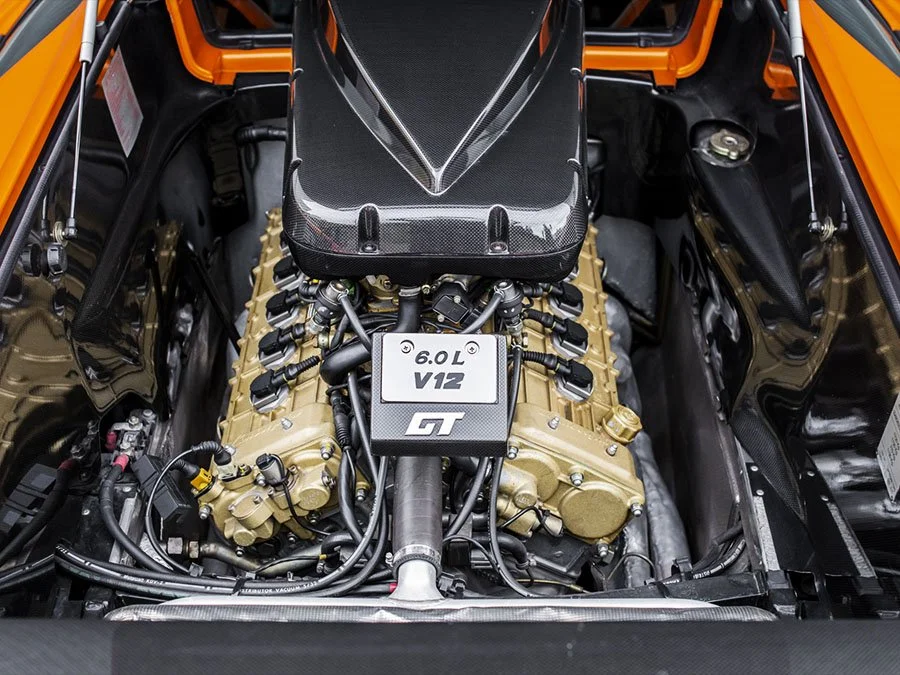
However, the new engine’s extra 283cc was only a small part of the story as Lamborghini fitted a host of new high performance parts.
The list included an individual intake system that used a single throttle body with improved runners for each cylinder, a magnesium intake manifold, new intake and exhaust camshafts, a new intake plenum, titanium connecting rods, a lightweight crankshaft and gold cam covers. Lamborghini’s existing LIE engine management system was re-mapped to optimise the variable valve timing system, a huge carbonfibre airbox atop of the engine featured a digitally-controlled airflow meter and a new twin outlet exhaust system came with a trick bypass system to reduce back pressure.
With a compression ratio hiked from 10.0:1 to 10.7:1, the horsepower rating went from 530bhp at 7100rpm to 575bhp at 7300rpm. There was also more torque on offer with 465lb-ft at 5500rpm compared to 446lb-ft at 5500rpm to the outgoing 5.7-litre motor.
Transmission was through a five-speed gearbox (offered with a choice of three alternative ratios), a dry single-plate clutch, a ZF final drive and limited-slip differential.
BODYWORK
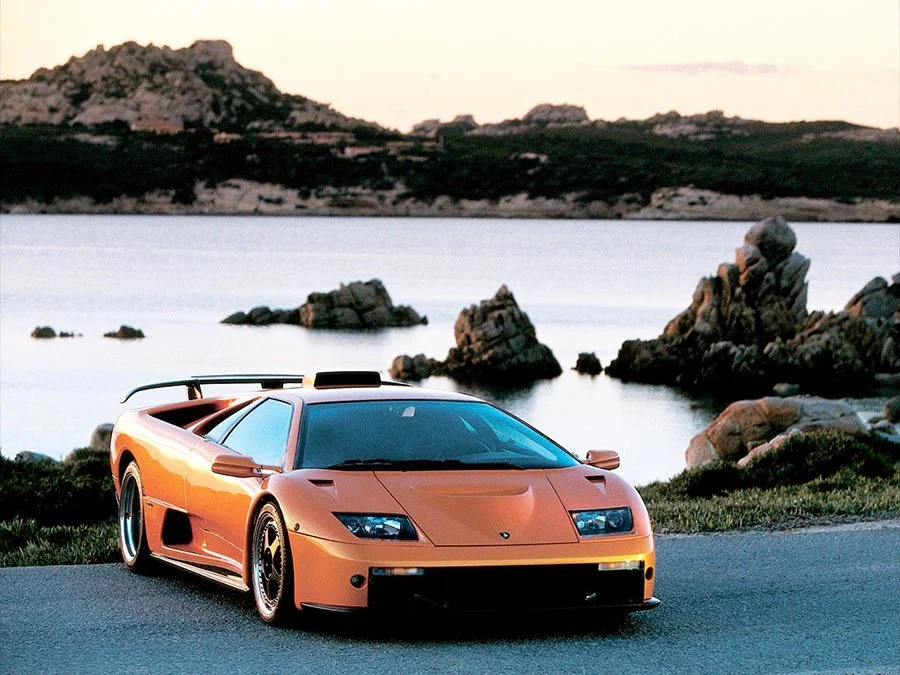
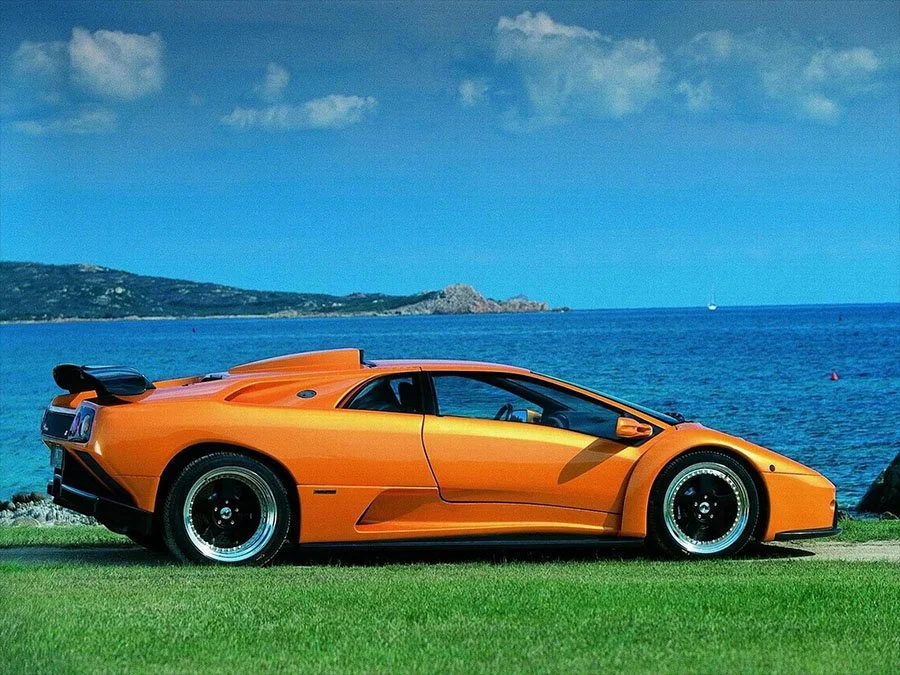
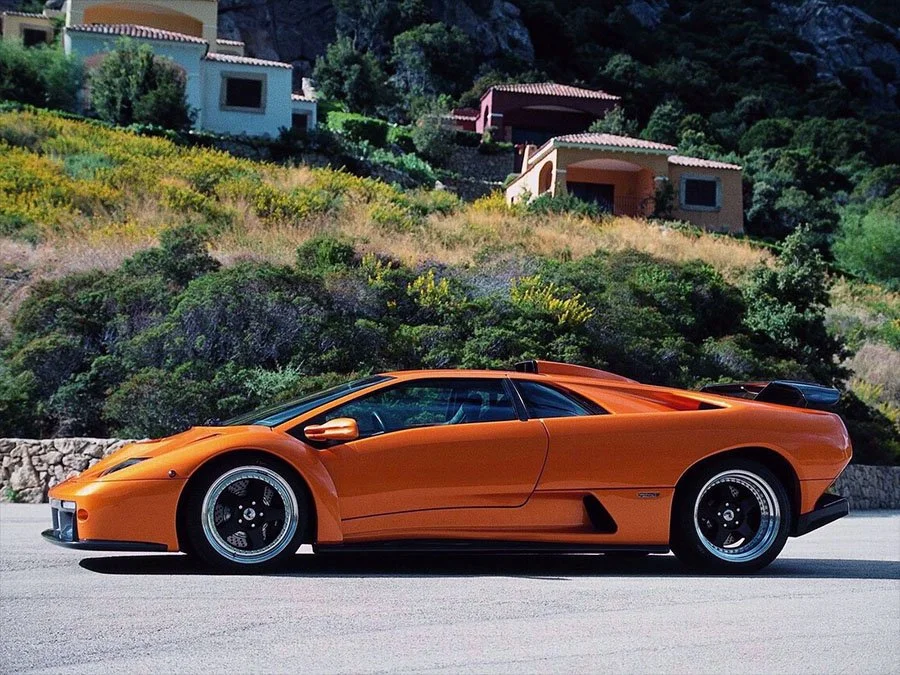
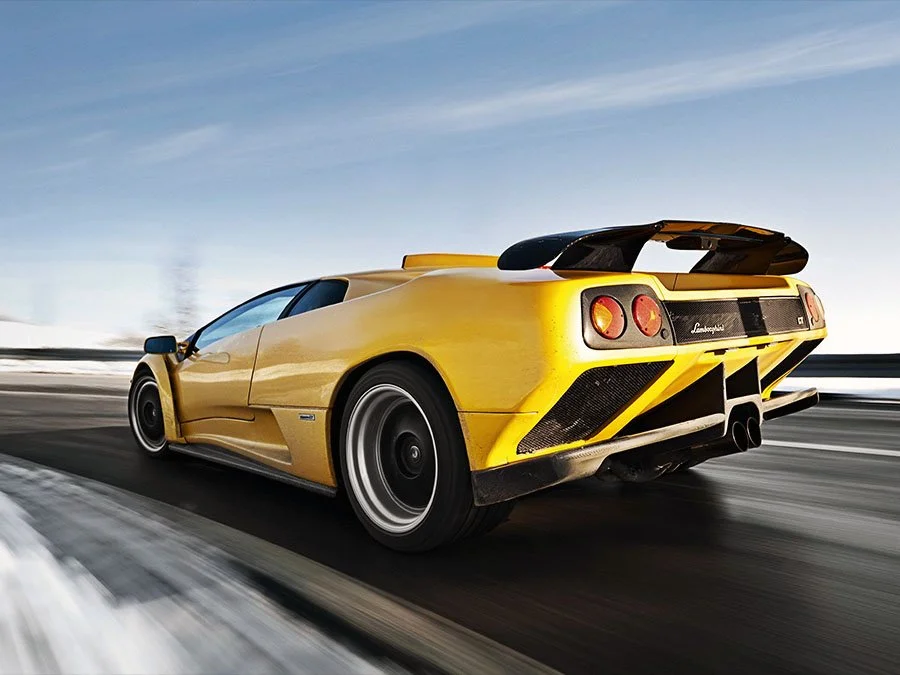
Apart from its steel roof and aluminium doors, the GT’s external panels were fashioned exclusively from carbonfibre. Fittingly, Lamborghini also made a significant number of predominantly aero-based modifications that marked this latest variant out as something a bit special.
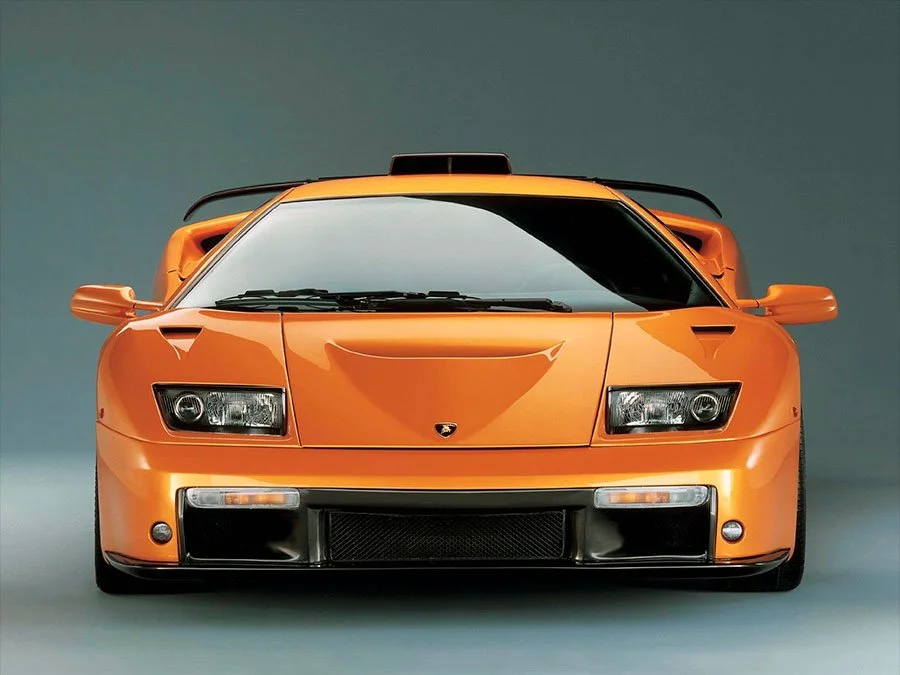
Up front was a completely different two-piece nosecone / bumper assembly with new lighting and a carbon black single piece inlay with an integrated chin spoiler and substantially enlarged intakes for the oil cooler / brakes. The front lid now incorporated an enormous air vent.
To accommodate the wider track front axle, the front fenders were flared and now featured stepped vertical cooling slots at the trailing edge along with re-shaped NACA ducts carved out from the upper surface.
Down each flank were new exposed carbonfibre running board-style skirts. Located above the engine was a massive new intake snorkel.
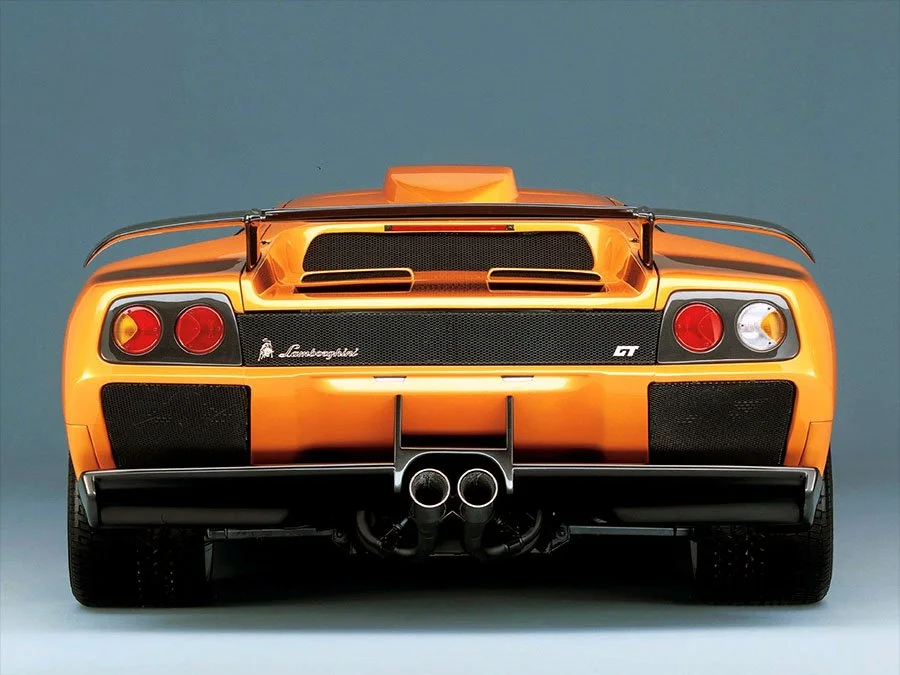
At the back, the rear bumper was deleted in favour of a massive rear diffuser that housed the two centrally exiting bog bore exhausts. Further up were new tail light clusters with integral fog and reverse units. There was also a new cockpit-adjustable rear spoiler in high gloss exposed carbonfibre.
INTERIOR
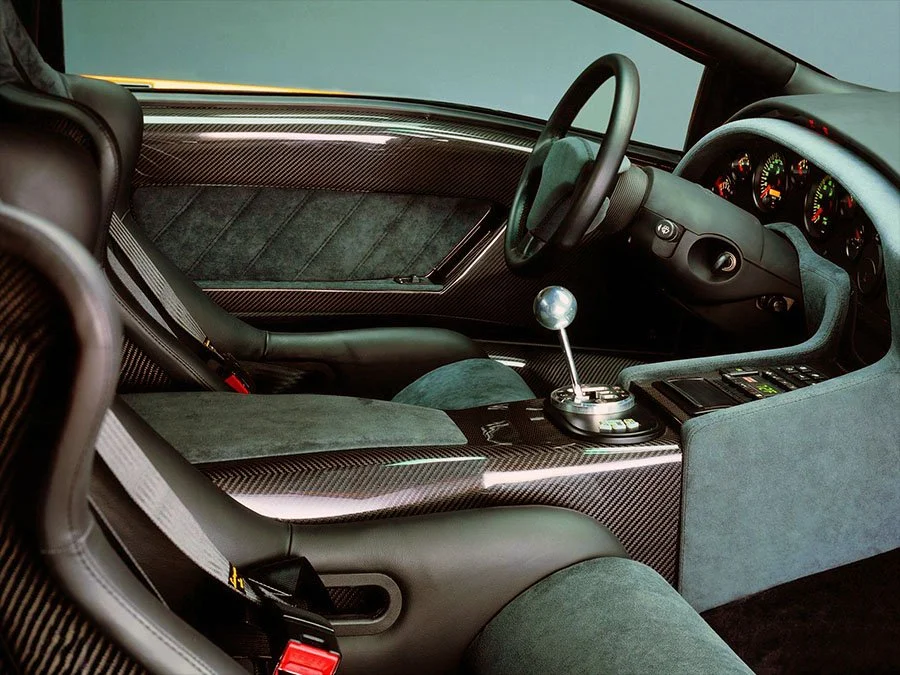
Inside, Lamborghini used the updated ’99 model year cockpit architecture with a few special tweaks here and there.
Immediately obvious were the new carbonfibre-shelled single-piece bucket seats and four-point harnesses. In line with the GT’s weight-saving theme, exposed carbonfibre was also now used for the re-profiled transmission tunnel casing, the dash fascia, central control panel, the inner sills and door panels.
A small diameter three-spoke steering wheel did not come with an airbag and nor was an airbag fitted to the passenger side of the cockpit.
A natural aluminium gear lever was now tilted rearwards to facilitate quicker shifts.
Drilled aluminium pedals were also fitted.
Leather was used to upholster the seat bolsters with alcantara suede for the seat centres, the padded panel atop the transmission tunnel, the door inlays, the lower dash and its adjoining sidewalls.
Air conditioning, electric windows and electric mirrors were fitted as standard.
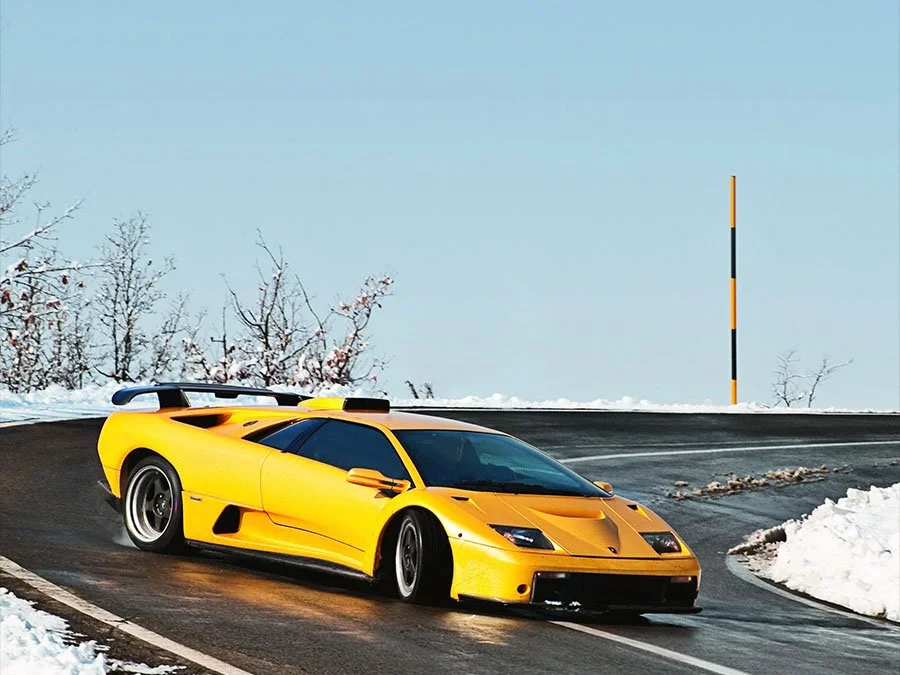
Instrumentation comprised large readouts for road and engine speed with smaller gauges for oil pressure, oil temperature, water temperature and fuel along with a matching analogue clock.
OPTIONS
Lamborghini offered the Diablo GT in a choice of four colours: Black, Orange, Silver and Yellow.
Optional extras were limited to airbags, comfort seats, full leather upholstery, two-tone upholstery, contrast stitching and a rear spoiler-mounted camera that was coupled to a centre console-mounted Alpine multimedia screen which doubled as a satellite-navigation system.
Unofficially, a body coloured rear spoiler could also be requested along with GTR spec. wheels, a GTR exhaust and GTR rear spoiler.
WEIGHT / PERFORMANCE
At 1460kg, the Diablo GT tipped the scales at 70kg less than the 1999 model year SV which had itself already shed 46kg compared to earlier iterations of the SV.
Top speed went from 209mph to 215mph and the 0-62mph time was cut from 3.8 to 3.4 seconds.
END OF PRODUCTION
Lamborghini had originally planned to build a limited run of just 80 examples of the Diablo GT. However, 83 units were ultimately completed by the time production was discontinued in mid 2000.
In addition, a batch of 30 GTR variants were manufactured for the 2000 Supertrophy series (covered separately).
Text copyright: Supercar Nostalgia
Photo copyright: Lamborghini - https://www.lamborghini.com