Guide: Bugatti 16.4 Veyron Grand Sport L'Or Blanc Art Car
/ Ben Tyer
BACKGROUND
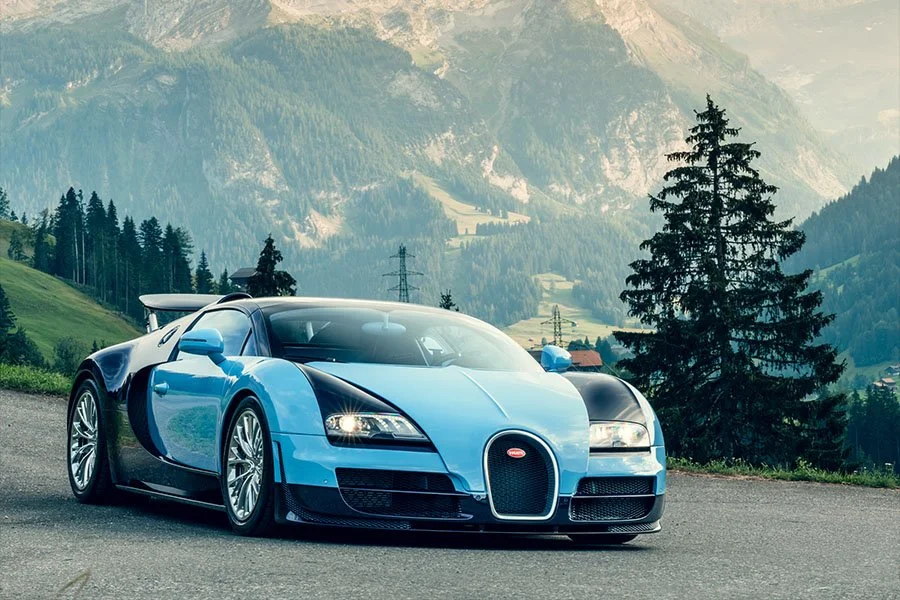
Among the many Veyron special editions created by Bugatti, of particular note were a pair of spectacular Art Cars based on the Grand Sport platform.
The Grand Sport was a targa-topped iteration of the original Veyron. Bugatti unveiled it at the Pebble Beach Concours d’Eelegance in August 2008 and production started in June 2009. A limited run of 150 units was anticipated.
The first few years of Veyron production saw Bugatti struggle to sell the car in the quantities that they had hoped. As a result, one-off specials and short runs of heavily customised Veyrons were produced to try and stimulate demand.
Perhaps the most famous of these (and certainly the most striking) was the Grand Sport L’Or Blanc unveiled during June 2011 at the Berlin Royal Porcelain Factory (KPM).
BUGATTI 16.4 VEYRON GRAND SPORT
Compared to the fixed-head Veyron, the Grand Sport came with a significantly modified monocoque. For safety reasons, load paths were redesigned and reinforcements were added around the sills, central tunnel, doors, windscreen and the engine intake scoops behind the cockpit.
Aside from a 2mm lower ride height and re-rated dampers, the rest of the mechanical specification was pretty much unchanged.
In the engine bay was an all-alloy W16 engine that featured dry-sump lubrication, dual overhead camshafts, four valves per cylinder and four MP-Engineering MP70 turbochargers. Displacement was 7993cc thanks to an 86mm bore and stroke.
With a compression ratio of 9.0:1, peak output was 987bhp at 6000rpm and 922lb-ft at 2200-5500rpm.
Transmission was through a Ricardo seven-speed dual-clutch gearbox and electronically-controlled permanent four-wheel drive system.
The Grand Sport was equipped with a distinctive transparent roof that had to be manually fitted and removed. A temporary canvas roof that could be carried in the car was also supplied.
With the fixed roof in place, top speed was an unaffected 253mph.
With the roof off, this dropped to 224mph. If the temporary canvas roof was attached, Bugatti recommended a maximum of 80mph.
0-62mph took 2.7 seconds.
BERLIN ROYAL PORCELAIN FACTORY (KONIGLICHE PORZELLAN-MANUFAKTUR BERLIN)
The Royal Porcelain Factory in Berlin (KPM) was founded in 1763 by King Frederick II of Prussia who purchased the organisation formerly run by Wilhelm Caspar Wegely and later Johann Ernst Gotzkowsky.
During his tenure at the head of the company, Frederick II was KPM’s best customer; he routinely ordered vast quantities of work for his palaces and guests.
KPM was initially best known for its fine white dinner services and went on to become a leader in the production of pictorial and veduta porcelain. KPM successfully transitioned from Rococo to Classicism, to Art Nouveau and (by the 20th century) Bauhaus and New Objectivity.
KPM’S VEYRON GRAND SPORT
The collaboration between KPM and Bugatti resulted in the first car to feature porcelain elements for its bodywork and interior.
The carbonfibre and aluminium exterior panels were coated with a fine layer of porcelain, after which KPM’s trademark shade of Cobalt Blue was applied by hand in a series of sweeping curves and delicate lines. The bodywork was then covered with five layers of lacquer.
Porcelain elements were also used for the petrol and oil filler caps, the ‘EB’ tail script and the centre caps for the wheels.
The rest of the specification included Mirrorshine grilles, aluminium door handles and red brake calipers. The wheels were a mix of diamond cut faces and Cobalt Blue inlays.
Inside, the L’Or Blanc was upholstered with a mix of dark blue and white upholstery. Two-tone door panels with porcelain inlays mimicked the exterior. There were additionally porcelain inlays on the transmission tunnel and the rear bulkhead between the seats (the latter decorated with Rembrandt Bugatti’s famous dancing elephant).
As a result of this successful collaboration, four KPM Edition Veyrons based on the Grand Sport Vitesse were subsequently built.
The one-off Grand Sport L’Or Blanc was originally marketed at a pre-tax price of €1.65m. Bugatti reputedly sold the car to a collector from the UAE.
Text copyright: Supercar Nostalgia
Photo copyright: Bugatti - https://www.bugatti.com
Owing to poor trading conditions that led to massively reduced demand for high end motor cars, the expensively revived Bugatti company filed for bankruptcy in 1995. However, that wasn’t quite the end…
In order to topple the McLaren F1 from its perch as the fastest production car ever openly offered to the public, Bugatti took a quite different approach. Rather than a philosophy that revolved around…
Despite disappointingly slow sales for the recently launched EB110 and an economic outlook that remained gloomy, during 1992 the Bugatti organisation revived under Italian industrialist Romano…
Perhaps more so than any other vehicle manufacturer, the Bugatti brand was rooted in the world of art and design. In addition to the automobiles of Ettore and his son Jean, the Bugatti family…
Amid a sea of absurdly high output and top speed figures, it’s easy to forget just what a technical marvel Bugatti created with its W16 engine. Comprising four banks of four cylinders in a rarely…
Having last produced a motor car in 1952, the Bugatti brand was revived in the early 1990s by Romano Artioli, a wealthy Italian vehicle distributor who had acquired the naming rights to the…
Chassis GT39099 was the only EB110 GT that left the factory painted Bianco Monaco. Its interior was upholstered in two-tone grey. The car was reputedly ordered via Bugatti boss Romano Artioli’s…
Before the McLaren F1 arrived to completely redefine the high end supercar game, Bugatti’s EB110 in SS or Super Sport trim ruled the roost as the fastest, most elaborately engineered new car on…
How much could one man love the Transformers? This much: an extraordinary Art Car commissioned from Bugatti as an homage to the kid’s TV show and movie franchise. Based on a…
When Volkwagen Audi Group boss Ferdinand Piech concluded the acquisition of Bugatti Automobiles in 1998, his plan was to revive the brand as builder of the fastest, most expensive…
Chassis GT39084 was an EB110 GT completed during 1994 and configured in the fabulous Verde Scuro with extended Light and Dark Grey leather. It was supplied to a Belgian customer through the..
Unveiled at the Geneva Motor Show in March 2012, the Grand Sport Vitesse was a Roadster version of Bugatti’s hot Veyron Super Sport. 92 were completed by the time production came to an end in…
Completed in 1994 to GT trim, chassis GT39078 was configured in the handsome colour scheme of Grigio Scuro with extended leather upholstery in a mix of Light and Dark Grey hide. GT39078…
Because Italian entrepreneur Romano Artioli had to revive Bugatti from scratch and simultaneously elected to create a state-of-art new car using bespoke parts throughout, the EB110 project must rank…
Of all the ill-fated projects born during the late 1980s collector car boom, none proved costlier than the epic Bugatti EB110. Having purchased the Bugatti naming rights in 1987, Italian industrialist…
After Bugatti had unveiled the EB110 SS at Geneva in March 1992, the Brunei Royal Family placed an order for the first three production cars: chassis SS39001, SS39002 and SS39003. A fourth…
Most of the circa 30 EB110s built to SS specification were painted yellow, blue, silver or grey. There were also a couple of white, black, green and red cars, but all bar one came with mono paint. The…
To celebrate its 110th anniversary as an auto make, Bugatti produced a batch of ten Chiron-based Centodieci’s priced at €8m apiece before local taxes. Unveiled at The Quail Motorsports Gathering…
Despite a troubled gestation that saw half a decade elapse before the first production car was finally ready, the Bugatti Veyron went on to re-write the rulebook in terms of the performance, luxury and…
Unveiled at the Geneva Motor Show in March 2012, the Grand Sport Vitesse was conceived as an open top version of the Veyron Super Sport which had turned Bugatti’s already formidable base car…
Five years after the production-ready Veyron was presented, Bugatti revealed the ultimate iteration of their record-breaking supercar in the shape of a limited production run-out model designed to…
Chassis GT39049 was a 1993 EB110 GT allocated for use as a press and promotional car. It was finished in the trademark EB110 colour scheme of Blu Bugatti with Grey upholstery and interestingly…
Five years after Bugatti started production of their record-breaking Veyron, the Molsheim firm introduced a third variant to accompany the original fixed-head iteration and open-top Grand Sport.
In order to satisfy those customers for whom the original 553bhp EB110 GT did not quite hit the mark, Bugatti introduced the monster SS version at Geneva in March 1992. In order to take the…
Of all the myriad special edition Chirons manufactured between 2018 and 2022, among the most interesting was the Profilee which Bugatti conceived as a more refined version of the radical Pur…
Chassis GT39008 started life as an EB110 GT prototype that served as a mule for the SS variant. It was equipped with an array of prototype features, most of which focused on cooling and aero behind the…
When Bugatti finally launched the production-ready Veyron in 2005 it was the culmination of a troubled six-year gestation that owed much to the new car’s hitherto unmatched technical…
Chassis SS39005 was the third SS prototype and the first to feature the trademark five-porthole sail panel treatment. It was painted Grigio Chiaro and upholstered with a mono-tone Nero interior. As…
Chassis SS39003 was one of four SS versions of the Bugatti EB110 delivered to the Brunei Royal Family. When Bugatti announced the SS, the Brunei Royals requested they take take delivery of the…
Among the many Veyron special editions created by Bugatti, of particular note were a pair of spectacular Art Cars based on the Grand Sport platform. The Grand Sport was a targa-topped…