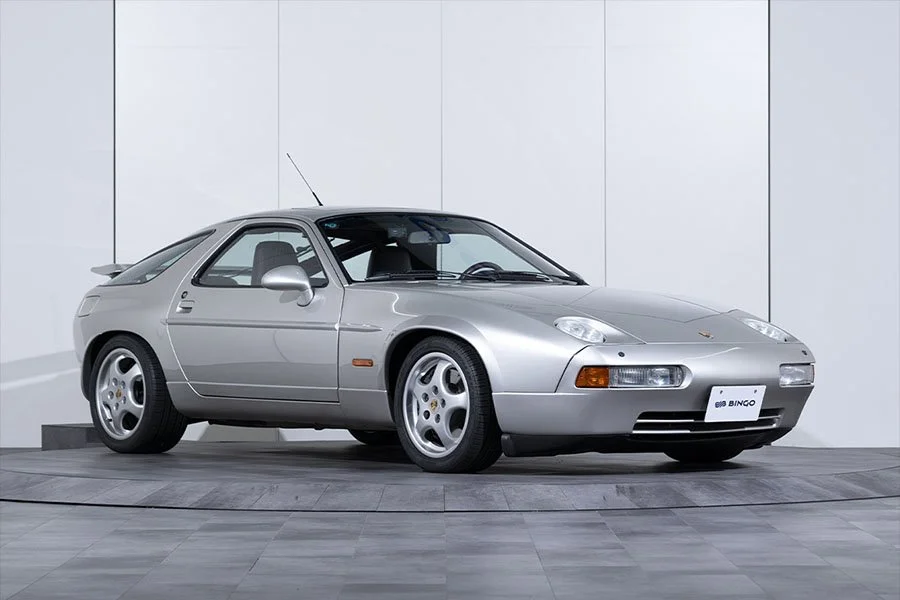
Smooth Operator - a Historical & Technical Appraisal of the Porsche 928 S4, Club Sport, SE & GT
/
BACKGROUND
Porsche had originally created the 928 as a more conventionally engineered, more upmarket replacement for the 911 which, with its air-cooled rear-mounted engine, was unlike anything else in the high end automotive sector.
Having debuted at the Geneva Motor Show in March 1977, 928 production began the following September for the 1978 model year. Two years later, the base 240bhp 4.5-litre 928 was joined by a more powerful 928 S equipped with 4.7-litre 300bhp iteration of the water-cooled 90° V8 along with distinctive front and rear spoilers and new forged alloy wheels.
A second iteration of the 928 S followed in late 1983 for the 1984 model year when Rest of World derivatives were uprated with latest Bosch LH Jetronic fuel-injection, digital Bosch EZF ignition with twin distributors and a higher compression ratio. In addition to an additional 10bhp, this latest motor also developed more torque lower down the rev range with a peak rating of 295lb-ft at 4100rpm as opposed to 283lb-ft at 4500rpm. In markets like the UK and Australia, these 1984 model year iterations of the S were dubbed the 928 S2.
Twelve months later (in late 1984 for the 1985 model year), Porsche introduced a third incarnation of the 928 S with a US market-only variant that received a further enlarged 5-litre engine that featured dual instead of single overhead camshafts and four instead of two valves per cylinder. Other upgrades on this American-market special (created to claw back some of the power lost to additional emissions equipment required in that market) included spark plugs located above new pent-roof combustion chambers, uprated manifolds and optimised valve timing.
Unsurprisingly, having gone to the expense of developing this much-improved DOHC 48 valve power unit, Porsche then used it as the basis for a world market 928 as management wanted to offer an engine which produced the same output with or without a catalytic converter and leaded or unleaded fuel.
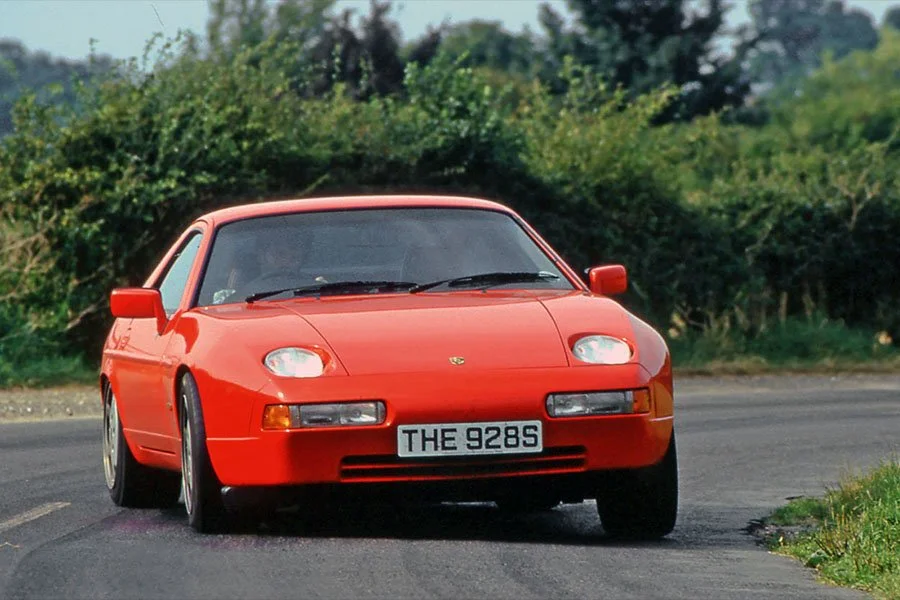
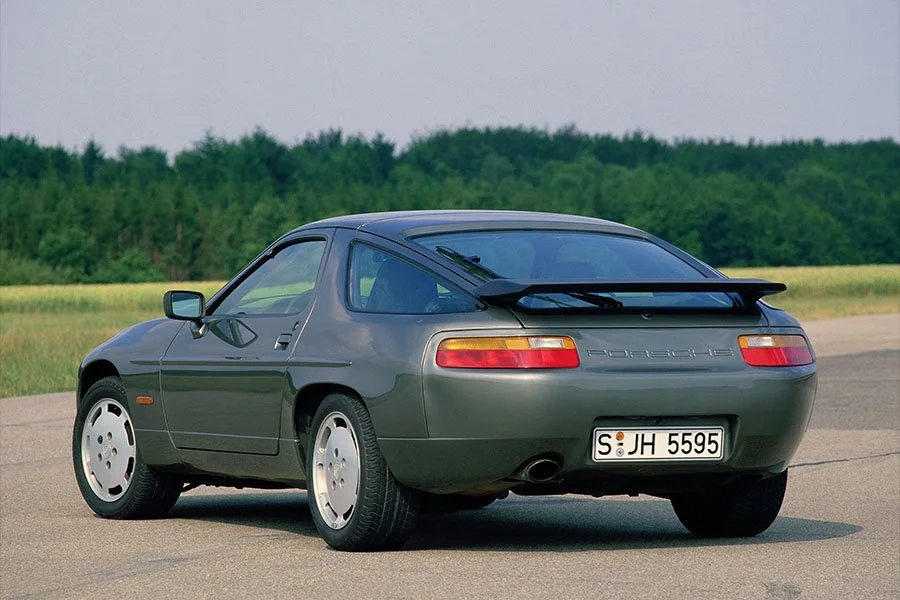
The resultant 928 S4 was unveiled at the Frankfurt Motor Show in September 1986 and went into production for the 1987 model year. In addition to a series of further engine enhancements that took it up to 320bhp and yielded gobs more torque (now 317lb-ft at 3000rpm), Porsche’s stylists gave this latest offering a major face-lift that brought the nine year design bang up to date.
ENGINE / TRANSMISSION
For this first 928 ‘World Market’ engine (the only regional difference was a lower grade fuel map for Australia), Porsche started with the five-litre dual overhead cam 32 valve engine introduced for the 1985 model year in North America (which had replaced the 4.7-litre single overhead cam 16 valve engine of old). In addition to twin cam heads with four valves per cylinder, the enlarged ‘85 model year American engine featured spark plugs located above new pent-roof combustion chambers, uprated manifolds and modified valve timing all of which yielded substantially more power and torque.
For the 928 S4’s Type M28/41 (manual) and M28/42 (automatic) engines, Porsche introduced an array of further updates.

The long list of new equipment included pistons and camshafts, an engine block with oil squirters for piston cooling, cylinder heads with slightly shallower combustion chambers, an optimised, more compact two-stage induction system with larger intake valves and enhanced ram effect, a narrower valve angle, altered valve timing and larger exhaust valves. For ease of cylinder head removal, bolts replaced studs.
Also updated was the Bosch LH-Jetronic fuel-injection and the EZK ignition system with its two knock sensors for optimised running. A revised cooling system featured thermostatically operated radiator shutters in the S4’s nose that opened only when needed to minimise drag in high-speed driving.
Twin electric engine cooling fans replaced the original single engine-driven unit.
Compression was unchanged at 10.0:1.
Regardless of whether a catalytic converter was fitted, the 928 S4 boasted peak output figures of 320bhp at 6000rpm and 317lb-ft at 3000rpm.
For comparison the 1985 model year US-only five-litre motor had developed 288bhp at 5750rpm 302lb-ft at 2700rpm and the outgoing 4.7 single cam 16 valve Euro spec motor produced 310bhp at 5900rpm) and 295lb-ft at 4100rpm.
Transmission was through either a five-speed manual or optional four-speed automatic gearbox with new single-plate clutch and open differential. S4-specific developments to the automatic set-up saw the shift programme for hard acceleration improved and a larger torque converter.
For the US market manual version, Porsche installed a longer final drive ratio than on Rest of World variants.

CHASSIS
The S4’s chassis package was enhanced with improved brakes and wider rear wheels.
New brake calipers featured larger pistons. However, some export market cars like those bound for North America, Australia and the Middle East initially used up components left over from the previous variant.
Ventilated brake discs had a diameter of 282mm at the front and 289mm at the rear. Like other Euro market 928s for the 1980 model year, stopping capacity was improved thanks to thicker discs with redesigned calipers and larger pads.
ABS was standard for all markets as had been the case since the 1985 model year.
The S4’s 16-inch forged alloy disc wheels were carried over from the previous model but whereas 7-inch wide rims had been used all round beforehand, the S4 came with wider 8-inch items at the back. These were mounted on 225/50 VR16 and 245/45 VR16 tyres respectively.
Like every 928, the S was built on a hot-dip galvanised steel bodyshell with a 2500mm wheelbase. An 86-litre fuel tank was fitted under the trunk floor.
Front suspension was via a multi-link MacPherson strut arrangement. At the back Porsche fitted their famed Weissach multi-link set up. An evolution of the semi-trailing arm configuration, the Weissach axle replaced the front pivot bushing of a trailing arm layout with a short link that allowed the suspension to adjust itself during cornering. The result was a dramatic reduction in lift-off oversteer and much improved stability.
Coil sprung shock absorbers were fitted at each corner along with an anti-roll bar at either end.
BODYWORK
For this latest iteration of the 928, Porsche carried out the most significant array of cosmetic alterations yet seen on the platform.
With the aim of improving aerodynamic efficiency, smooth new de-formable plastic nosecone and tail fascias were lifted from the 928-4 shooting break concept that Porsche had assessed in 1984.
The new front spoiler featured openings that channelled more air to the brakes. It also directed more air underneath the car as opposed to around the sides. In a similar vein, sensor-driven cooling flaps added between the grille and radiator greatly reduced drag as did revised underbody panelling.
To further optimise the aero package, Porsche switched the S4 to a bonded windscreen, positioned the wipers lower down than before and added deeper side skirts that diverted air around the rear tyres.
At the back of the car, larger flush fitting tail light clusters replaced the earlier recessed type and a new polyurethane rear spoiler was added.
The net result of all these changes was that, with the electronic front cooling flaps in a closed position, the S4 was able to boast a drag coefficient of 0.34 compared to 0.42 for original 928 and 0.39 for the 928 S.
Body panels were fashioned from a mixture of steel (roof, rear quarter panels and opening rear hatch), aluminium (hood, front fenders and doors) and thermoplastic (pretty much everything else).
INTERIOR
While the S4’s exterior changes lent the new car a fresh new look, Porsche deemed no such measures necessary for the cockpit architecture. Aside from front seats with a new three position memory settings, new exterior mirror settings and a subtly modified rear seat area to accommodate the new torque converter, the S4’s interior fixtures and fittings were carried over from the outgoing model.

Behind the four horizontally spoked steering wheel was an adjustable instrument binnacle that housed large analogue read outs for road and engine speed. Outboard of these were smaller voltmeter, oil temperature, water temperature and fuel gauges.
The rest of the switchgear (ventilation controls, audio system etc.) was located on the central console that adjoined the slim forward section of the transmission tunnel. This tunnel widened dramatically towards the back of the car and meant the rear seats were no more spacious than those in the 911.
Air-conditioning, three-way electric seats and electric mirrors were fitted as standard.
OPTIONS
Porsche offered a practically limitless level of customisation for the 928 S4, both through the official options list and the Exclusive department.
In addition to an automatic transmission, buyers could request a 40% locking limited-slip differential, sports seats, leather upholstery, two-tone leather upholstery, contrast seat piping, fabric seat and door inserts, Bilstein dampers, an electric sunroof, tinted glass, out-of-range paint and leather combinations and an original S-type rear spoiler.
Given sufficiently deep pockets, you could have a car sent to the Exclusive department where almost any indulgence could be catered for - from extra leather and wood-covered surfaces to a 930 Flachbau-style front end with conventional pop-up headlights.
WEIGHT / PERFORMANCE
Compared to the outgoing variant which tipped the scales at 1500kg, the Euro / Rest of World spec. 928 S4 came in 80kg heavier (1580kg). The US version was another 10kg on top. Manual and automatic 928s weighed the same as one another.
Top speed for the Euro / RoW manual was 168mph with a 0-62mph time of 5.9 seconds (165mph and 6 seconds for the US version).
Top speed for the Euro / RoW auto was 165mph with a 0-62mph time of 6.3 seconds (162mph and 6.6 seconds for the US).
BONNEVILLE SPEED RECORDS

In anticipation of the S4’s debut, Porsche HQ and Porsche North America collaborated on an effort to set some speed records for a catalyst-equipped car at the Bonneville Salt Flats.
During March 1986, Euro market 928 S4 prototype chassis G18 underwent preparation in Stuttgart that saw it converted from automatic to manual transmission.
To optimise airflow, underbody panelling that extended back to the transaxle was installed, the exterior mirrors were removed and some subtle additions to the bottom of the nosepiece were incorporated where brake-cooling inlets were blocked. A cockpit switch set the air-inlet louvres in one of three positions: shut, 30% open and fully open.
7-inch-wide wheels were fitted all round (instead of the S4’s wider 8-inch rears). They were shod with Pirelli P700 tyres trimmed down to a minimal tread depth then pumped up to a remarkable 64 psi. Ride height was dropped and special Bilstein dampers were installed along with a stiffer front anti-roll bar, a non-standard ECU and 2.54:1 rear axle ratio.
A few weeks after a series of shakedown runs at the Nardo speed bowl in Italy (April 5th and 6th) chassis G18 was dispatched to the Holbert Porsche dealership in Pennsylvania. Here, the existing white paint job was switched to red for marketing purposes.
On August 7th, Al Holbert recorded an average of 171.110mph for the flying mile and 171.926mph for the kilometre which enabled Porsche to declare the 928 S4 as the world’s fastest catalysed car.
H21 CABRIOLET PROTOTYPE
With production of the 928 S4 underway, Porsche tentatively explored the potential for a Cabriolet version.
During the spring of 1987, work began on a prototype internally dubbed H21. The idea for an open top 928 came straight from the top of the company: Porsche CEO Peter Schutz had seen how adding open top versions of the 911 dramatically increased sales and he wanted to see a drop head 928.
The finished article looked great, but any plans for production were abandoned early in 1988 owing to the engineering costs of going into production.
1987 MODEL YEAR PRODUCTION
During the 928 S4’s first year in production, 4791 units were completed which represented a 2% drop on the previous twelve month period.
This figure was split 2184 cars in Euro / Rest of World trim, 2421 car to US specification and 186 for Japan.
1988 MODEL YEAR
For the 1988 model year, customers could order their 928 S4 in Club Sport or SE trim (covered in detail below).
Cruise control was added to the S4’s list of standard equipment and supple ruched leather was added to the options list along with preparation for an in-car telephone.
Cars equipped with an automatic gearbox now came with a beefier torque tube.
From February 1988, S4 engines benefited from new pistons with strengthened skirts and improved oil drainage.
Production for the 1988 model year was down 10% on the twelve months prior with 4346 units. This figure was split 2287 cars in Euro / Rest of World trim, 1792 to US specification and 267 for Japan.
928 CLUB SPORT

The manual gearbox-only Club Sport option that came on stream during the 1988 model year was given code M637. Porsche’s idea was to create a more performance oriented S4 at the expense of a little comfort and practicality.
To reduce weight, the following equipment was deleted: rear wiper, exterior rubbing strips, central locking, cruise control, rear sun visors, remote tailgate release, cassette storage boxes, oddments trays and transaxle tube vibration damper.
Sound insulation was greatly reduced as was the size of the tool kit, the original wiring loom and air-conditioning system were switched for simplified units and the usual electric seats were switched for lightweight Sports seats.
New D90 Club Sport forged alloy wheels continued the weight-saving theme even though they were an inch wider than on the regular S4 (8-inches front, 9-inches back on 225/50/16 and 245/45/16 tyres respectively). 17mm spacers for the rear wheels further enhanced the Club Sport’s more aggressive stance as did the lowered ride height that came about as a result of shorter, stiffer springs and re-calibrated gas-filled dampers (what became the Sport suspension option).
To complement the new D90 wheels, other external updates included rolled fenders all round and bold Club Sport decals on the front fender. On the inside, Porsche fitted a new short-shift gear lever.
In terms of the engine, the Club Sport ostensibly ran a Type M28/41 unit like every other manual 928 S4. However, the 330bhp engines fitted to these cars came with a host of trick parts to include a re-tuned intake system, uprated pistons, hot camshafts with greater valve lift, modified engine management and ignition systems (which took the redline from 6000rpm to 6775rpm) and a lightweight free-flow twin outlet exhaust.

The normally optional limited-slip differential was fitted as standard along with a shorter final drive ratio (2.73:1 instead of 2.20:1).
At 1480kg, Porsche had managed to strip 100kg of ballast from the Club Sport. It weighed in at 1480kg (compared to 1580kg) and had a markedly faster 0-62mph time (5.3 seconds as opposed to 5.9). There was also lots more punch above 4000rpm and top speed was 175mph (up from 168mph).
Unfortunately, perhaps because a lightened and simplified S4 seemed at odds with the 928 ethos, demand was miniscule. Just 23 customer cars were built which took overall Club Sport production to 27 units when the four 1987 model year prototypes were taken into account.
928 SE
As Porsche Great Britain did not expect the Club Sport to sell well, the SE was introduced which combined much of the Club Sport’s high performance equipment with most of the normal S4’s comfort equipment re-instated.
To this end, the SE was essentially an S4 with the Club Sport’s lower and stiffer Sports suspension, its lighter and wider D90 forged alloy wheels, the rolled fenders, wide track rear axle and short shift gear lever. There was also the 330bhp Club Sport engine with its re-tuned intake system, uprated pistons, high-lift camshafts, re-mapped engine management and ignition systems (which took the redline from 6000rpm to 6775rpm), lightweight free-flow twin outlet exhaust, close-ratio five-speed manual transmission and limited-slip differential.
The 928 SE (Special Equipment) was offered in a choice of four standard colours: Grand Prix White, Guards Red, Black and Silver Metallic. Black leather electric Sports seats came with red piping and special duo-tone black and red pinstripe fabric inlays.
Top speed was a quoted 175mph along with a 0-62mph time of 5.6 seconds.
In total, 42 cars were produced in SE trim for the UK market.
1989 MODEL YEAR
For the 1989 model year, all 928 S4s were quoted at 1590kg which represented a 10kg gain for Euro / Rest of World spec. cars.
More significant was a real ‘world first’: the arrival of a digital tyre pressure monitoring system which was added to the options list along with heated front seats.
The list of standard equipment now included a remote alarm system, a ten-speaker audio system with six-channel amplifier and a new onboard diagnostic system that flagged up warnings for 21 different functions.


Other updates included brake pad wear indicators, modified front brake calipers with improved seals, a thicker cylinder head casting and an improved central locking system. The radio antenna was moved from the back of the left-hand side rear fender to the trailing edge of the roof.
The automatic gearbox was re-tuned to hold a gear for longer when the accelerator pedal was pushed to the floor giving a sportier feel.
1989 model year production continued the 928’s downward sales trend. After a 10% drop the previous year, sales were down a further 17% this time round with 3614 units split as follows: 2424 Euro / Rest of World cars and 1190 for the United States.
928 GT
Despite a lack of interest for either the 928 Club Sport or SE, Porsche forged ahead with plans for another more driver-focused 928 in an attempt to stimulate demand.


Produced from March 1989, the 928 GT was offered exclusively with a manual gearbox. It came with the lighter and wider D90 forged alloy wheels, rolled fenders, side protection trim delete, a wide track rear axle and short shift gear lever. Lower and stiffer Sports suspension was a no-cost option
In the engine bay was a newly designated Type M28/47 Club port spec. motor officially quoted at 330bhp. It featured the by now familiar re-tuned intake system, uprated pistons, high-lift camshafts, re-mapped engine management and ignition systems and lightweight free-flow twin outlet exhaust. Transmission was again through a close-ratio five-speed transaxle gearbox but a limited-slip differential became an optional extra.
Peak output was a 330bhp at 6200rpm and 317lb-ft at 4100rpm (compared to 320bhp at 6000rpm and 317lb-ft at 3000rpm for a standard S4). Top speed was 171mph and 0-62mph required 5.6 seconds.
1990 MODEL YEAR
For the 1990 model year, Porsche only offered the 928 S4 with an automatic gearbox which meant the 928 GT became the sole manual variant.

S4s now came with the uprated pistons, lightweight twin outlet exhaust system and forged D90 alloy wheels from the Club Sport, SE and GT.
The previously optional tyre pressure monitoring system became standard. Safety was further improved by way of three instead of two-point inertia reel seat belts in the rear and a new 959-derived electronically controlled limited-slip differential dubbed PSD for Porsche-Sperr-Differential. With a locking effect that ranged from 0 to 100%, PSD helped to reduce oversteer using the standard ABS sensors to control lock engagement based on wheel slip and speed.
Dual airbags became standard issue in certain left-hand drive markets (like the United States) and required some modification to the existing dash assembly. Owing to packaging constraints, only a driver airbag was available on right-hand drive cars.
A traditional analogue clock with illuminated hands replaced the earlier digital type.
Having been down 17% for the 1989 model year, sales were down another 16% for 1990 with just 3049 cars produced split between 2592 in Euro / Rest of World trim and 455 for the United States (plus two for Canada).
1991 MODEL YEAR
The 1991 model year would be the last for the 928 in its current S4 / GT guise before one final iteration known as the GTS came on stream. Nevertheless, quite an array of updates were introduced.
Mechanically, the power steering rack and pump were modified and given revised settings, the adjustable cooling flaps in front of the radiator were deleted, improvements were made to the exhaust-side cooling at the cylinder heads and the temperature sensors for the ignition circuit monitoring system were moved to improve efficiency (from cylinders four and eight to three and seven).
Inside, Porsche added a modified handbrake assembly to make cockpit access easier, a thicker rim for the leather-covered steering wheel, improved sound insulation and improved door seals.
The manual gearbox 928 GT came with a new shift knob assembly.
Cars bound for the United States now came with a check engine warning light.
After 16% and 17% drops the previous two years, 1991 proved even worse. Production ran to just 2037 units split 1650 Euro / Rest of World cars and 387 for the United States which represented a 67% year-on-year drop.
END OF PRODUCTION
928 S4 and GT production ended in August 1991 by which time 17,837 units had been completed during five years of production.
The two variants were replaced by Porsche’s final interpretation of he 928 theme, the 928 GTS, which debuted at the Frankfurt Motor Show in September ‘91.
Text copyright: Supercar Nostalgia
Photo copyright: Porsche - https://www.porsche.com