Mansour's Monster - a Historical & Technical Appraisal of the Porsche 935 Street
/
BACKGROUND
Mid way through the 1977 Formula 1 season, Renault made a big splash when it entered the championship with a turbocharged car: the RS01.
Initially, results were unconvincing. During five outings, the single car team only managed one top ten grid position, failed to finish on four occasions and didn’t even qualify for its last race of the year.
1978 saw Renault’s fortunes steadily begin to improve. Although still blighted by appalling unreliability for most of the season, the RS01 routinely started around the top ten and twice qualified third on the grid. A fourth place finish for Jean-Pierre Jabouille in the penultimate race of the year garnered the French team its first F1 points.
1979 subsequently proved a breakthrough season. Although Renault was still the only outfit running a turbocharged motor, the by now two car team took its first pole position thank to Jabouille at the South African Grand Prix (round three). Things got even better when the updated RS10 arrived from the fifth race of the year and, having started first and second for the French Grand Prix, Jabouille delivered Renault its maiden victory after an epic battle with Gilles Villeneuve’s Ferrari while Rene Arnoux bagged third spot in the sister RS10.
Although the rest of the F1 fraternity was still yet to be convinced by turbocharging, that would change in 1980 when the new RE20 took five pole positions, Arnoux won in Brazil and South Africa, Jabouille won the Austrian Grand Prix and Renault placed fourth in the Constructors’ standings. At the Italian Grand Prix in September, Ferrari became the second team to trial a forced induction motor when Villeneuve ran the new 126C during practice.
1981 saw Toleman join Ferrari and Renault running turbocharged engines all season. That year, five of the 15 races on the calendar were won by turbocharged cars and the writing was on the wall for normally aspirated motors.
Towards the end of the ‘81 season, McLaren boss Ron Dennis approached Porsche about the possibility of creating a turbocharged engine for his F1 team.
Porsche agreed if Dennis could come up with the $5m required for development.
To raise the cash, Dennis turned to Mansour Ojjeh of Techniques d’Avant Garde (TAG).
Ojjeh’s father, Akram, was an internationally renowned Saudi businessman whose interests included aviation, construction and retail. He was perhaps best known though as the intermediary for arms sales between Saudi Arabia and France.
TAG had been established in 1977 as a private Luxembourg-based holding company for Akram Ojjeh’s advanced technology and luxury brand interests. As Akram’s heir apparent, Mansour Ojjeh had taken charge of TAG’s US ventures and been instrumental in the company’s move to become title sponsor of the Williams F1 team from 1979.
The proposal Ron Dennis pitched to Mansour Ojjeh was simple: stake the $5m Porsche wanted and TAG would become co-owners of McLaren.
Ojjeh agreed and the TAG Turbo engine programme was born.
The TAG-branded Porsche F1 engine was subsequently unveiled at the Geneva Motor Show in March 1983. Its race debut came at the Dutch Grand Prix in August and the following season TAG Turbo-powered McLaren MP4/2s won twelve out of 16 races and secured both the ‘84 Driver and Constructor titles. This feat was repeated in 1985 after six more Grand Prix victories.
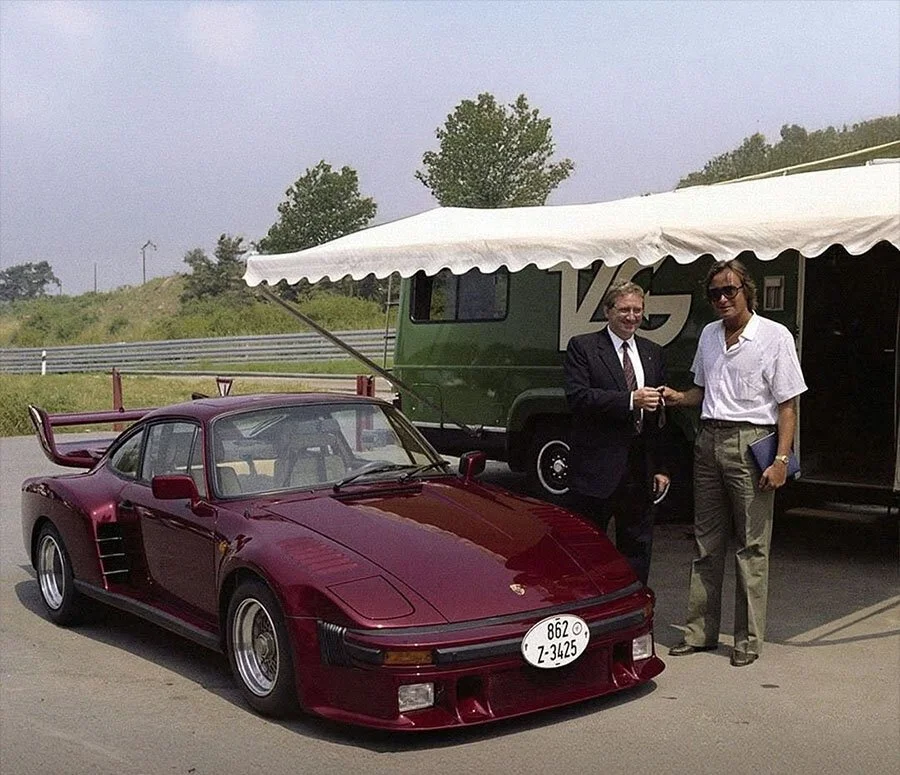
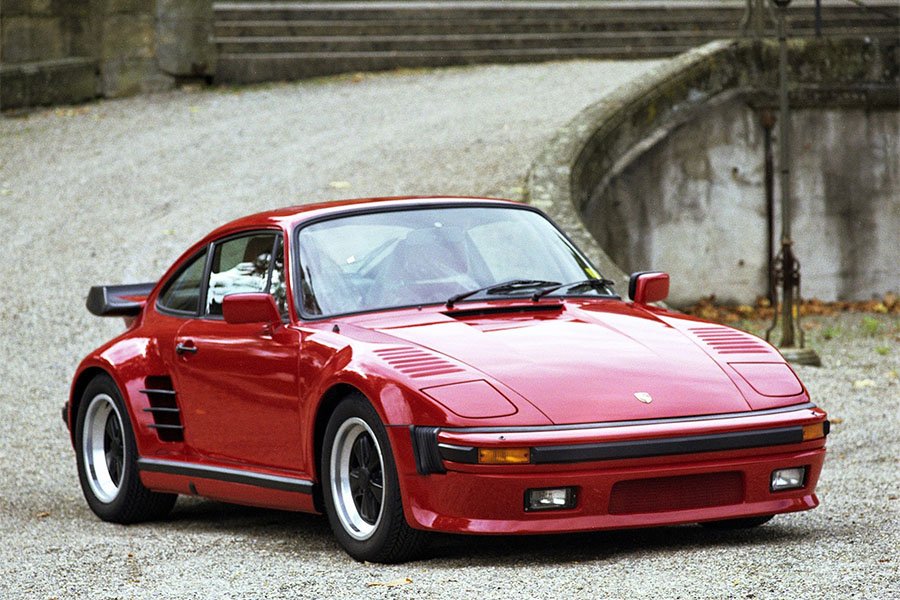
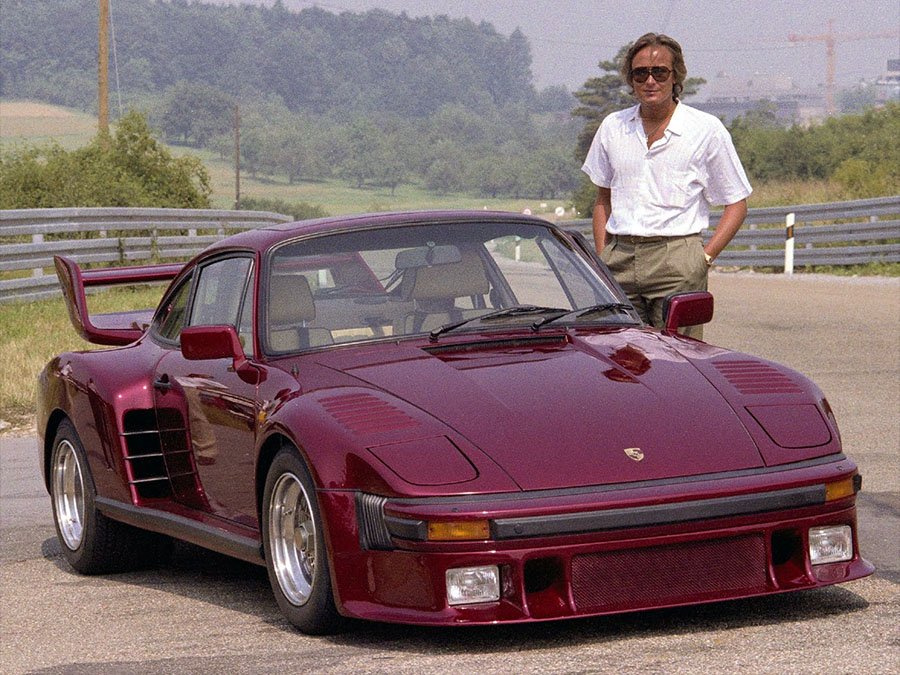
As part of the deal to create a turbocharged V6 engine for McLaren, Mansour Ojjeh acquired arguably the most extreme 930 ever produced by Porsche’s Sonderwunsch department.
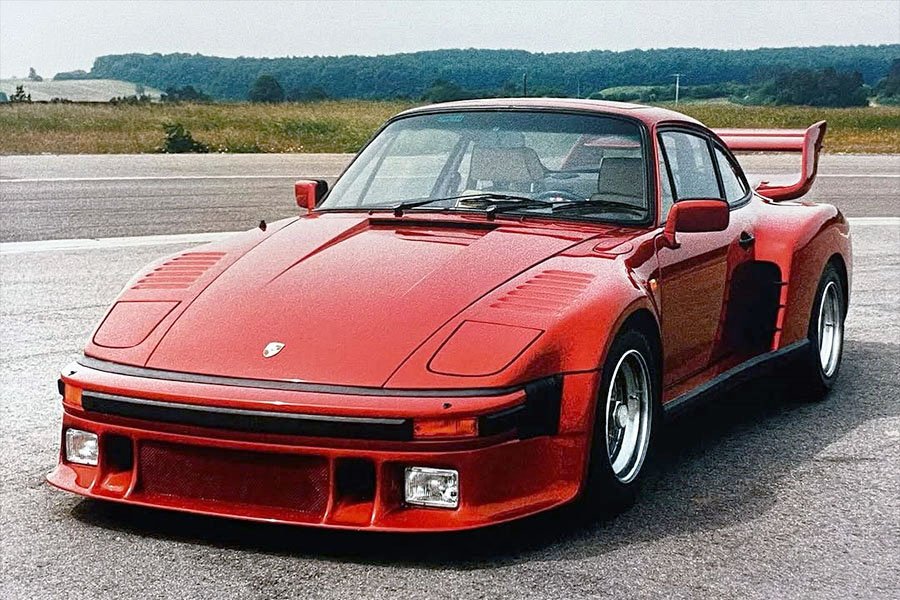
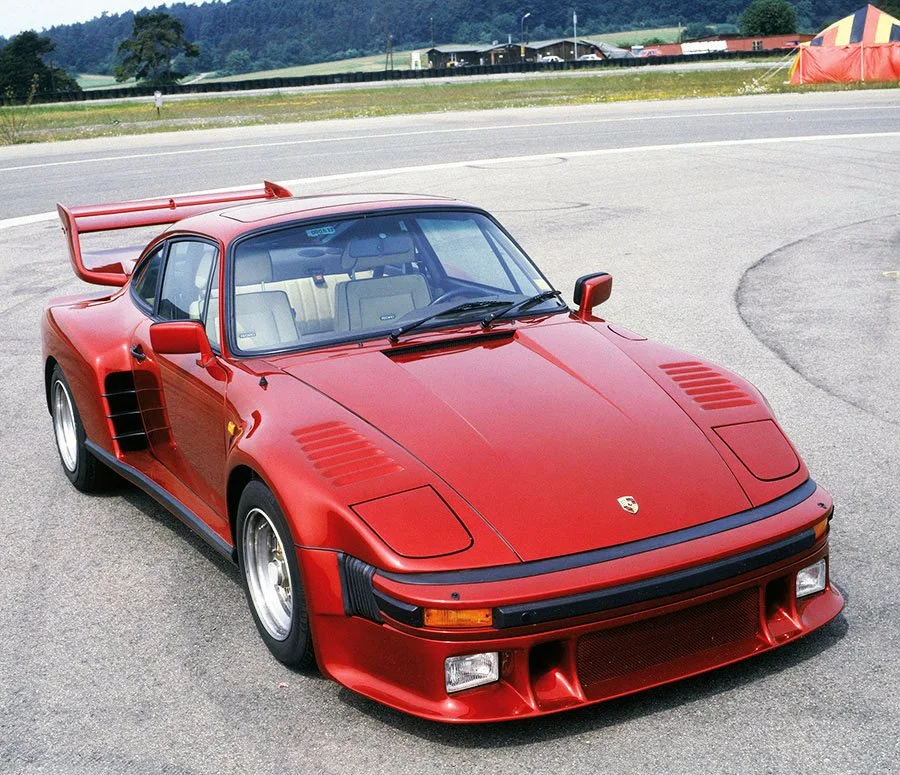
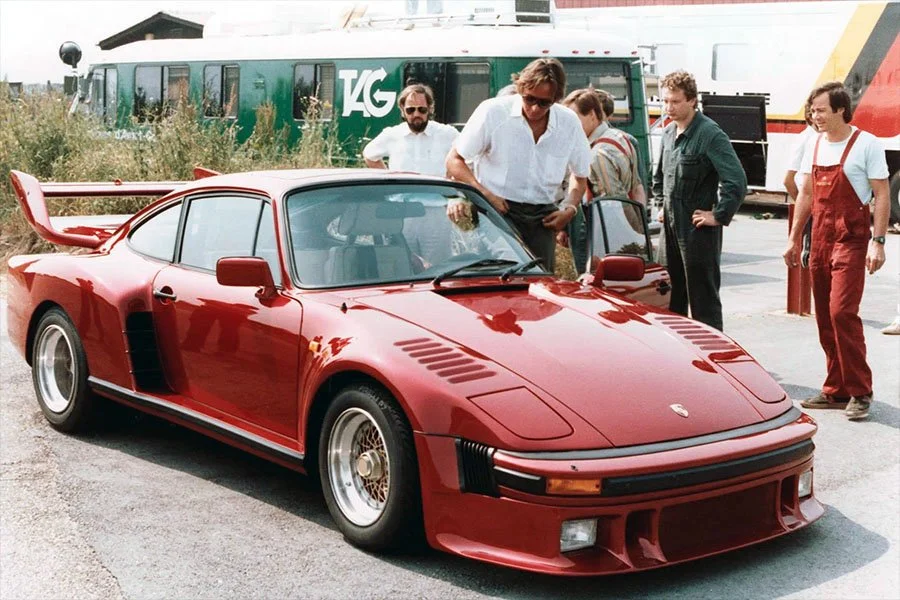
Handed over at Porsche’s Weissach test track in July 1983, the new car built on chassis WPOZZZ93ZDS000817 was conceived as a “935 for the street – but with all the luxuries”.
Variously dubbed the 935 Street and 935 TAG Turbo, it cost three times as much as a standard 911 Turbo and received in the region of 550 special modifications. The car was in fact so highly modified that Porsche even had to obtain single vehicle type approval for it.
CHASSIS
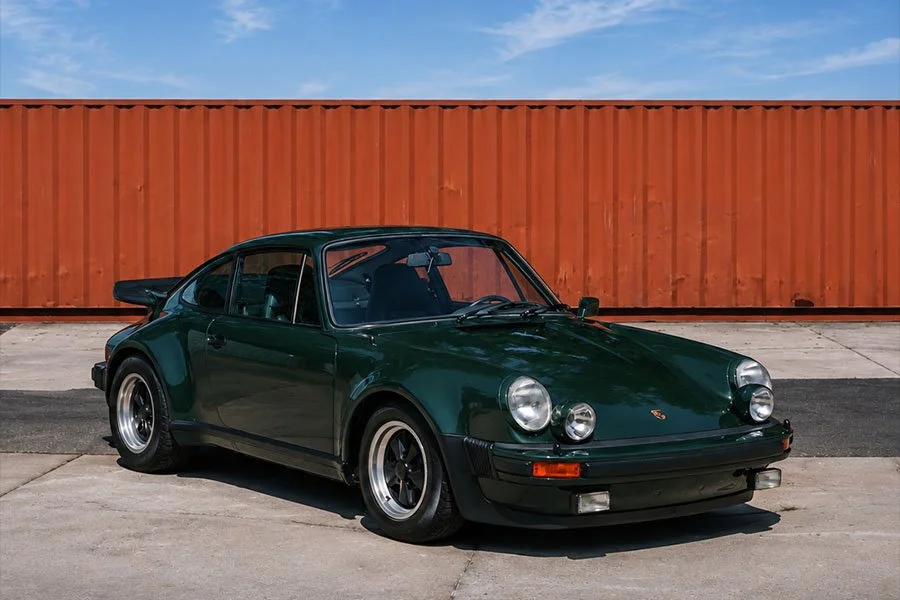
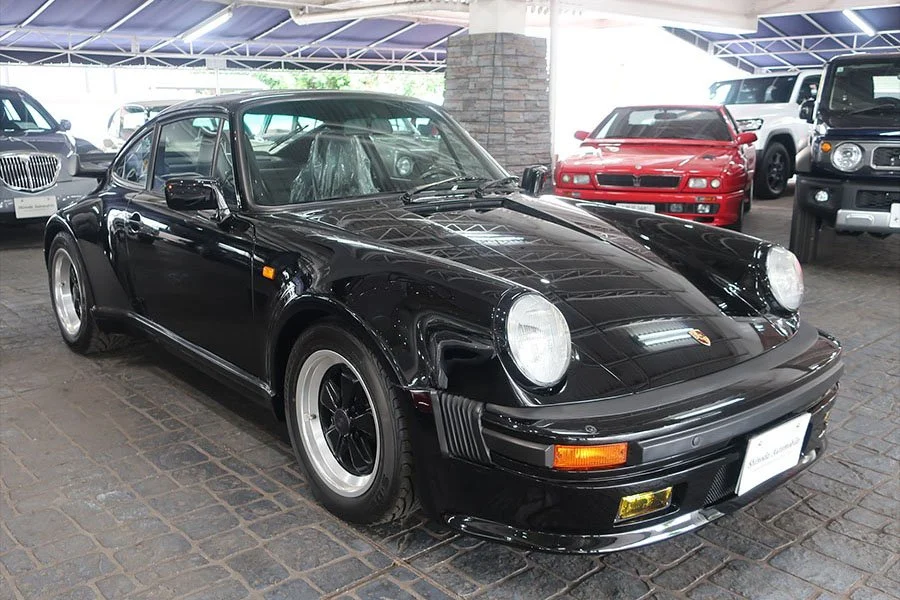
Starting point for the 935 Street was a 930 bodyshell plucked from the production line.
In standard trim, Porsche ran MacPherson struts with lower wishbones, longitudinal torsion bars and anti-dive geometry up front while the back end used semi-trailing arms with anti-squat. Bilstein shocks were fitted all round along with an anti-roll bar at either end.
As per the 934, the 935 Street was stiffened up with a front strut brace. New Bilstein shocks and uprated anti-roll bars were made fully adjustable and the ride-height was lower than a standard 930.
The 930’s brake system, which had already been massively improved for the 1978 model year, was imported without modification. It comprised 917-derived cross-drilled and ventilated discs of 304mm diameter at front and 309mm at the rear with finned four piston alloy calipers.
The 16-inch diameter five-bolt forged alloy wheels supplied by Fuchs for the regular 930 were discarded. Instead, the 935 Street rode on 15-inch centre-locks from BBS which were 10-inches wide at the front (up from 7) and 13-inches wide at the rear (up from 8). These were shod with Pirelli P7 tyres (285/40 and 345/35 respectively).
ENGINE / TRANSMISSION
In the engine bay was a much-modified version of Porsche’s latest Type 930/66 engine as introduced for the 1983 model year.
Another air-cooled all-alloy Flat 6 with two valves per cylinder, single overhead camshafts and dry-sump lubrication, it displaced 3299cc thanks to a bore and stroke of 95mm and 74.4mm respectively.
A 7.0:1 compression ratio was retained along with the latest Bosch K-Jetronic fuel-injection.
For the 935 Street, Porsche’s list of modifications included high-lift camshafts, a free-flow four-outlet exhaust, an uprated KKK turbo and a larger capacity air-to-air intercooler.
At 0.8 bar, the 935 Street was quoted as producing 375bhp at 5500rpm and 361lb-ft at 5000rpm.
With the boost turned up to 1.2 bar, north of 400bhp would have been available.
For comparison, the stock 930 developed 300bhp at 5500rpm and 303lb-ft at 4000rpm.
Transmission was through an aluminium-cased four-speed gearbox with new, longer ratios and a 934-style nose-mounted oil cooler.
BODYWORK
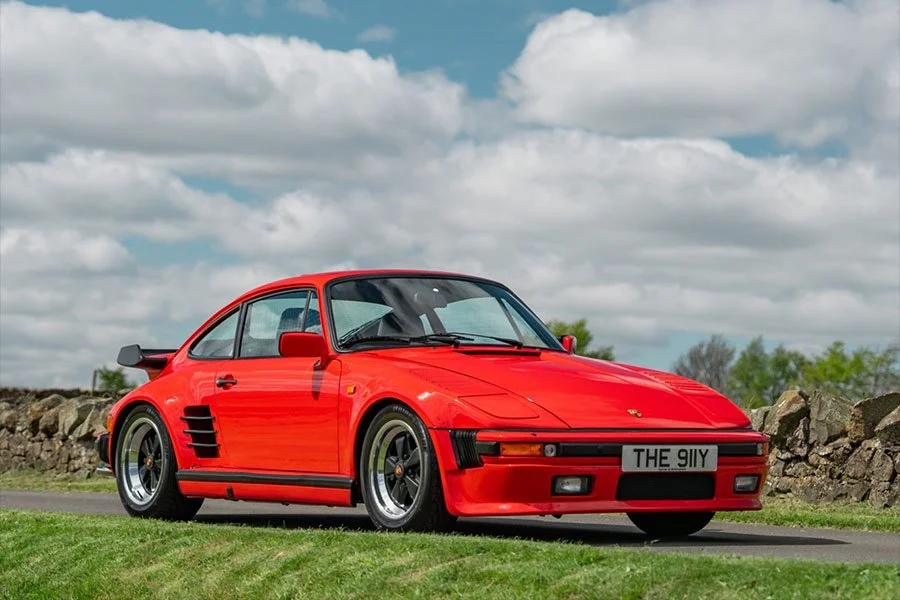
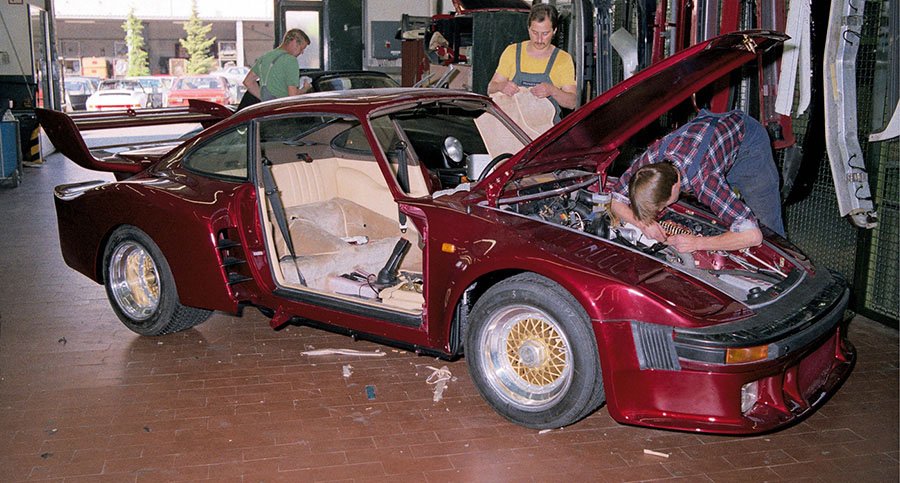
Externally, the 935 Street incorporated an array of radical modifications to differentiate it from a standard 911 Turbo.
Up front, Flachbau Series 2-style retractable headlights were adopted along with the normally optional bank of trailing louvres to aid wheel well ventilation. Lower down, a 934-style apron was fitted that housed a pair of rectangular driving lights
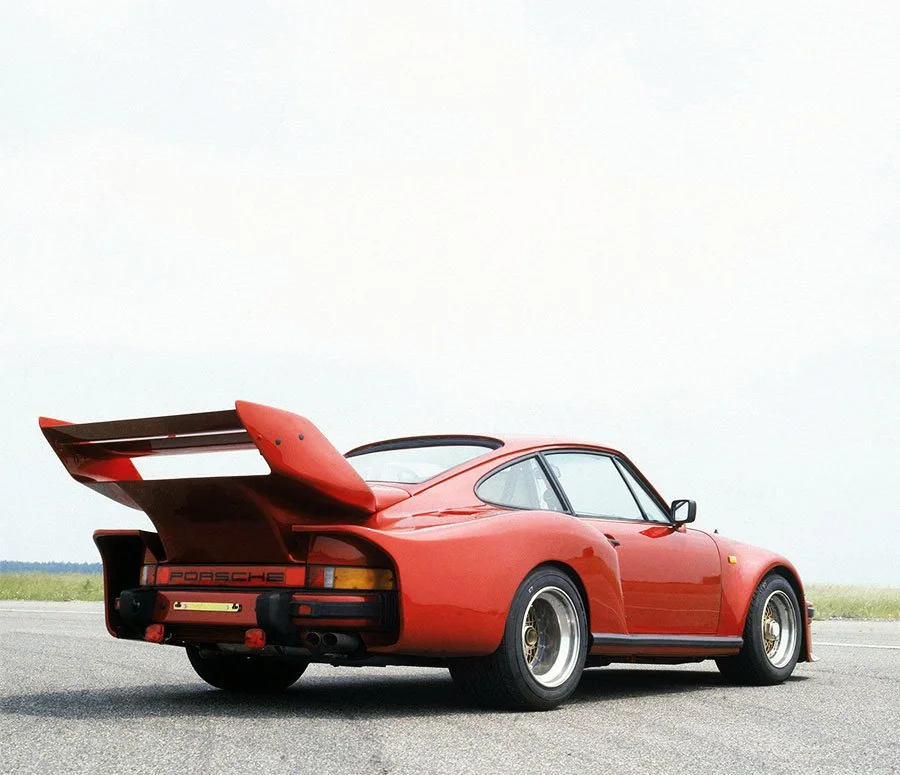
To accommodate the wider than standard wheels, all four fenders were dramatically flared. In a similar fashion to the 935, the rear fenders were completely re-profiled and at their leading edge incorporated vertical cooling slots (each now with a trio of slatted vanes).
Running board-style 935 side skirts were necessary to link the fenders along each sill.
Also reminiscent of the 935 was the engine cover which featured an enormous twin plane rear spoiler with adjustable upper element.
Length-wise, the rear spoiler added 374mm over a regular 930. As for the flared fenders, they increased width by 195mm.
For added practicality, a washer nozzle for the rear windscreen was fitted.
The finished car was painted Brilliant Red Metallic which subsequently became a popular choice for other Flachbau customers.
INTERIOR
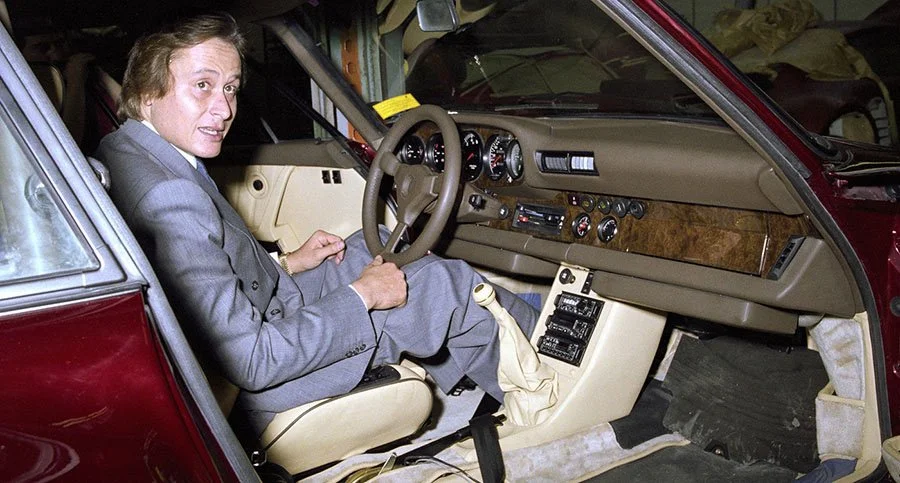
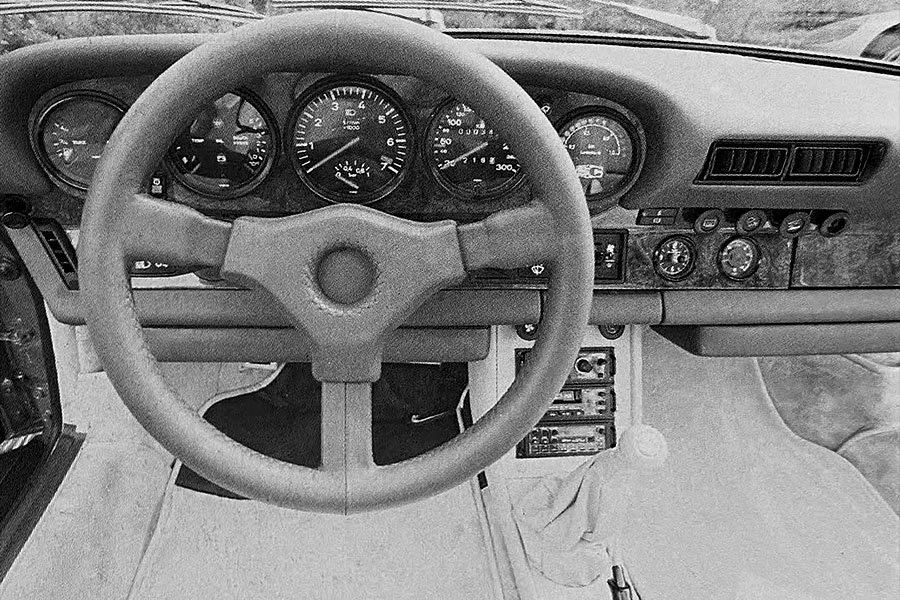
Inside, the 935 Street was configured with duo-tone upholstery that comprised brown hide for the dash, knee roll, door caps, piping, parcel shelf and the three-spoke Italvolante steering wheel with extended beige leather and matching carpet everywhere else.
Veneered walnut was used for the dash and instrument fascia.
A standard five-gauge binnacle from the regular 930 was retained, but instead of a clock, an SC & Porsche-branded LED boost gauge that ran at up to 1.2 bar was housed off to the far right. The other four gauges were imported without modification. They comprised a 7000rpm tacho with integral boost gauge directly behind the steering wheel to the right of which was a 300kph speedometer. Located on the left-hand side were combined read outs for fuel / oil level and oil temperature / oil pressure.
Alongside the ventilation controls, a custom VDO clock and outside temperature gauge were added.
Underneath the knee roll (which itself featured additional padding), Porsche fitted an extended centre console that housed a state of the art Clarion audio system with graphic equaliser, tape deck and radio. The gear knob was given a gold Porsche crest.
Recaro Ideal electric seats were another expensive addition. As for the rear seats, they were discarded in favour of two slide-out luggage boxes atop of which was a carpeted deck.
The rear of the cockpit was also home to a roll cage.
Central locking , an electric sunroof and air-conditioning were fitted for added comfort and practicality.
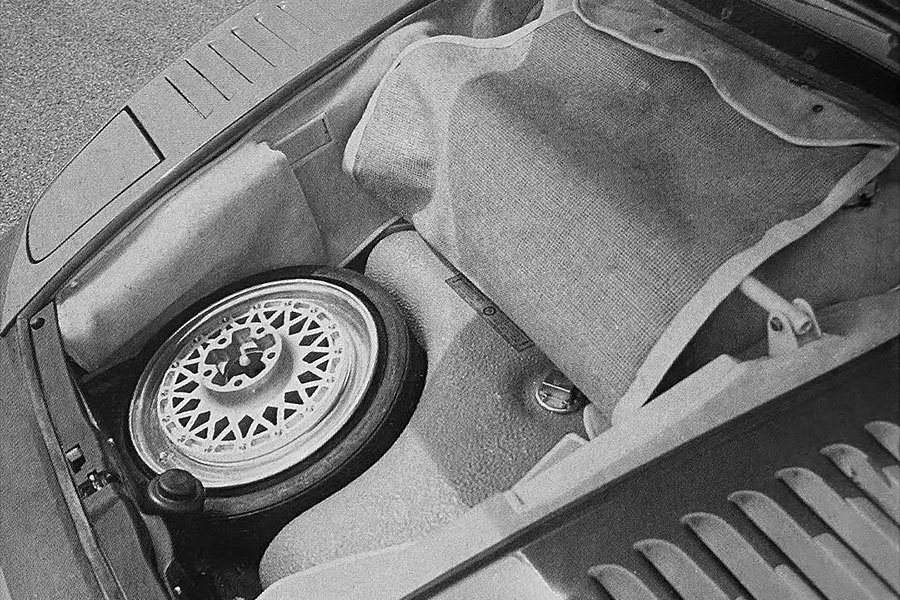
Underneath the front lid was a custom carpet set and centre-lock space saver spare wheel / tyre.
WEIGHT / PERFORMANCE
At 1380kg, the 935 Street weighed in 80kg heavier than a bone stock Euro-spec. 930 on account of its much higher specification.
As a consequence of its longer gear ratios, the 0-62mph was conservatively rated at 5.2 seconds (one tenth slower than standard), but top speed was markedly higher: 186mph as opposed to 161mph.
SUBSEQUENT HISTORY
As a one-off commission, no further copies of the 935 Street were either expected nor completed.
Chassis ‘817’ was later sold to McLaren Cars Director, David Clark, who in turn passed it on to Texan oil man and race team owner, John Mecom Jr. In order to make it road legal on the other side of the Atlantic, the car was fitted with a speedometer in miles per hour plus US-style side marker lights.
Text copyright: Supercar Nostalgia
Photo copyright: Porsche - https://www.porsche.com