One to Buy: Unrestored ex-Steve McQueen 1952 Hudson Wasp Twin H-Power Two-Door Brougham Coupe
/ Ben Tyer
During the late 1940s and throughout the 1950s, American styling was at the forefront of automotive design thanks to the integration of Jet Age features such as fully enveloped airflow bodies, wraparound glass canopies, finned fender lines and elaborately sculpted exterior trim.
At the vanguard of this cutting edge design was the Hudson Motor Car Company which was also one of the leading lights in the burgeoning NASCAR scene; with the newly released Hornet, Hudson scored no less than 81 victories and delivered multiple championships between 1951 and ‘55.
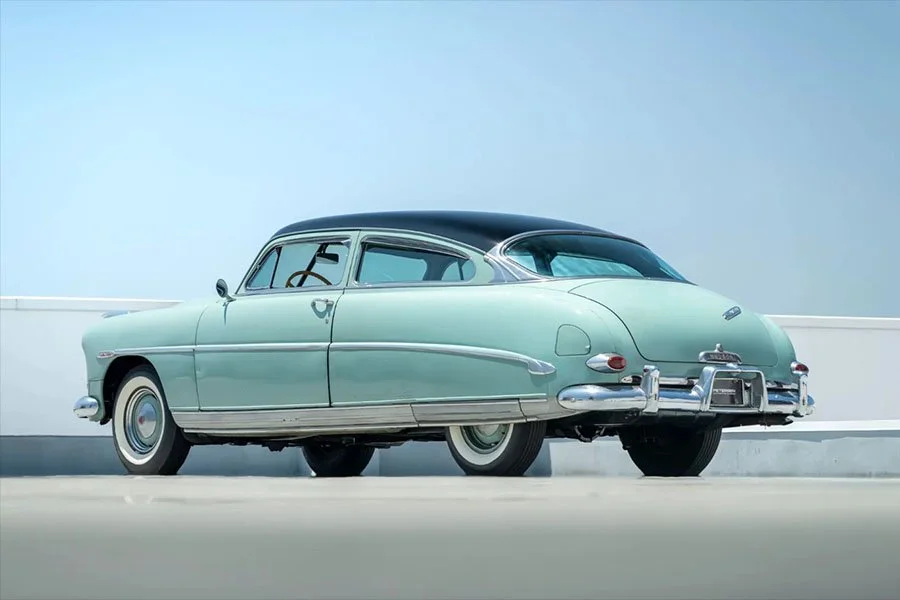
For the 1952 model year, Hudson introduced the Wasp as a junior model to the Hornet. It featured the company’s Monobilt unitary-type construction and was offered in a choice of body styles, the most handsome of which was the Two-Door Brougham Coupe as depicted here.
Perhaps the most famous Wasp owner was actor and film maker Steve McQueen who became legendary for his love of all things motoring.
At RM Sotheby’s Hershey sale in Pennsylvania scheduled for October 8th and 9th, McQueen’s remarkably original Wasp, chassis 188454, will be going under the hammer.
Optioned with the rarely seen Power Dome cylinder head, Twin H-Power carburettors and Hydra-Matic Drive four-speed automatic transmission, McQueen’s wife Barbara Minty recalled the actor had a deep affection for his Wasp, frequently using the car around Santa Paula and for trips to church on Sundays.
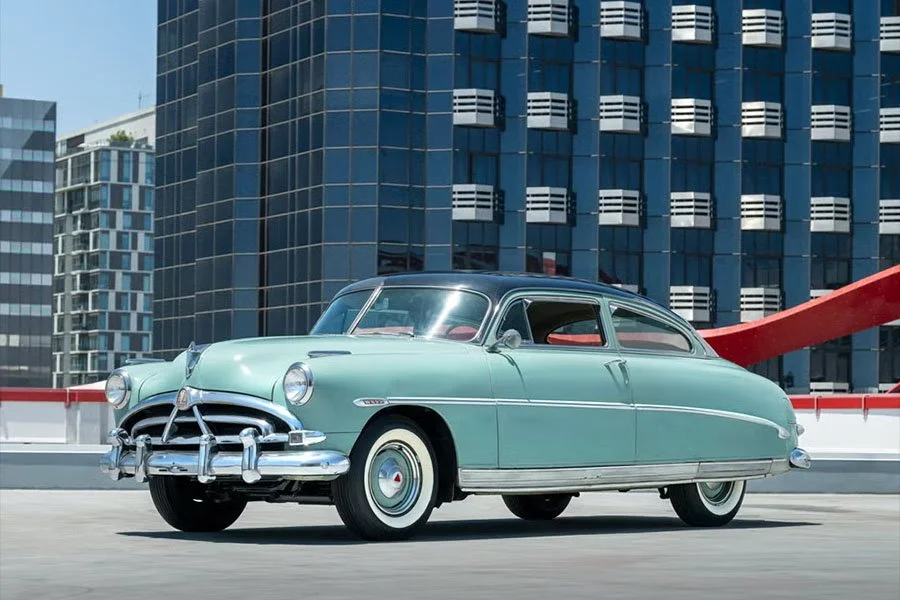
McQueen retained chassis 188454 until his untimely death in 1980. It was subsequently offered as part of his estate sale at the Imperial Palace in Las Vegas during November 1984 and since 2006 has formed part of the renowned Peterson Automotive Museum. Understood to retain ‘mostly original paint and interior’, the matching numbers chassis 188454 is being offered with a little over 63,000 miles on the odometer.
For more information visit the RM Sotheby’s website at: https://rmsothebys.com/
Aston Martin launched the DB4 in late 1958 to replace the ageing DB MkIII which could trace its origins back to 1949. In addition to handsome new Touring of Milan coachwork, the DB4 ushered in a…
In addition to an in-house 935-inspired K1 and Vaillant-liveried 934 on the books for 1976, the Cologne-based Kremer brothers prepared a 934 financed by German privateer, Gerhard Holup.
Five years after Lamborghini had displayed the original production-spec. Countach (the LP400), an even more dramatic variant was revealed under lights at the Geneva Motor Show in 1978. Dubbed…
Five years after he had joimed Porsche (back when the company was based in the Austrian town of Gmund and the 356/1 prototype was still on the drawing board), engineer Ernst Fuhrmann was given…
Although BMW’s Formula 1 programme of 2000 to 2009 did not deliver on championship-winning potential, it did pave the way for an F1-inspired V10 to find itself in the 2004-2010 M5 and the 2005…
When it comes to most extreme iterations of the 911, three candidates stand out. One is the 1974 Carrera RSR Turbo, another the 935 it spawned which, from 1976, was built in various states of tune.
Inspired by Zagato-bodied iterations of the Ferrari 250 GT Competizione, Japanese collector, Yoshiyuki Hayashi, commissioned a coachbuilt mid 2000s revamp based on the 575M. Zagato’s…
Although the Stratos had it all and then some, the Fiat Group’s replacement was derived from more mainstream fare and proved you didn’t need bona fide supercar characteristics to become the era’s…
During the peak of its popularity in the mid 1980s, the 944 Turbo was selling in almost as many numbers as the 911 Carrera - well over 10,000 a year. However, by the early 1990s, the 944 was…
During the late 1950s, arguably the most beautiful two-saeat Roadster offered by any manufacturer was the Pinin Farina-styled first generation Ferrari 250 GT Cabriolet. Underneath rakish lines…
Owing to poor trading conditions that led to massively reduced demand for high end motor cars, the expensively revived Bugatti company filed for bankruptcy in 1995. However, that wasn’t quite the end…
Launched at the Paris Motor Show in September 1982, the C3 was Audi’s third iteration of its executive-sized 100 model. Also offered in more upmarket 200 trim and sold as the 5000 in the…
When Jaguar displayed the XK120 prototype at the London Motor Show in October 1948, it did so with little expectation of sending the model into production. However, even in the gloom of post-war…
A litany of beautiful and successful Maserati sports racing cars were produced during the 1950s with among the most highly regarded having been the second generation A6 GCS of which 52…
Despite a long-standing relationship with Pininfarina, Ferrari commissioned Carrozzeria Bertone to design and manufacture bodywork for its first V8-engined road car. Unveiled at the Turin Motor Show…
To see off the expected threat from GT1 iterations of the Ferrari F50 and a reverse engineered purpose built racer that Porsche was known to have in development, McLaren created an uprated…
The collaboration to create a V16-powered monster by automotive engineer Claudio Zampolli and music producer Giorgio Moroder was arguably the most ambitious of all the supercars formulated…
During the mid-to-late 1980s, arguably the most elegant sporting Coupes offered by Europe’s high end manufacturers were the Aston Martin V8 and BMW’s E26 M635 CSi. While in Vantage trim the…
Between the 1950s and 1990s, members of the Korps Rijkspolitie, the Dutch National Police responsible for the nation's highways, were issued a variety of open top Porsche patrol cars; 356…
After the 288 GTO and F40 had used twin turbocharged V8s that propelled them to hitherto unseen levels of performance, Ferrari took a different approach for its third generation limited production…
Between 1967 and 1969, Porsche commissioned three transporters from Mercedes-Benz based on the O317 platform. During the years that followed, this handsome trio traversed Europe, initially…
While most examples from Lancia’s 200-strong batch of 037s built to homologate the model for Group B competition led a relatively pampered life, a handful were rallied by their owners and a few…
Owing to tighter emissions legislation, E36 M3s bound for North America had to be fitted with lower compression engines that did not feature the same radical cylinder head, variable valve timing…
Unlike most attempts at retro-themed automotive designs, Alfa Romeo’s spectacular 8C produced between 2007 and 2010 ranks among the most beautiful motor cars of the modern era. Styled by…
Although Nissan’s standard RB26DETT straight six offered formidable tuning potential as evidenced by the litany of circa 1000bhp GT-Rs that had been tweaked with aftermarket parts, when it came to…
To replace the 2.6-litre 212 Export which had served privateers so well throughout the 1951 season, Ferrari introduced the 2.7-litre 225 Sport for 1952. In total, 21 examples of the 225 Sport were…
Porsche most famously came a cropper with regard to trademark law when, in late 1964, the German firm was forced to re-brand its 901 as the 911 because Peugeot had already registered three digit…
Having created one of the 1980’s wildest homologation specials with the Sierra RS Cosworth, Ford took a similar approach when it came to a MkV Escort conceived for top flight rallying. Unveiled in…
After a five-year spell campaigning the E36 M3 GTR, BMW’s North American competition partner, Prototype Technology Group (PTG), switched focus to the new E46-based Motorsport 3-series.
Kremer Racing’s 1974 campaign focused primarily on two of the latest specification 911 RSRs which the Cologne outfit built up from naked Porsche-supplied bodyshells. Together, chassis 004…