One to Buy: ex-Alain Finkelstein 1969 Abarth SE 010
/ Ben Tyer
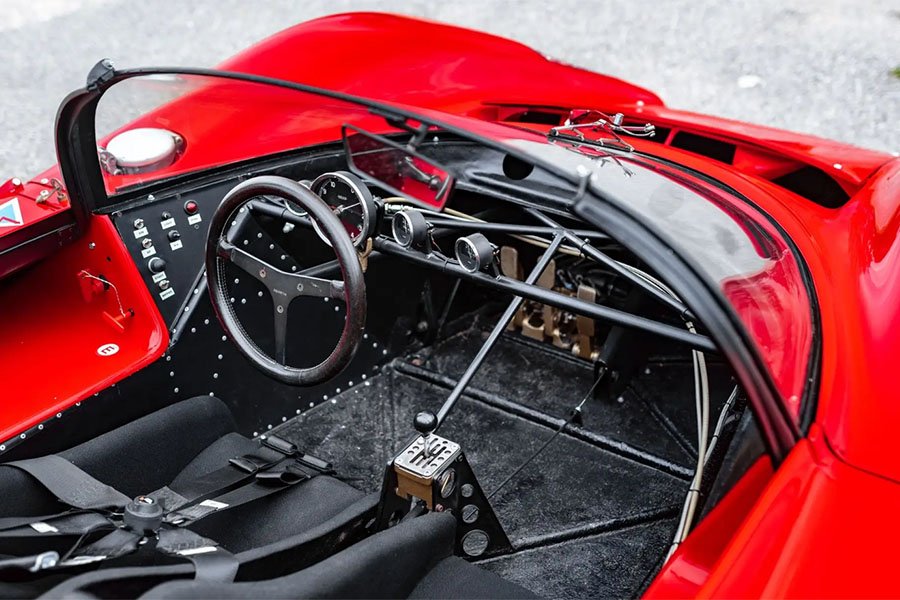
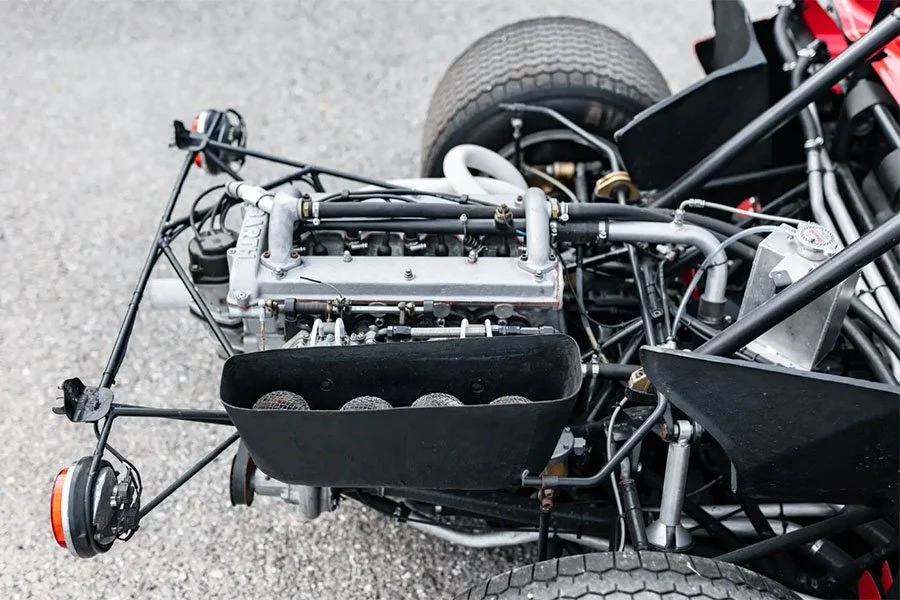
The SE 010 was Abarth’s new-for-1968 under two-litre Group 6 challenger created to take on similar machinery from the likes of Alfa Romeo (33/2), Porsche (910), Chevron (B8), Lotus (47) and Ferrari (Dino 206 S).
Although designer Mario Collucci had wanted to go with a mid-engined layout, Carlo Abarth got his way and the SE 010 ultimately adopted a rear-engined configuration which was deemed perfect for the hillclimbs and tight, twisty circuit races the Turin firm expected to prioritise.
Having hit the ground running and picked up a litany of wins using the two-litre engine for which it was conceived, 1.3, 1.6 and even 3-litre engines were successfully shoehorned into the SE 010 which, from the spring of 1969, was also homologated into the Group 4 class following the FIA’s decision to reduce the production requirement from 50 to 25 cars.
Set to go under the hammer at RM Sotheby’s auction in Paris on February 22nd is an SE 010 in superb restored condition and with outstanding provenance.
Chassis 0018 was originally sold to Alain Finkelstein who used it to great effect in the French Hillclimb Championship (the Championnat de France de la Montagne) between 1969 and ‘70.
Finkelstein placed third in the standings following his 1969 campaign and, although single seat racing cars were permitted to compete from 1970, he still managed to finish sixth during his second season with the car.
1971 saw chassis 0018 campaigned by Jean-Marie Porcier, after which it was sold to former French hillclimb champion, Pierre Maublanc. In 1976 the car was purchased from Maublanc by Jean Rocher who has retained it ever since and, between 2016 and 2017, subjected the car to an exacting restoration.
For more information visit the RM Sotheby’s website at: https://rmsothebys.com/
Although the Stratos had it all and then some, the Fiat Group’s replacement was derived from more mainstream fare and proved you didn’t need bona fide supercar characteristics to become the era’s…
As if the paltry 200-car homologation requirement for Group B did not permit sufficiently extreme machinery, manufacturers were permitted to build even more potent Evolution variants from the…
Tuscany has all manner of public roads doing a laudable impressions of a tarmac rally stage, and if you’re going to drive an Italian homologation special around for a day you’d struggle to find a better area to get lost in on purpose.
Chassis 208 was one of five S4s used by the Totip-backed Jolly Club outfit during 1986. That season, Jolly Club’s programme focused on Dario Cerrato’s attempt to retain the European and Italian Rally…
During a 20 year period from the early 1970s to the early 1990s, the combined efforts of Fiat and its Lancia subsidiary won championship after championship at rallying’s highest level. After the Fulvia…
There’s little better than having a great car with a special history to make it stand out from the crowd. Collector-grade examples of Integrale Evoluziones are already pretty expensive, but this is…
Having commissioned its newly acquired Abarth competition department to create a Group 4 homologation special based on the 124 Sport Spider, Fiat’s new-for-1973 special stage challenger…
The 124 was launched by Fiat in 1966 as its mid-range offering and replacement for the outgoing 1300 / 1500 line which had been in production since 1961. Originally unveiled as a four-door Sedan at…
In order to beat the all-conquering Peugeot 205 T16, the engineers at Lancia and its competition arm Abarth had to come up with a remarkable machine that, like its French rival, was designed…
Of the myriad special editions offered by Lancia on the Delta HF Integrale Evoluzione platform, arguably the most spectacular was the Evo 1-based Martini 6 produced to celebrate the firm’s sixth…
Unveiled at the Paris Motor Show in October 1958, Abarths new dual overhead cam 750 Bialbero Record Monza instantly became the car to beat in the sub 1-litre GT racing categories. Based on…
Having already created a 594cc version of Fiat’s eponymous 500 back in 1963 (the 595), Abarth elected to take the four cylinder engine’s capacity out to just under 700cc with the 695 SS of 1964.
After a disappointing debut season in 1982, the Lancia 037 came good in 1983 by winning that year’s Driver and Manufacturer World Rally Championship titles. The rear-wheel drive 037’s state-of-art…
Despite having been launched back in 1979, Lancia’s compact Delta proved the class of the Group A field during the second half of the 1980s following the FIA’s decision to impose a ban on radical…
Between 1974 and 1976, the Lancia Stratos established itself as among the most successful rally cars of all time winning three Manufacturers’ titles for the Turin-based firm. However, ahead of the 1977…
For 1966, new Appendix J motor racing regulations came into effect that split machinery into one of seven categories. Groups 1, 2 and 5 were for Touring cars. Group 3 was for Grand Touring cars and…
The Evoluzione was Lancia’s last and perhaps most significant technical push to keep the all-conquering Delta HF Integrale at the head of the field in top flight rallying. Launched at the…
As more and more manufacturers piled into rallying following the introduction of Group B regulations for 1982, the new generation of purpose-built machinery led to an explosion in media…
By virtue of its extraordinary state-of-art specification and 205 T16-toppling competition record, Lancia’s Delta S4 can legitimately be regarded as the ultimate expression of the legendary Group B…
Having commissioned arguably the most radical rally car ever to tackle the special stages in 1971 (the Lancia Stratos), for marketing reasons the Fiat Group decided its replacement should be more…
Of the myriad special editions created by Lancia on the Evoluzione 1 and 2 platform, arguably the most sought after is the Club Italia of which just 15 were built for VIP customers in 1992. In addition…
Currently on offer at the Ruote da Sogno showroom in Reggio Emilia is a veteran of Lancia’s 1989 World and European Rally Championship campaign with a stellar event winning history. The car in…
For three straight season between 1974 and 1976, Lancia set the World Rally Championship alight with the purpose-built Stratos, the like of which had never been seen before. However, while the…
To keep the ageing but effective HF Integrale ahead of the competition for what would be the Delta’s fifth season in the World Rally Championship, Lancia produced their most extreme iteration of the…
The SE 010 was Abarth’s new-for-1968 under two-litre Group 6 challenger created to take on similar machinery from the likes of Alfa Romeo (33/2), Porsche (910), Chevron (B8), Lotus (47) and…
A major contributing factor to the incredible pace with which Group B machinery developed between 1982 and 1986 was the Evolution rule. Evolution variants enabled manufacturers to…
Although rallying had been in rude health throughout the 1970s, for the second half of the decade, sports car racing was in the doldrums. To help stimulate a revival, a new simplified regularity…
From the SE 04 1000 SP (a one-litre prototype racing car), Abarth designer, Mario Collucci, created a series of even more potent two-litre variants. First to arrive was the visually similar SE 04/L in the…
Born from the ashes of Piero Dusio’s failed Cisitalia project, Abarth & C. was established in March 1949 for the production of automobiles and performance accessories. Carlo Abarth purchased…
By the early 1980s, Fiat knew that for their domination of World and European rallying to continue, an all-new challenger conforming to the latest Group B regulations would have to be produced.