Uncrowned King - a Historical & Technical Appraisal of the Ford RS200 Evolution
/
BACKGROUND
The Group B regulations that came into effect from 1982 stipulated that, to compete, a manufacturer first had to build at least 200 base copies of the car they wanted to run. However, the base car was not the end of the story as, from the point of homologation and every twelve months thereafter, further uprated Evolution variants could be created so long as an additional 20 copies were produced every time.
Ford had initially planned to contest the Group B era with its Mk3 Escort-based RS1700T but it quickly became apparent that a purpose-built model was needed if the firm was to stand any chance of beating a new generation of cars designed from the ground up with the special stages in mind.
Writing off its RS1700T investment, an all-new model was given the green light which, after myriad delays, made its public debut at the Turin Motor Show in November 1984.
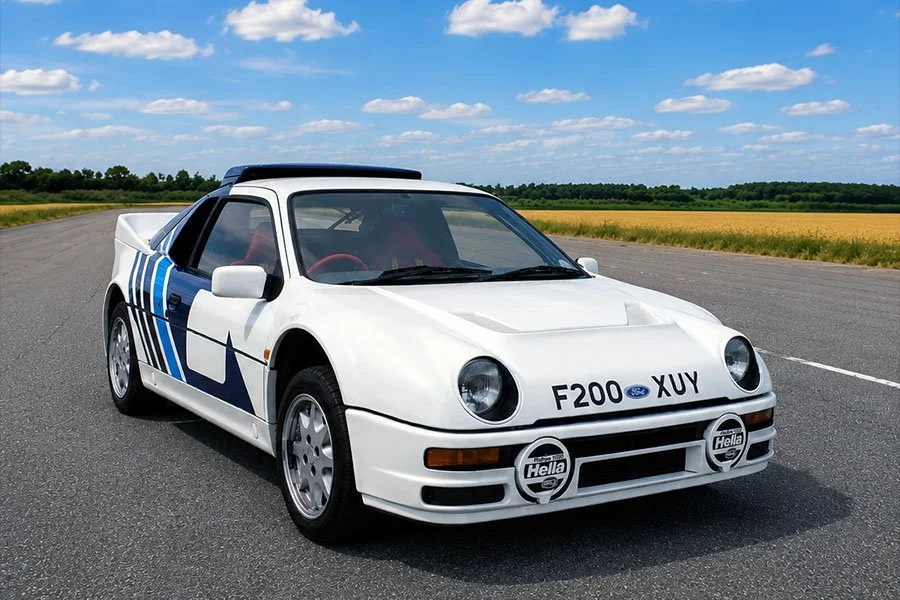
Dubbed RS200, the new Ford seemed to have everything a world-beating Group B rally car would need: a mid-engined all-wheel drive layout, compact dimensions, an immensely tuneable forced induction engine and financial backing from a major multinational.
Unfortunately, owing to supply and manufacturing issues, the first RS200 production car was not completed until September 1985 and Ford’s Group B application was only rubber stamped on February 1st 1986.
At this point, Ford probably should have had its batch of 20 RS200 Evolutions ready but, for its limited 1986 World Rally Championship campaign, the firm expected to run suitably enhanced versions of the base RS200. A full season with the Evolution variant was expected to follow in 1987.
As the Cosworth-developed BDT engine found in the base RS200 was already stretched to its limit, a heavily revised version was commissioned from Brian Hart who had been responsible for much development on Ford racing engines in the years prior. The new BDT-E engine destined for the RS200 Evolution was expected to produce between 500bhp and 600bhp depending on its state of tune - far more than the 420bhp being squeezed out of the BDT motor used in Ford’s works cars during the early part of 1986.
25 engines were ordered along with parts for 25 more.
Unfortunately, by the time the BDT-E engine was unveiled at a press conference in London on July 8th 1986, the rallying landscape had changed significantly.
In a world of lax crowd control and minimal car safety, Group B machinery had already claimed the lives of several competitors and more than a few spectators even before the ‘86 season kicked off. The straw that broke the camel’s back came on the Tour de Corse which took place at the beginning of May where Lancia pairing Henri Toivonen and Sergio Cresto were killed when their Delta S4 plunged into a ravine and was consumed by fire.
The FIA’s response was two-fold. Firstly, further Evolution variants were outlawed for the rest of the ‘86 campaign. Secondly, and even more significantly, Group B cars would be banned altogether for the 1987 World Rally Championship. Instead, tamer Group A machinery, subject to a 5000 car production requirement, would become the premier category in an attempt to dramatically reduce speeds.
When the FIA dropped its bombshell, Ford had only entered two WRC events with the RS200: Rally Sweden (where Stig Blomqvist bagged a promising third) and Rally Portugal (where both works cars were withdrawn after the privateer RS200 of Joaquim Santos had span off into the huge crowd during stage three, killing three children and a woman and leaving a further 32 seriously injured).
Despite there being no hope of the BDT-E engine ever contesting a World Rally Championship event, Ford hoped the expensively developed power unit would still find a home in Rallycross and Group C2 Sportscar racing. In addition, it would become the ultimate option for RS200 buyers as Ford still had a good number of cars languishing unsold.
The BDT-E engine was homologated for these aforementioned categories on December 1st 1986.
ENGINE / TRANSMISSION
Having started life in the Escort RS1700T with a 1786cc displacement, Cosworth’s original BDT engine was enlarged to 1803cc for the base RS200. However, even in its ultimate form, the 1.8-litre BDT maxed out at 450bhp which Ford knew would be insufficient against Lancia’s epic turbocharged and supercharged engine in the Delta S4.
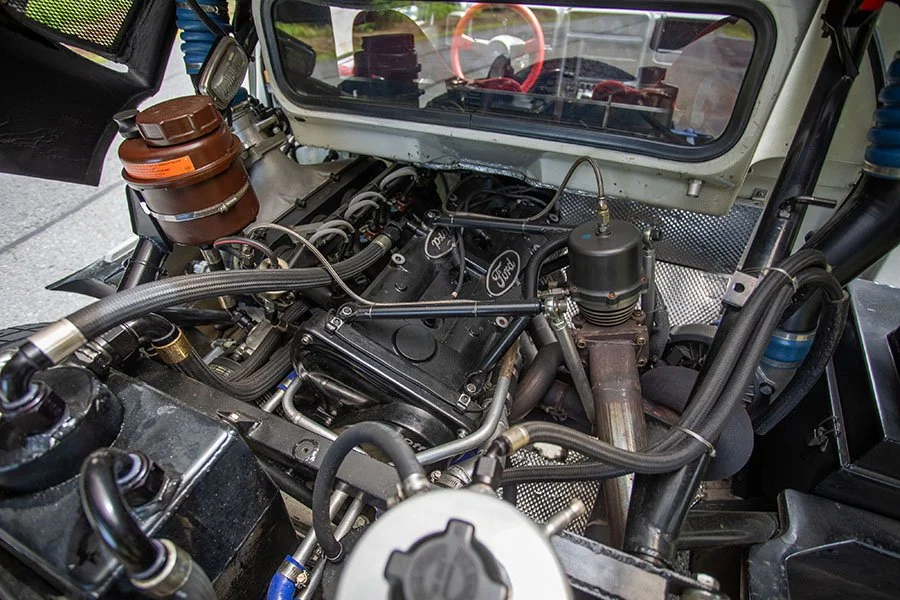
With this in mind, Brian Hart came up with an almost totally new engine for the RS200 Evolution, one that had shared only its cam cover with the existing BDT motor.
By utilising a slightly longer block (extended by around 20mm), the BDT-E’s capacity could be enlarged to 2137cc which, with the FIA’s 1.4 multiplier for turbocharged engines, meant a swept displacement within the 3-litre limit. Cylinder bore was increased from 86mm to 90mm and stroke lengthened from 77mm to 84mm.
As before, this latest iteration of the BDT theme featured an aluminium alloy block and head with four valves per cylinder, dual overhead camshafts and dry-sump lubrication.
However, in addition to the block, the big valve ported head, heavy duty crankshaft and connecting rods were all brand new as was Bosch Motronic 1.2 engine management which replaced Ford’s existing EEC IV software.
A bigger Garrett TR3 turbocharger was used instead of the normal TO3/4 unit and fed a massive new intercooler that stretched right across the car above the rear window.
Engine and turbo oil systems were also uprated as was the exhaust.
With boost pressure running at 1.5 bar and a 7.2:1 compression ratio, peak output was a quoted 506bhp at 7500 rpm and 401lb-ft at 5500 rpm. If cranked to 1.6 bar and fitted with hot high lift camshafts, the BDT-E motor produced 580bhp at 7700rpm and 460lb-ft at an unchanged 5500rpm.
Transmission was through the RS200’s familiar combination of a front-mounted Hewland five-speed gearbox, FF Developments all-wheel drive system with three viscous coupling limited-slip differentials and a twin-plate AP Racing clutch.
CHASSIS
The RS200 was based around a brand new chassis with a 2530mm wheelbase designed by Tony Southgate and chief engineer of Ford Motorsport, John Wheeler.
The main floor, sills and bulkheads were fashioned from bonded and riveted Ciba-Geigy aluminium honeycomb sandwich with steel outer skins. A stressed central tunnel and the inner rear bulkhead were moulded from a lightweight reinforced aramid carbonfibre composite. The double-skinned upper / roof structure was in a carbonfibre / aramid / glassfibre composite.
An integrated steel rollcage was bolted direct to the monocoque as were the front and rear subframes manufactured from high-strength alloys.
Mounted in the rear bulkhead behind the seats were a pair of aluminium fuel tanks (one with a 73.6-litre capacity, the other with a 41.8-litre capacity).
Suspension was via double wishbones with twin coil sprung height adjustable dampers at each corner and an anti-roll bar at either end.
The unassisted rack and pinion steering arrangement was a modified Sierra item.
An AP Racing brake system comprised 285mm ventilated discs with four-piston aluminium alloy calipers all round.
8 × 16-inch Speedline alloy wheels were shod with Pirelli P700 tyres (225/50 VR 16).
BODYWORK
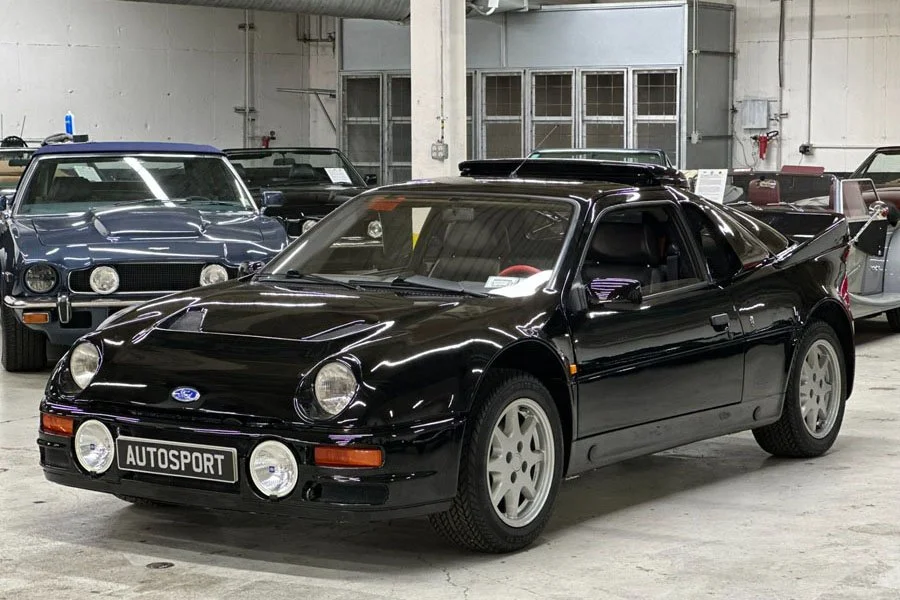
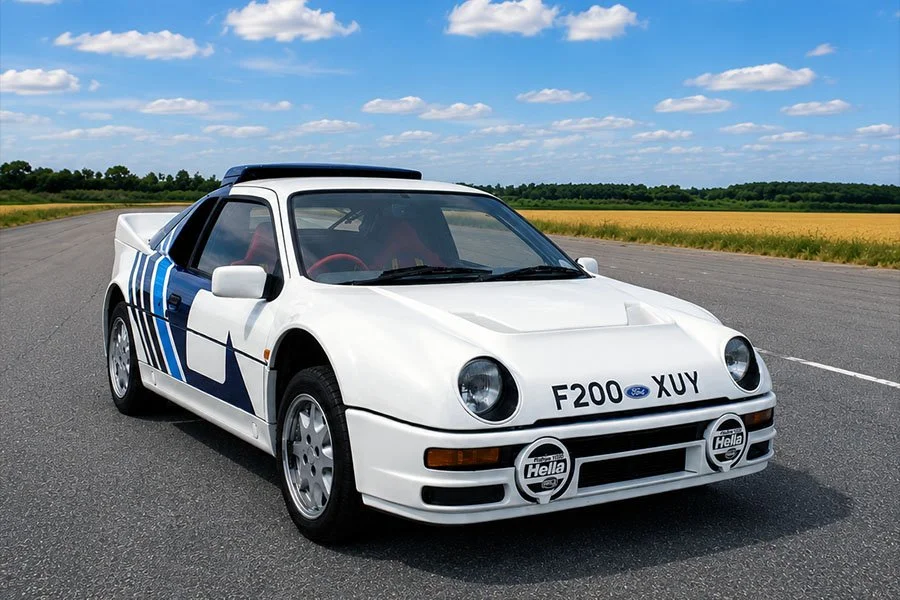
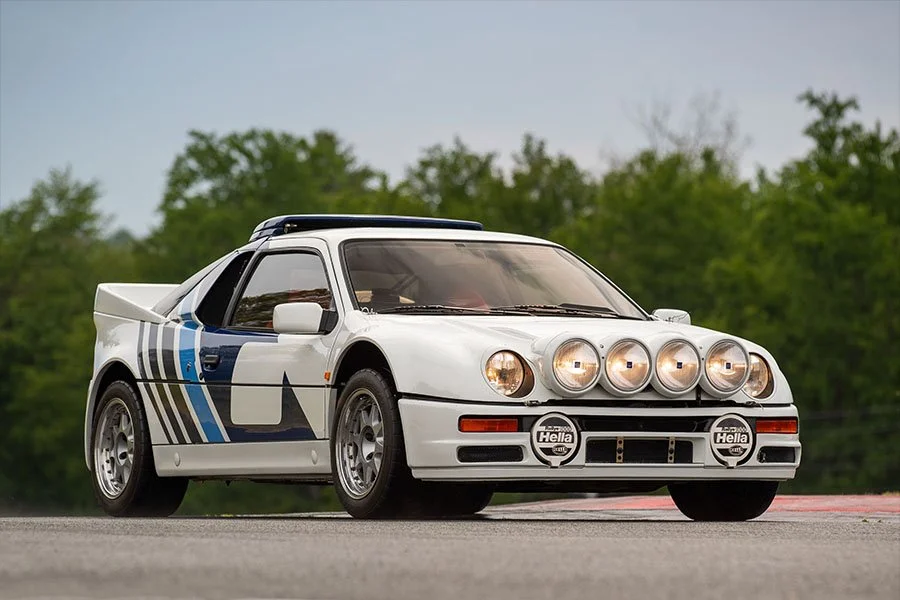
Initial design work for the RS200 had taken place in-house at Ford’s Motorsport department in Boreham with final styling carried out at the firm’s Ghia subsidiary in Turin. The car was characterised by its compact size with very short overhangs. A 0.4 drag coefficient may have seemed high, but Ford was more concerned with stability than conventional aerodynamic efficiency.
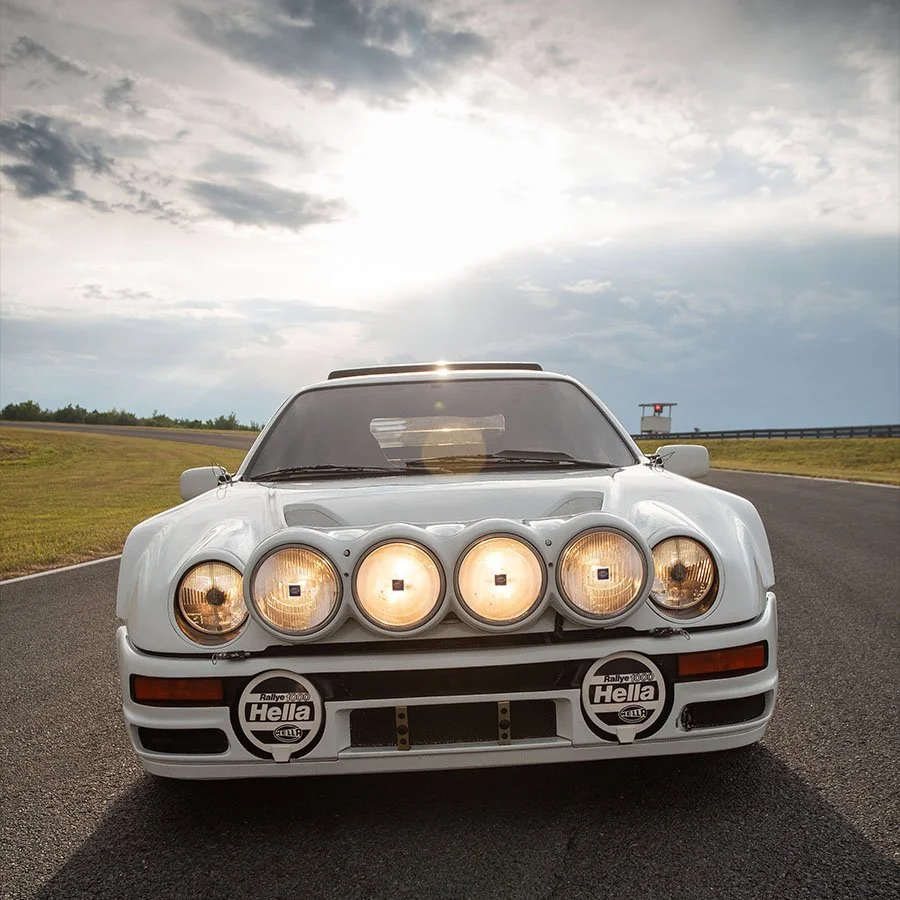
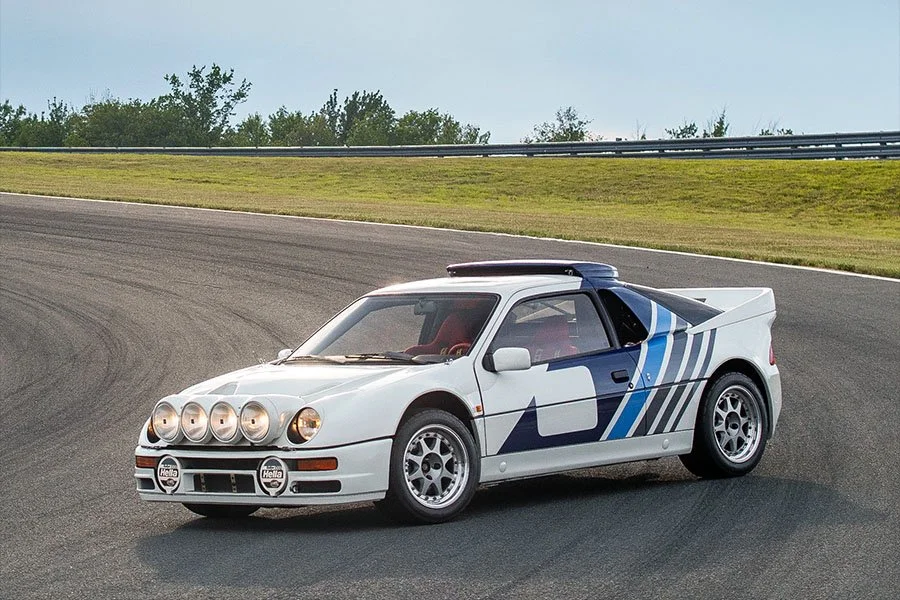
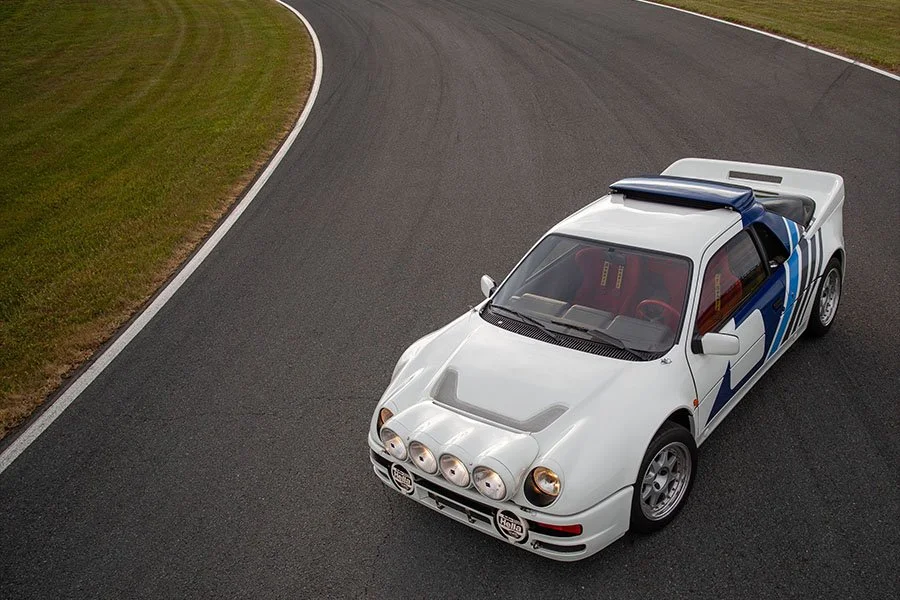
Up front, bulges for the two semi-shrouded circular headlights swept back towards a massive central vent that enabled hot air to escape from the radiators. Lower down, the front apron housed cutaways for a pair of spot lights that normally wore Hella-branded covers. A slim brake cooling duct was carved out from the corners of the front apron and a matching intake slot was located above the licence plate housing.
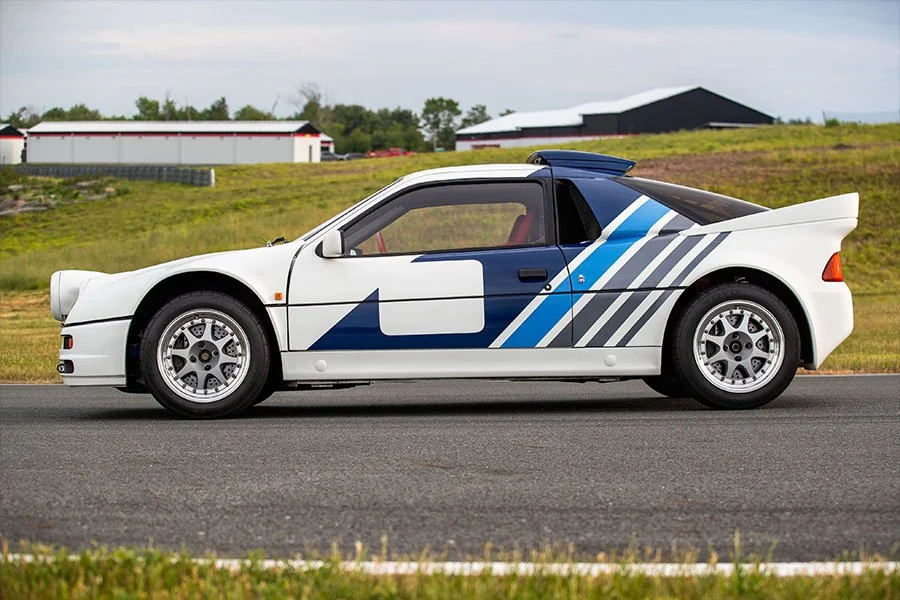
Down each flank were deep side skirts, low profile doors and a vertical air duct behind each side window. Mounted at the leading edge of the lift-up rear hatch was the full width intercooler duct.
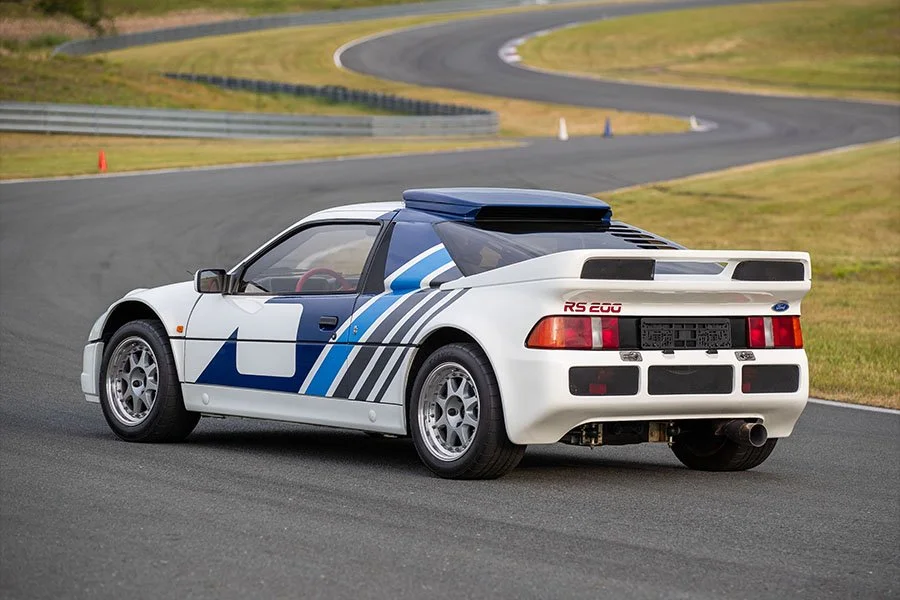
The back end was dominated by an integrated spoiler that wrapped around the vented panoramic rear screen. At its trailing edge, the spoiler contained two large vents that enabled hot air to escape from the engine bay. A trio of rectangular vents that served the same purpose were cut away from the rear apron underneath a satin black fascia where Ford incorporated tail lights sourced from the Sierra.
With its well balanced proportions, the RS200 was arguably the most handsome of all the purebred Group B cars created for rally use.
The front lid (hinged at the leading edge) was manufactured from a carbon, fibreglass and aramid epoxy composite. The centre section, doors and rear lid (again hinged at the leading edge) added plastic into the carbon, fibreglass and aramid epoxy mix. Bumpers were plastic composite, side and rear windows were acrylic and the windscreen was a laminated glass Sierra item.
INTERIOR
Despite its exotic layout (this was only the second mid-engined car that Ford had offered to the public), the RS200 felt much like any other Ghia-spec. model from the Blue Oval thanks to widespread use of grey plastics and imported switchgear.
Directly behind a three-spoke red or grey-rimmed steering wheel sourced from the XR3i was a rectangular four-gauge binnacle that housed a large 10,000rpm rev counter, a Terraspeed digital speedometer, small read outs for oil pressure and water temperature and half a dozen warning lights.
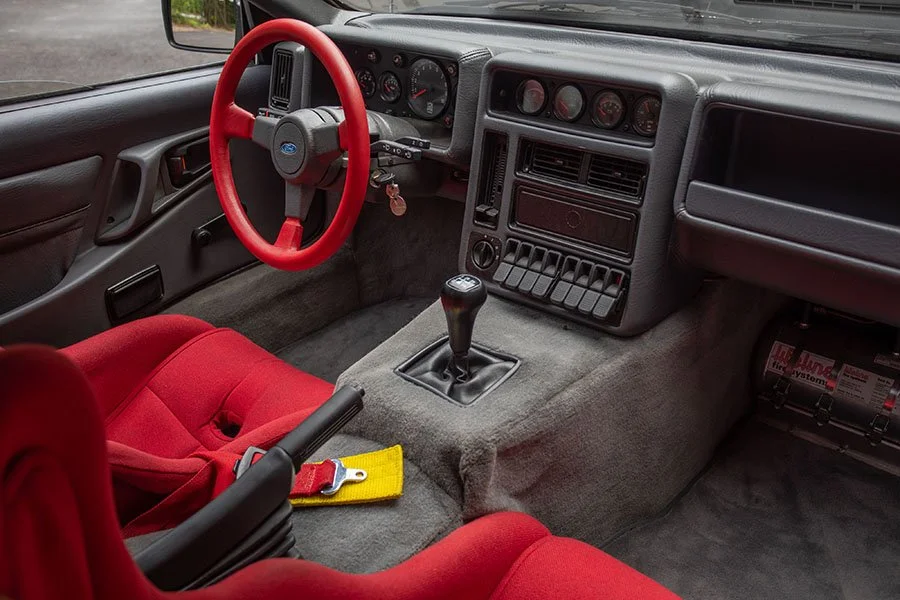
Located in the centre of the flat-top dash was a supplementary four-gauge binnacle with small read outs for turbo boost, battery voltage, fuel pressure and fuel level. Underneath this were the heating / ventilation controls, a blanked-off cavity for an audio system and a bank of flick switches.
In front of the passenger was an open-fronted glovebox.
Either side of the extremely wide transmission tunnel were single-piece Sparco bucket seats trimmed in either red or grey fabric.
Manual window winders were fitted as standard.
OPTIONS
Offered separately was a detachable rally light pod, a Motorsport stripe kit, split-rim three-piece wheels and ear-type Motorsport air scoops that flanked the roof-mounted intercooler duct.
WEIGHT / PERFORMANCE
As a consequence of its larger engine and strengthened drivetrain, the RS200 Evolution weighed in around 10kg more than a comparably equipped base RS200 (so circa 1190kg in road trim).
Depending upon gearing, 0-62mph could take as little as 3 seconds and run to 170mph.
PRODUCTION CHANGES
In May 1987 the RS200’s steering rack was modified to provide a tighter turning circle, the clutch was modified to permit smoother engagement at low revs from rest, sturdier fixings were added for the luggage box mounted under the front lid and a two-speaker radio / cassette player with roof-mounted aerial was made available.
In August 1987, Ford announced that all new and existing RS200s were to be updated with a braided hose between the oil filter and turbocharger housing.
From the beginning of 1988, Ford subsidiary Tickford took over preparation of the remaining unsold cars. At this point, all new examples were upgraded with electric and heated exterior mirrors.
New options offered on these Tickford-prepared cars included a larger version of the existing bucket seat with increased rake for the backrest, new Recaro comfort seats in velour or leather, deep pile carpet, door trim panels with storage pockets, central locking with an integrated alarm system, air-conditioning, a heated windscreen, a black leather Stig Blomqvist edition Momo steering wheel, an HD lamp wiring harness and an HD alternator.
PRODUCTION
In total, 24 of the existing 152 RS200s were converted to Evolution trim.
Of these, 21 were left-hand drive and three were right-hand drive.
Text copyright: Supercar Nostalgia
Photo copyright: Ford - https://www.ford.com & RM Sotheby’s - https://rmsothebys.com/