Guide: Special Brew - a Historical & Technical Appraisal of the Lotus Type 28 Ford Cortina
/
BACKGROUND
In 1962, the North American Automobile Manufacturers Association lifted its ban on US car builders having any motor sport involvement. Imposed during 1957 as a response to the 1955 Le Mans disaster, the ban had gone so far as to preclude assisting anyone involved in racing: even publicising the speed-related features of a model was outlawed.
Wanting to improve his company’s image, Henry Ford II quickly instigated the Blue Oval’s Total Performance programme which ultimately went on to incorporate practically every discipline of motor sport along with a new line of showroom models.
Over in the UK, the spring of 1962 saw Ford’s recently appointed head of UK public relations, Walter Hayes, organise a meeting with Lotus boss, Colin Chapman. Hayes had been tasked with instigating a five-year programme to promote Ford in motor sport and, with this in mind, a plan was devised to create a hot iteration of the forthcoming Cortina.
At the time, Lotus was fast becoming a force to be reckoned with in F1 and was known to have a 1.5-litre Ford-based twin cam engine in development that would power a range of road and racing cars.
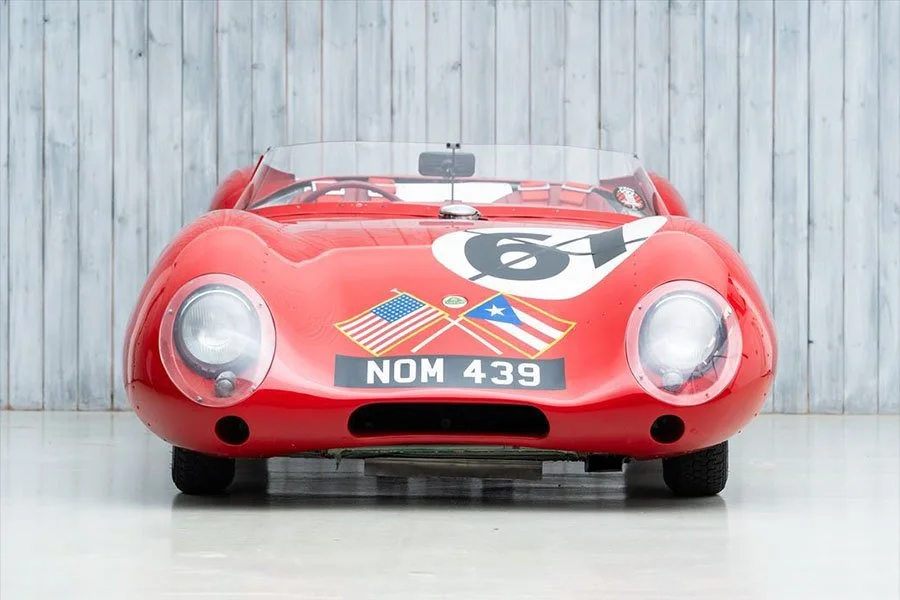
Said engine made its debut in the back of a Lotus 23 driven by Jim Clark at the Nurburgring 1000km race on May 27th 1962. Entered under the auspices of the Essex Racing Team (but with Lotus Development Director, Mike Costin, in charge of operations), the diminutive Lotus proved a sensation; against much bigger-engined works cars from Ferrari and Porsche, Clark took the lead on the first lap and stayed there until lap twelve when a broken exhaust caused him to be overcome with fumes.
Always keen to generate more revenue, Chapman agreed a deal with Hayes that would see Lotus create a modified version of the Cortina to serve as a high performance range-topping flagship. It would also be built in sufficient numbers to qualify for the Group 2 class of motor sport which had a minimum 1000 car production requirement within a twelve month period.
The arrangement would see specially modified, painted and partially trimmed Cortina bodyshells that had been assembled on a separate production line at the Ford plant in Dagenham trucked to the newly extended Lotus factory in Cheshunt.
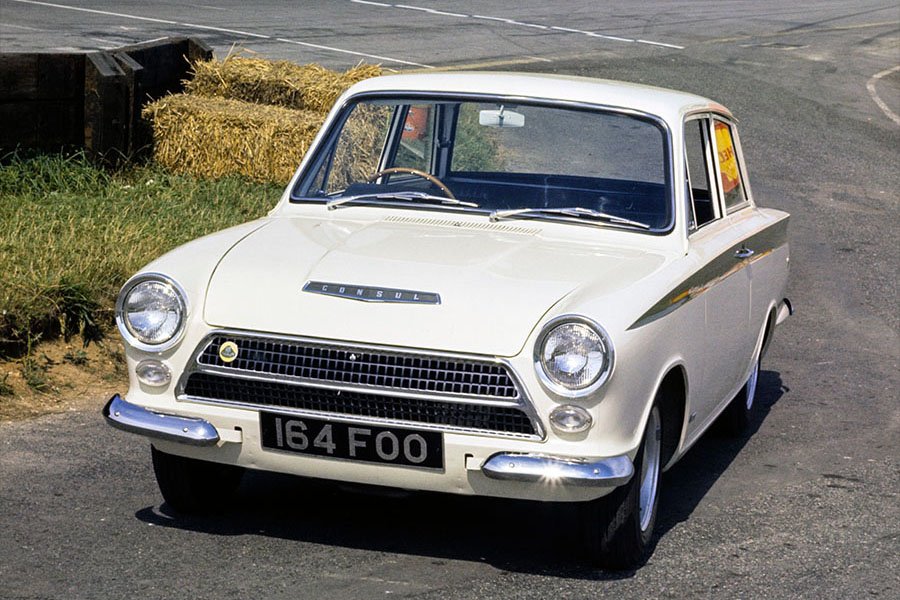
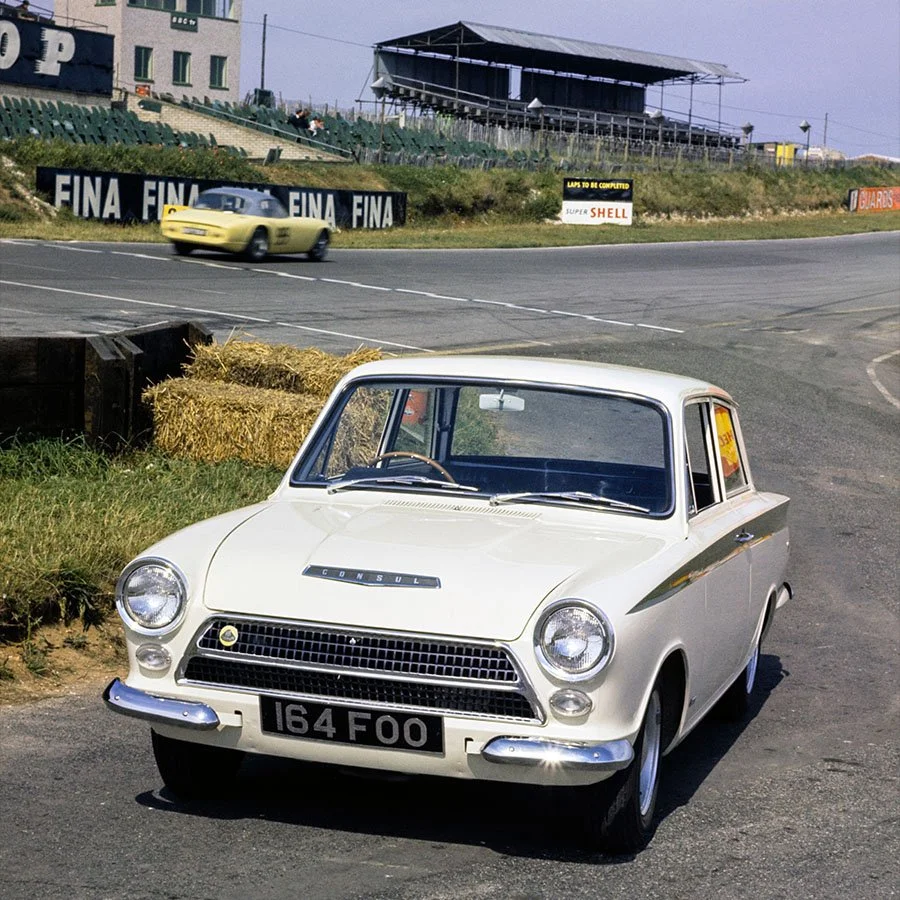
Lotus then handled final assembly of these partially assembled Ermine White bodyshells, adding many of the car’s special components along with the trademark Sherwood Green stripes. Sales and marketing would be handled by Ford.
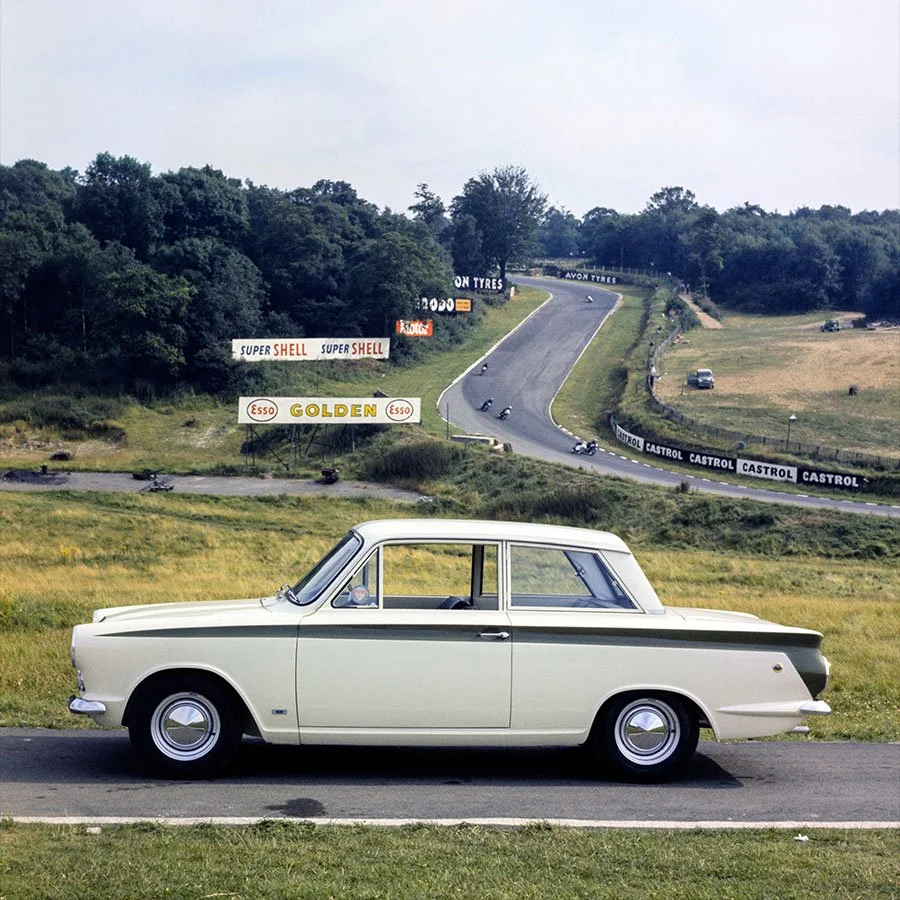
The first mule (a 1200 Deluxe) was delivered to Lotus in August 1962, a few weeks before the standard Cortina made its debut at October’s London Motor Show.
The Type 28 Lotus Cortina (initially marketed by Ford as the Consul Cortina developed by Lotus) was unveiled at a press conference held in Monte Carlo during January 1963 and then publicly displayed at the London Racing Car Show a few days later.
Production officially began in February 1963. After a slow start, the manufacturing process was fully up to speed by the middle of the year and Group 2 homologation was approved on September 5th.
CHASSIS
In the interest of lightness, stiffness and so as to be able to incorporate a host of new components, Ford’s standard Type 74 two-door monocoque bodyshell was much-modified in the transition to Lotus Cortina trim.
Heavy duty double-skinned tubular King Posts were added on both sides of the trunk between the top of the rear wheel hub and the original rear leaf spring mounting points. An additional tube was also added between the top of the sill behind the B-pillar.
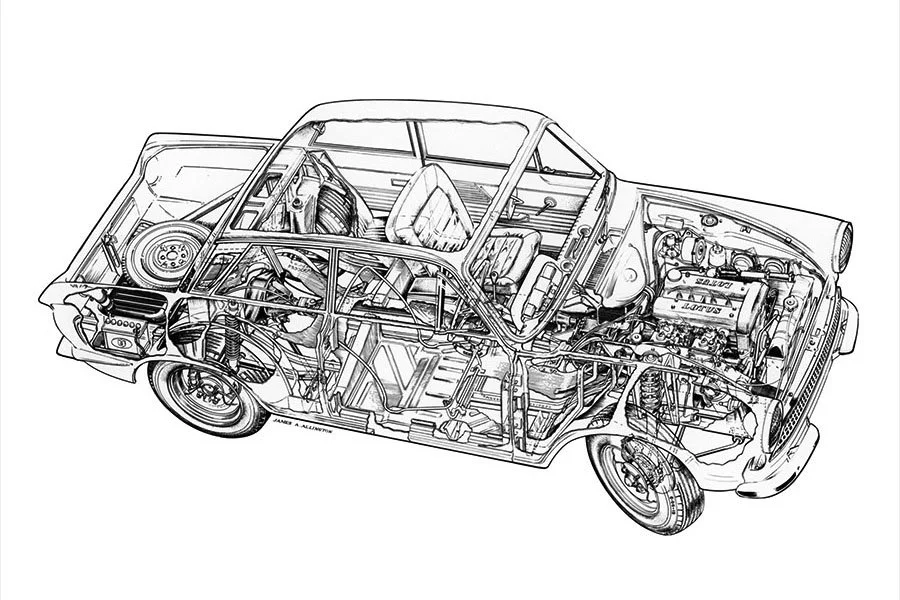
In order to clear the differential (necessary owing to the lower rear suspension configuration) a custom panel was added to the fore section of the trunk floor. There were also modified saddle panels on the chassis rails over the back axle to enable extra movement.
To optimise weight distribution, the battery was moved from the engine bay to the trunk.
The spare wheel (which would no longer have fitted in its normal location in the nearside trunk wheel well owing to the aforementioned King Posts) was now stowed flat on the trunk floor. For the same reason, the normal trunk lid support springs were removed and replaced with a sliding captive support mechanism imported from the Anglia.
There were also changes to enable the installation of a revised suspension layout.
Lotus redesigned the front suspension by using a shortened spring and MacPherson strut unit with beefier damping properties plus slightly longer forged as opposed to pressed track control arms and a thicker, longer anti-roll bar.
More radical changes were made at the rear where the standard leaf spring arrangement was replaced with vertical coil-over shock absorbers. To accommodate such a feature, the original axle was modified with a Lotus Seven-derived A frame bracket beneath trailing radius arms and a Watts linkage.

There was also an uprated now servo-assisted Girling brake system with 9-inch (240mm) front discs and 9-inch rear drums at the rear. A similar system was used by the lesser Cortina GT, but without a servo, which was fitted into the Lotus version’s engine bay.
Steel wheels with polished aluminium hub caps measured 5.5 x 13-inches all round and were shod with 6 x 13-inch tyres.
Steering was made more responsive as a consequence of shorter steering arms and a new higher geared steering box.
A 36.3-litre fuel tank imported from the standard Cortina was mounted over the rear axle.
ENGINE / TRANSMISSION
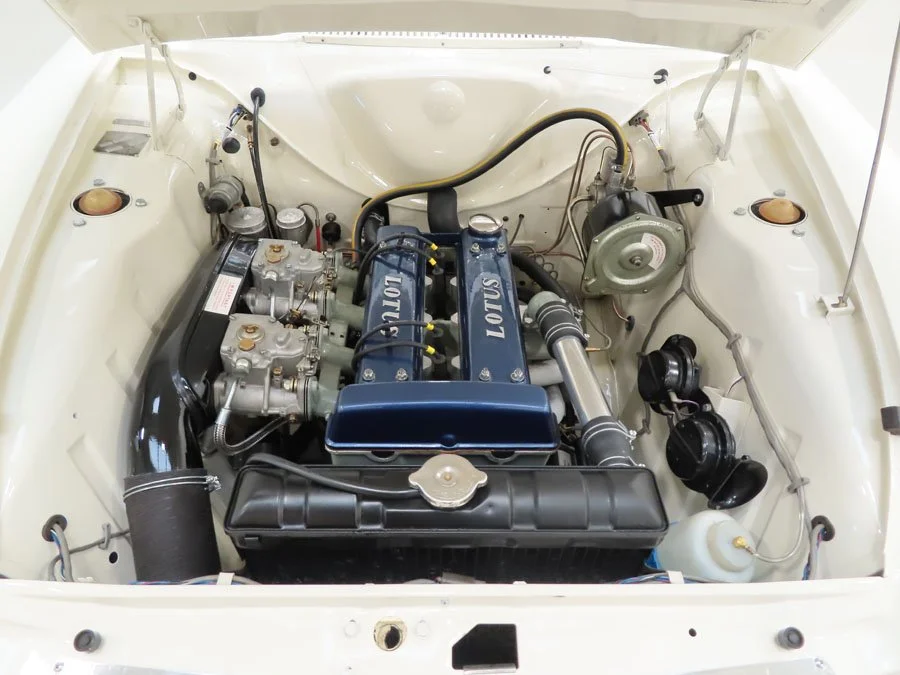
In the engine bay was the same 1.6-litre Lotus Ford twin cam inline four cylinder engine as fitted to the Elan. For the Lotus Cortina, a larger capacity radiator was used and cold air was delivered to the carburettors via a nose-mounted air cleaner.
These cracking little motors comprised a four cylinder Ford 116E five bearing block enhanced by Lotus with an aluminium dual overhead camshaft head. The cylinder heads and production engines were initially assembled in Tottenham by JA Prestwich (JAP).
Most of JAP’s shares were owned by the Villiers Engineering Company and, later in 1963, production moved north to Wolverhampton.
Displacement was 1558cc thanks to a bore and stroke of 82.57mm and 72.75mm respectively.
With a 9.5:1 compression ratio and a pair of twin-choke Weber 40 DCOE sidedraught carburettors, peak output came in at 105bhp at 5500rpm and 108lb-ft at 4000rpm.
The engine was mated to the same close-ratio four-speed Ford gearbox as the Elan, but now came with a larger diameter clutch and a single piece propshaft with swaged ends to accommodate standard production universal joints.
As per the Elan, the gearbox and nose section of the differential were housed in special lightweight aluminium casings.
BODYWORK
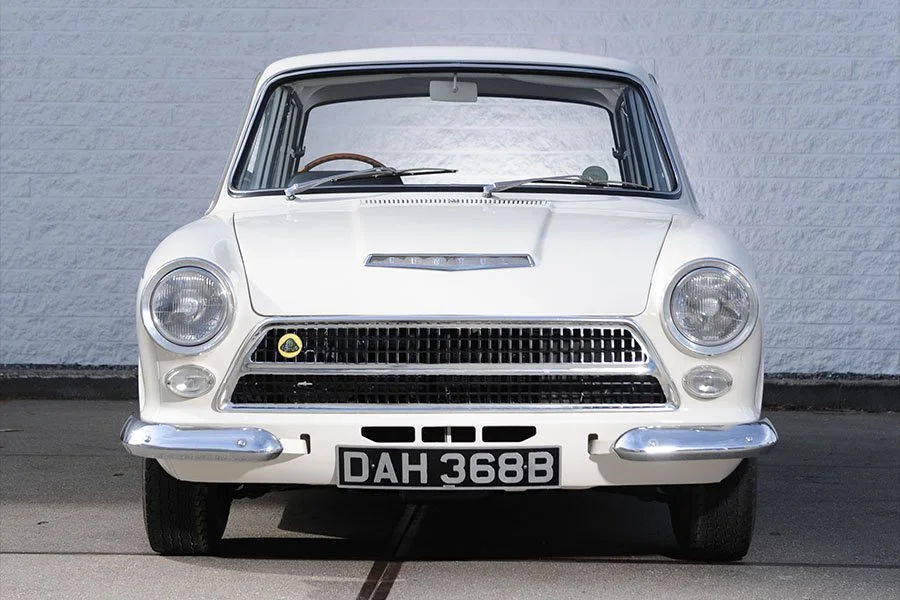
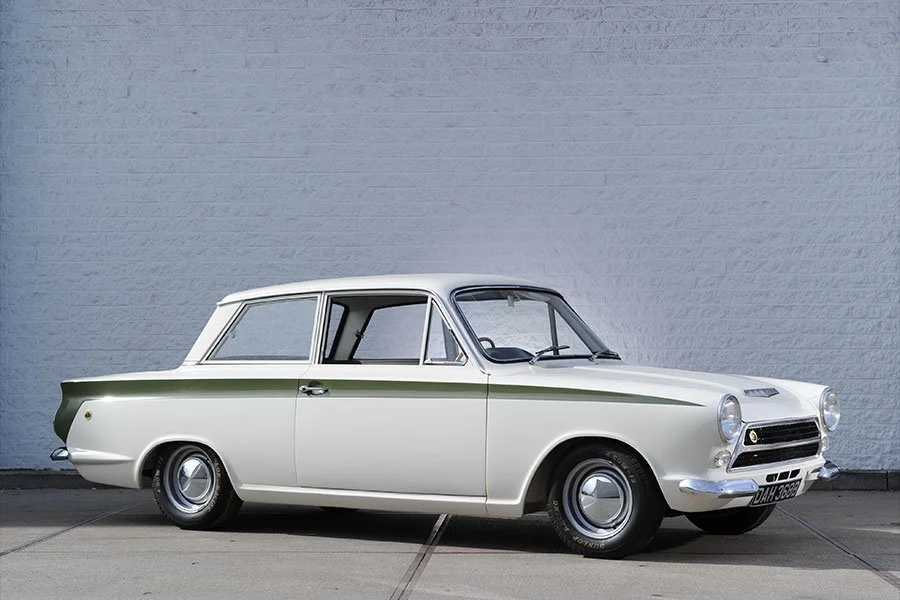
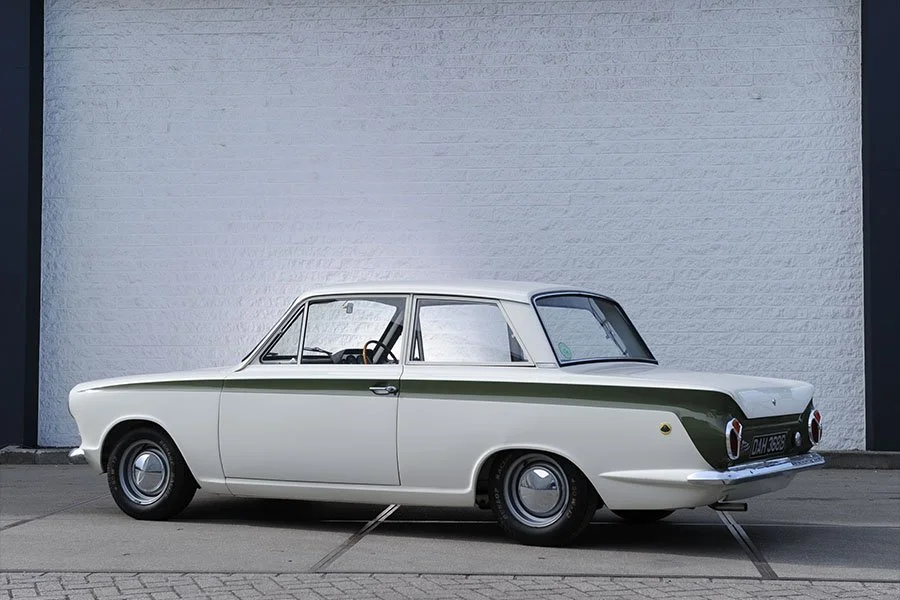
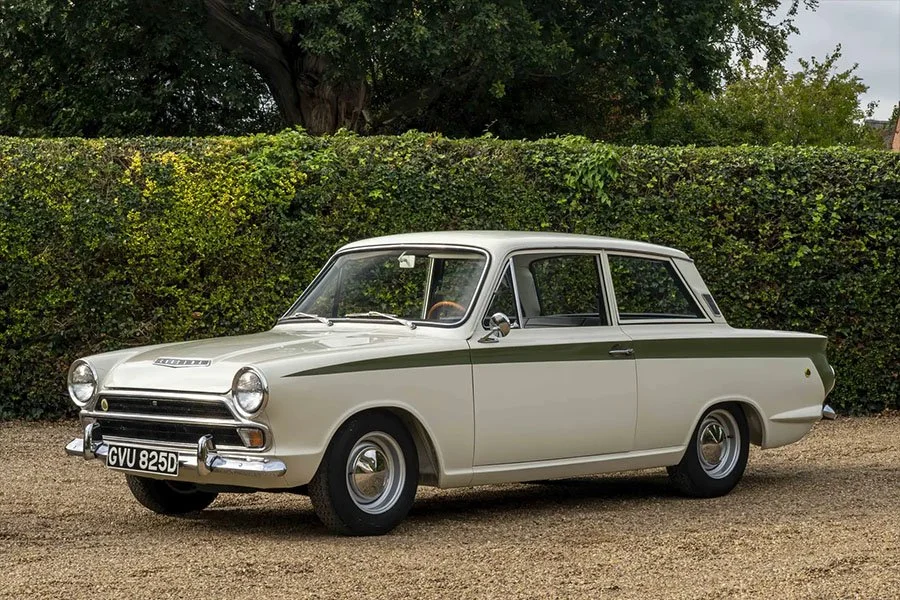
Externally, in addition to wider wheels and tyres, a small number of tell-tale cues differentiated the Lotus Cortina from its lesser siblings.
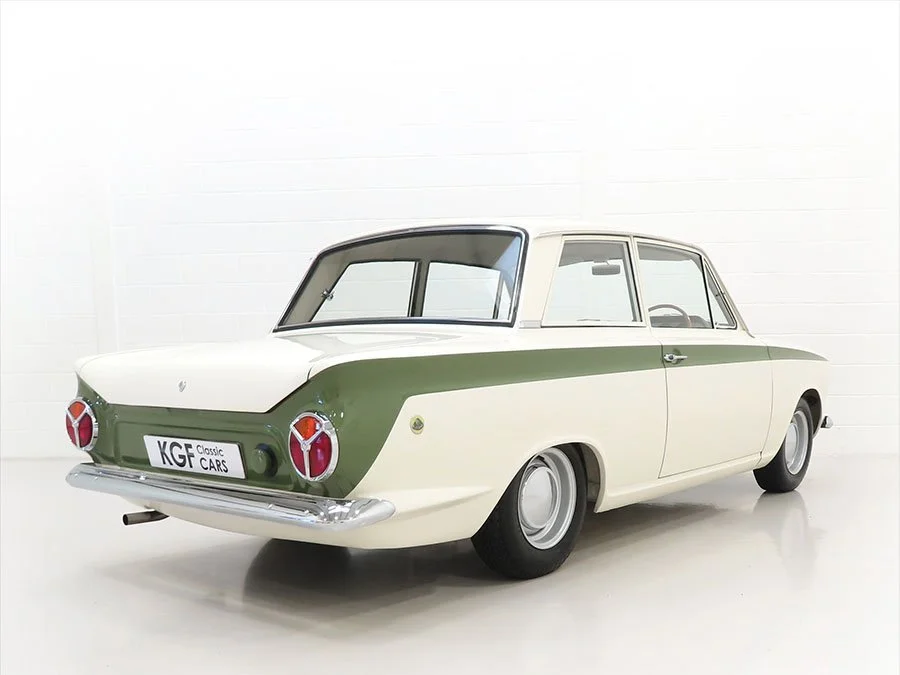
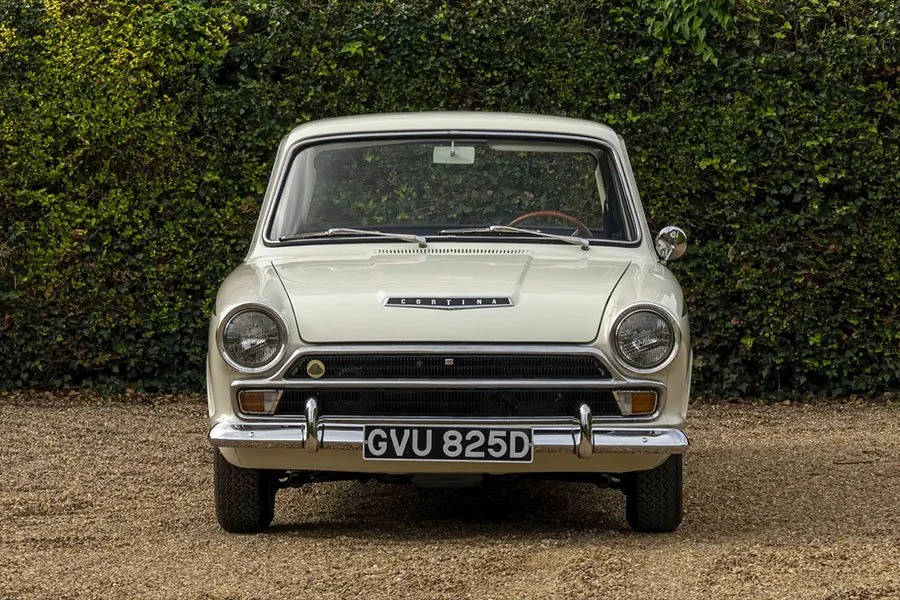
Instead of a full width front bumper, quarter bumpers were installed (sourced from the Anglia van).
Lotus badges were added to the front grille and on each rear fender.
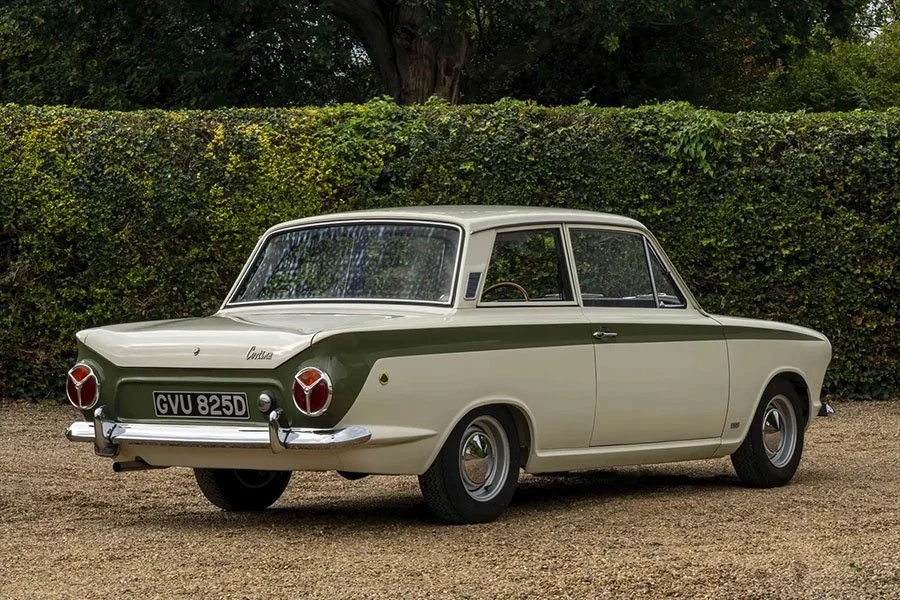
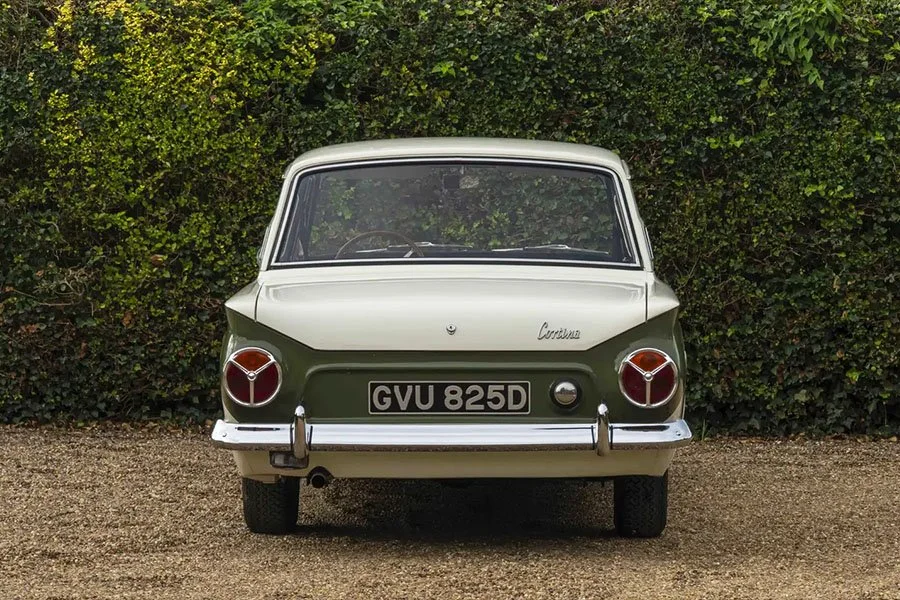
Graduated Sherwood Green stripes were painted along each flank and linked by a matching tail fascia inlay.
To reduce weight, the hood, trunk lid and doors were fashioned from aluminium instead of the usual steel.
Customers were officially only offered one colour scheme: Ermine White with Sherwood Green stripes. However, a small number of special order cars did emerge in green and red (the latter of which were mostly destined for works use). In addition, a solitary gold example was created for the Terry’s chocolate company and at least one car was dispatched with blue instead of green stripes.
INTERIOR
Inside, the Lotus Cortina came with a host of parts unique to this range-topping special.
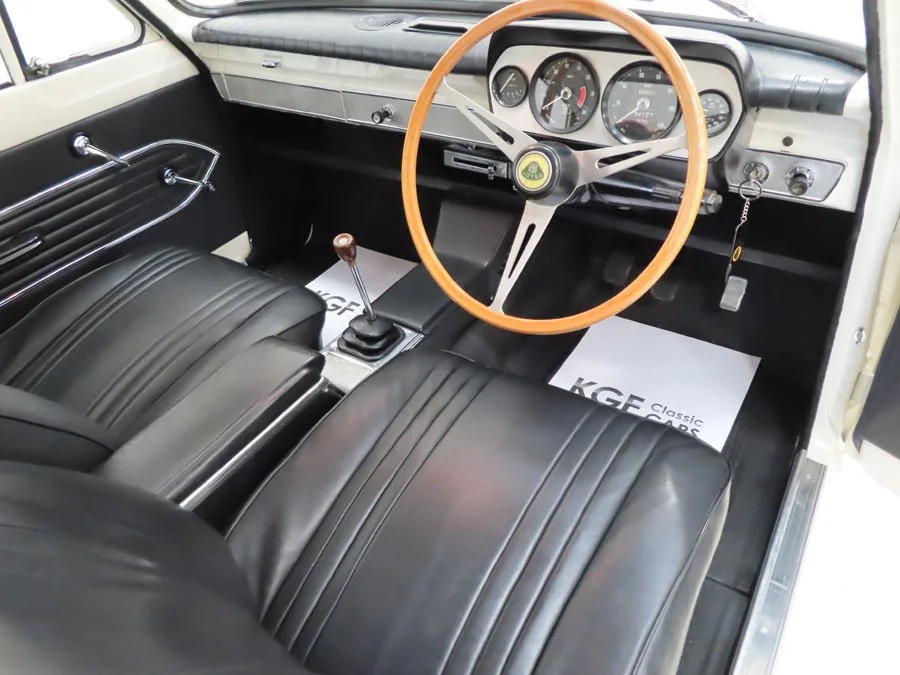
To better hold the driver and passenger in place, more heavily bolstered front seats were installed.
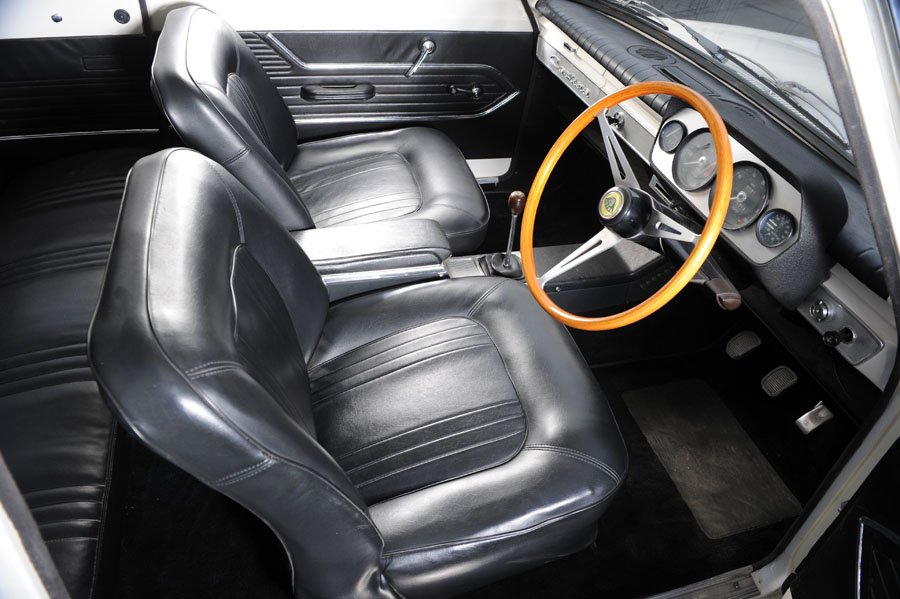
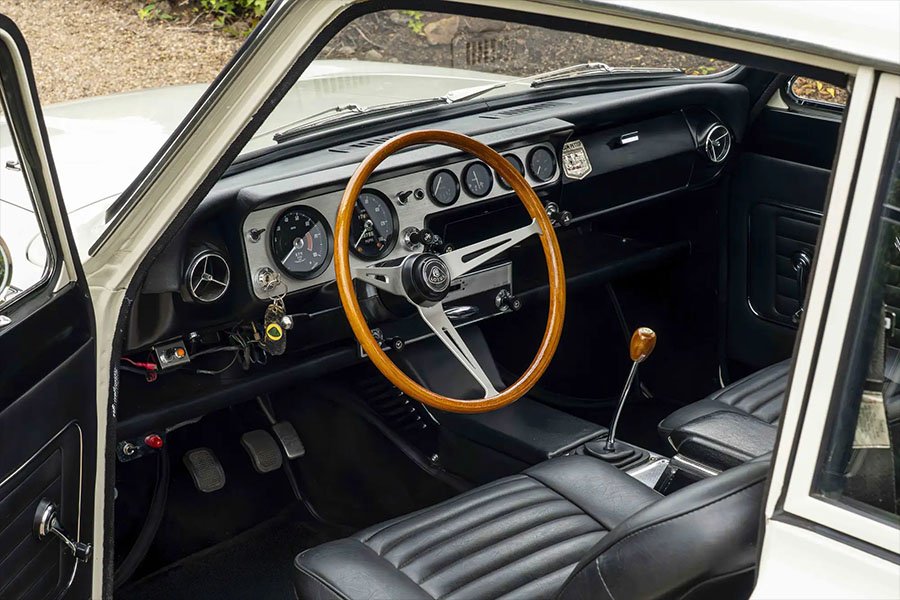
A wood-rimmed Springall steering wheel with Y-shaped polished aluminium spokes was mounted on a shortened steering column and came with a Lotus-branded horn push. There was also a matching Lotus-branded wooden gear knob.
Behind the steering wheel was a custom four-gauge binnacle that housed a large 140mph speedometer and 8000rpm rev counter. Outboard of these were two smaller instruments for fuel and oil pressure / water temperature.
Located between the seats was a model specific centre console which included an armrest with integral storage box.
Black leatherette vinyl was used used for the dash top, seats, door trim panels and rear sidewalls. Dunlop rubber mats were fitted instead of carpet and un-timmed sections of the cockpit were finished in Ermine White metal to match the exterior.
OPTIONS
Once Group 2 homologation had been approved, a Production Racing Conversion was introduced as an option. These cars (covered in detail separately) came with a 140bhp Cosworth Mark S-15 engine, various brake, suspension and tyre upgrades, lightweight Plexiglas side and rear windows and a limited-slip differential.
WEIGHT / PERFORMANCE
Despite its beefed-up bodyshell, the Lotus Cortina’s various weight-saving measures meant it weighed in at the same 825kg as the two-door Cortina GT.
Top speed went from 95mph to 109mph while the 0-62mph time dropped from 13.9 seconds to 10.1 seconds.
EARLY PRODUCTION CHANGES
Lots of alterations were made to the Lotus Cortina’s specification during its production run.
In March 1963 minor changes were made to the seat trim.
July 1963 saw modified axle housings adopted.
During October 1963, the tail light housings were updated to a less pointed style and the metal around the fuel filler tube was switched to a swaged as opposed to flat type. Inside, a new steering wheel came without fixing studs and now featured a central horn push. The horn had originally been operated via a control stalk which now activated the headlight flasher. There were also a couple of minor switchgear and instrumentation changes.
Very soon afterwards, Lotus switched the Weber carburettors from the 40 DCOE 2 type to new 40 DCOE 18 units.
In January 1964, Ford and Lotus introduced a Special Equipment package that could be ordered on new cars and retro-fitted by Lotus to already existing examples.
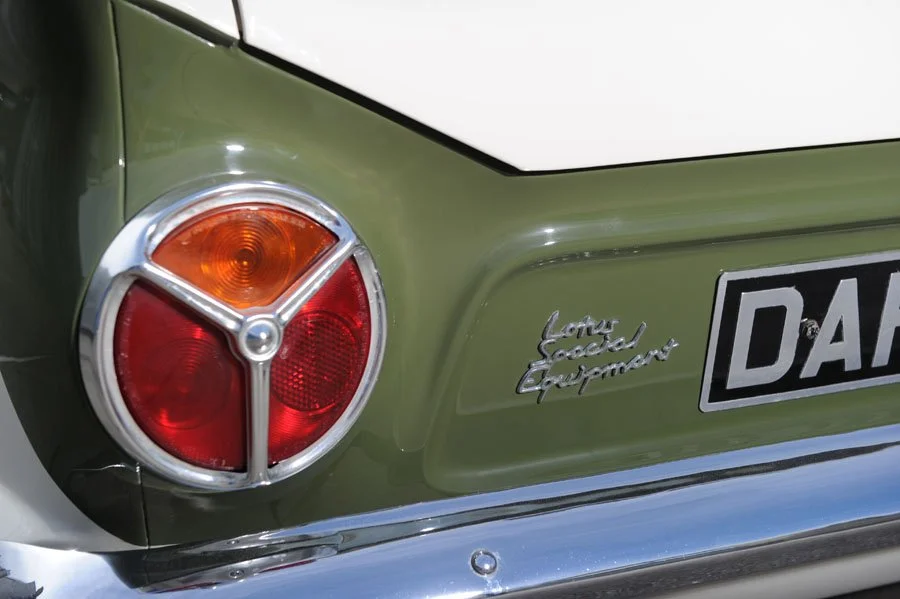
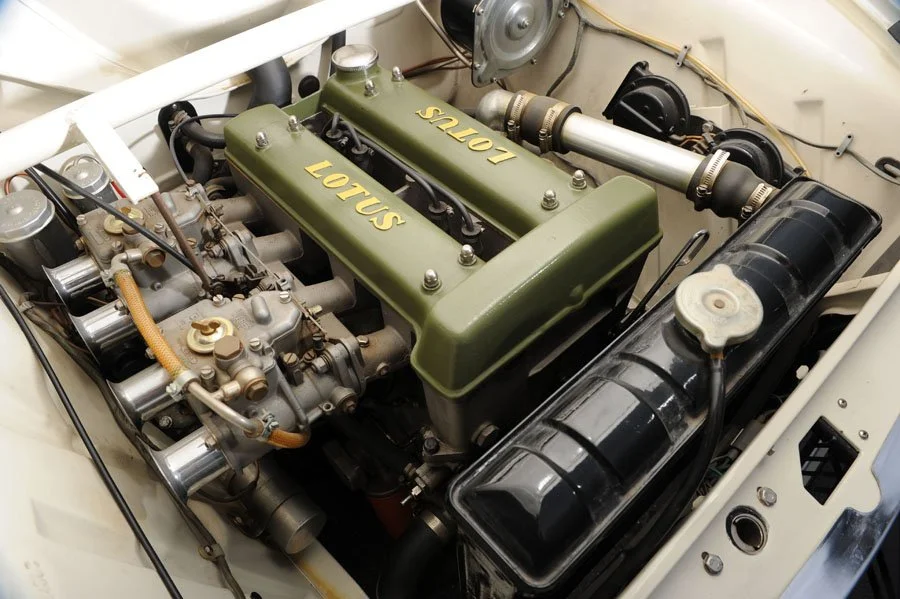
The Special Equipment kit comprised a 115bhp engine with an uprated C-type camshaft, re-jetted carbs with 32mm chokes, modified distributor settings, a free-flow exhaust system and green instead of the normal blue cam covers. Also included were adjustable Armstrong rear dampers with uprated springs, radial Dunlop SP or Pirelli Cinturato tyres, anti-lift windscreen wipers, a Special Equipment badge for the tail fascia and Irvin three-point safety belts.
A high compression ported head was offered at extra cost.
In March 1964, Ford began to fit a new gear knob, two instead of three-piece rubber floor mats and a new non-adjustable cover for the brake servo.
From June 1964, the aluminium opening panels, aluminium gearbox casing and aluminium differential cover became optional extras as standard steel parts were phased in.
The following month (July ‘64) a two-piece propshaft replaced the original single-piece item and the gear lever was switched to an angled instead of straight design.
SERIES 2
August 1964 saw the entire Cortina range given a face-lift.
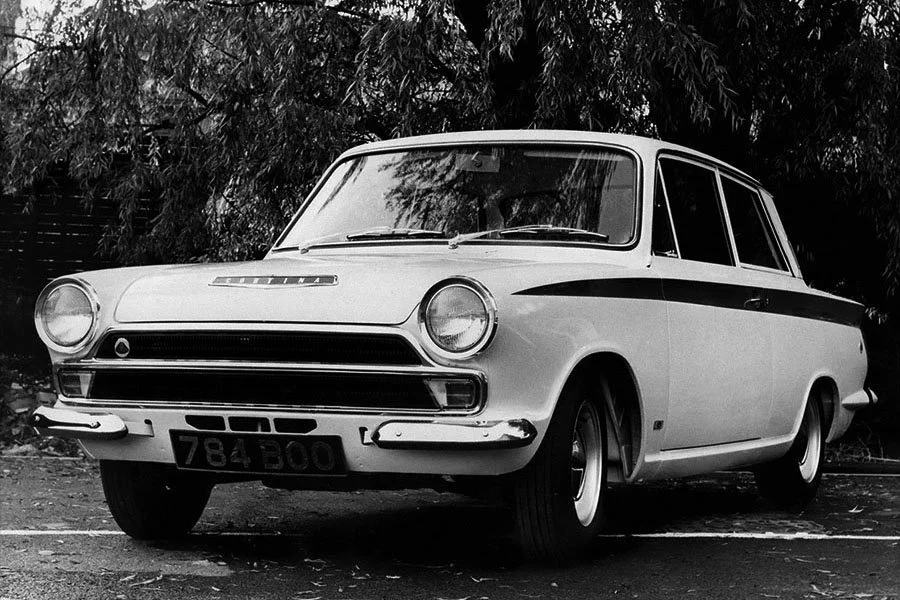
Most noticeably, the original front grille was changed for a larger full width design that now housed amber instead of clear indicators at each end. Vents were also added to the C-pillars.
Inside, Ford introduced a completely new dash assembly and centre console. The original four gauge binnacle directly behind the steering wheel was switched for a two-gauge item that now just housed the rev counter and speedometer. Additional (smaller) read outs for fuel, electrical charge, water temperature and oil pressure were housed on an adjoining fascia.
Fresh air blowers were added at either end of dash and several of the driver controls were updated. The horn reverted to a control stalk which also flashed the headlights and activated the indicators (as per standard Cortinas).
A new deep dish steering wheel was fitted along with a dummy black and silver horn push (instead of the original yellow and green version).
Other interior updates included satin black instead of body coloured metalwork, carpet instead of rubber floor mats, fixed rear side windows and new horizontally ribbed seat inlays.
The only mechanical change was a lighter diaphragm clutch.
Opening quarterlights became an option on home market cars but were standard for export models.
Special Equipment versions now came with a leather covered steering wheel rim.
SUBSEQUENT PRODUCTION CHANGES
During November 1964, the original close-ratio gearbox was switched for an interim unit that used the second gear ratio from the Cortina GT.
The following month (December ‘64) a standard Cortina GT steering ratio was adopted.
Early in 1965, the original light blue cam covers were switched to a darker blue.
April 1965 saw a new ‘Lodestar’ headliner fitted instead of the original ‘Confetti’ type and the clip-on servo cover was replaced with a new plastic cover.
In June 1965, enamel Lotus badges replaced the original painted type and a commemorative shield to celebrate Jim Clark’s Indy 500 victory was added to the dash. A new exhaust manifold and silencer were fitted along with a redesigned engine breather tube.
SERIES 3 / SERIES 4
Between June and October of 1965, the transition from Lotus 7-derived A frame to leaf spring rear suspension occurred.

The leaf spring configuration was broadly to Cortina GT specification albeit with Lotus-specific five-leaf ‘reverse eye’ springs. In light of this switch, the heavy duty double-skinned tubular King Posts originally added on both sides of the trunk between the top of the rear wheel hub and the original rear leaf spring mounting points were deleted. A shorter propshaft was also installed.
So that a left-hand drive version could be offered (dubbed Series 4 while right-hand drive iterations were dubbed Series 3), all bodyshells now came with a repositioned brake servo (moved from the front bulkhead to the inner front fender) plus horns located behind the grille.
Production of left-hand drive examples began in August 1965.
All cars destined for the North American market came with the Special Equipment package as standard along with a pre-engaged starter and some minor switchgear, lighting and badge changes.
POLICE VERSION
After a mock up based on one of the original launch cars (12 PAR) was dressed up in police trim to gain some cheap publicity, starting in June 1965 eight Lotus Cortinas were delivered to the West Sussex Constabulary as alternatives to their black 2.4-litre Mk2 Jaguars soon due for retirement.
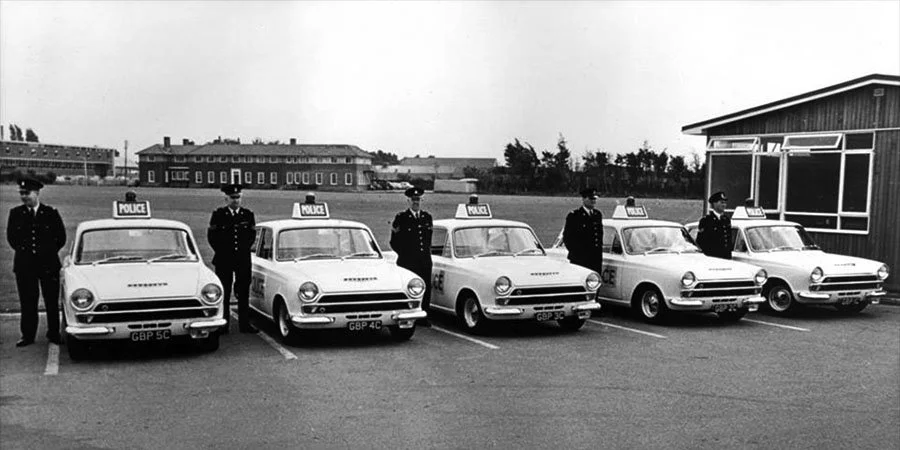
The eight cars (sequentially registered GBP 1C to 9C but omitting 6C) were finished in plain Ermine White and uprated with a host of special parts to include Police script down each flank, roof lights, sirens, a stop sign, a CB radio with additional aerial and loud speaker, a passenger rear view mirror, a map reading light, a fire extinguisher and a transposed speedometer and rev counter that enabled the accompanying officer to clock the speed of a vehicle being pursued.
In order to cope with the additional electrical equipment, an alternator was fitted instead of a dynamo.
FINAL PRODUCTION CHANGES
During October 1965, the close-ratio gearbox was replaced with a standard item from the Cortina 2000 E.
The front brake calipers were relocated to ahead of the discs for superior cooling and self-adjusting rear drums were fitted.
Inside, front seats from the Cortina GT were installed along with some other trim from that particular variant.
Externally, an oval Ford badge replaced the rectangular item originally fitted to the front fender.
Some cars bound for North America now came with a standard full-width front bumper.
CONVERTIBLE VERSION
One Lotus Cortina (a Series 1) was converted by Crayford Engineering of Westerham to Convertible trim.
In a similar fashion to its normal Cortina conversions, the bodyshell was suitably reinforced to compensate for the roof’s removal.
END OF PRODUCTION
Production of the Mk1 Lotus Cortina ended in September 1966.
Figures from Ford suggest that 2894 examples were built.
Meanwhile, Lotus claimed the total to have been 3304 units.
The reality is that Ford had much better record keeping procedures than Lotus who may have been keen to fudge the numbers in order to get the car homologated as quickly as possible.
A Ford-built and developed Lotus Cortina Mk2 was subsequently launched in March 1967.
Text copyright: Supercar Nostalgia
Photo copyright: Ford - https://www.ford.com, KGF Classic Cars - https://www.kgfclassiccars.co.uk/, Bonhams - https://cars.bonhams.com/ & Iconic Auctioneers - https://www.iconicauctioneers.com/