Transition Vision - a Historical & Technical Appraisal of the Alfa Romeo Tipo 33 Stradale Pininfarina P33 Roadster
/
BACKGROUND
Within a few months of the Tipo 33 Stradale’s September 1967 launch, Alfa Romeo knew its handsome new model was not going to hit the 50-car production requirement for homologation into the FIA’s Group 4 Sport category.
However, although the number of completed 33 Stradales was lagging well behind schedule, Alfa Romeo had quickly ended up with a surplus of expensively produced rolling chassis, the options for which were limited.
While some manufacturers would have stripped said chassis of any useful mechanical components or simply pushed the incomplete cars into some dusty factory corner, Alfa Romeo went down another route and commissioned a series of show-stopping design concepts from some of Italy’s top coachbuilders.
First to arrive was the Bertone Carabo built on chassis 109 that debuted at the 1968 Paris Motor Show which took place from October 3rd to the 13th. Kitted out as a metallic green wedge, the Carabo came to be regarded as a seminal piece of automotive design as it spearheaded the switch from soft curves to straight lines.
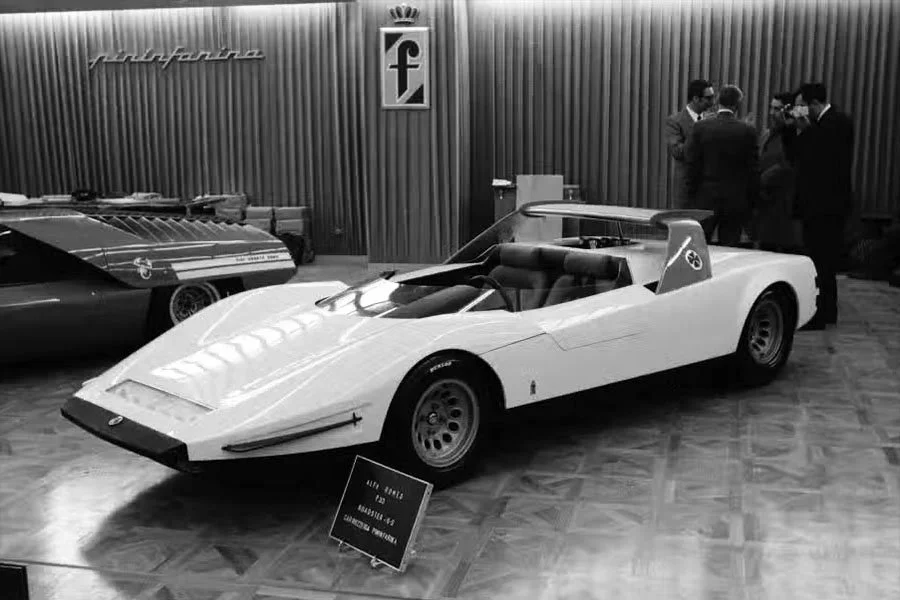
Less than three weeks later, another of Alfa Romeo’s long term partners, Pininfarina, took the wraps off their own Tipo 33 Stradale Speciale: the P33 Roadster.
Built on chassis 108 (delivered to Pininfarina in the spring of 1968), the P33 Roadster made its international motor show debut at Turin between October 30th and November 10th.
BODYWORK
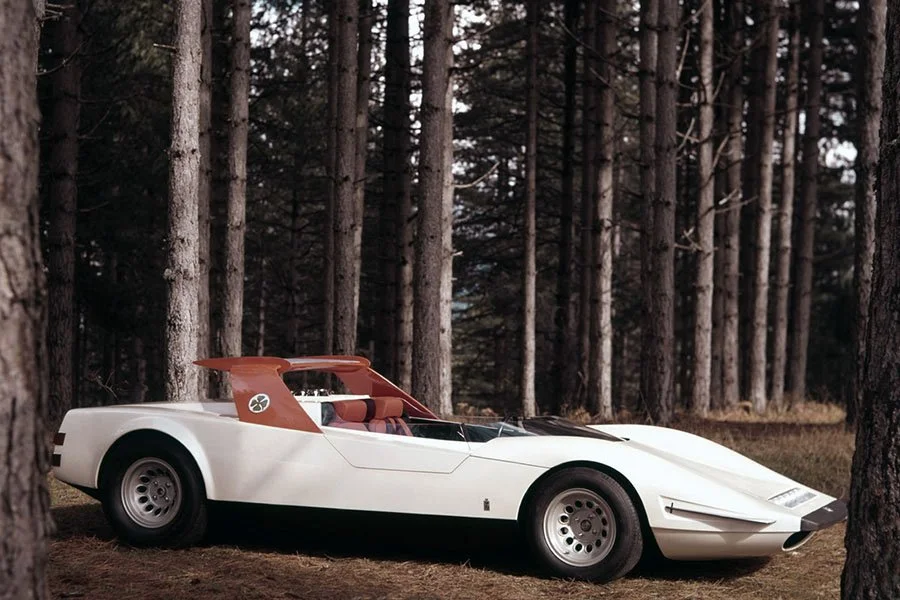
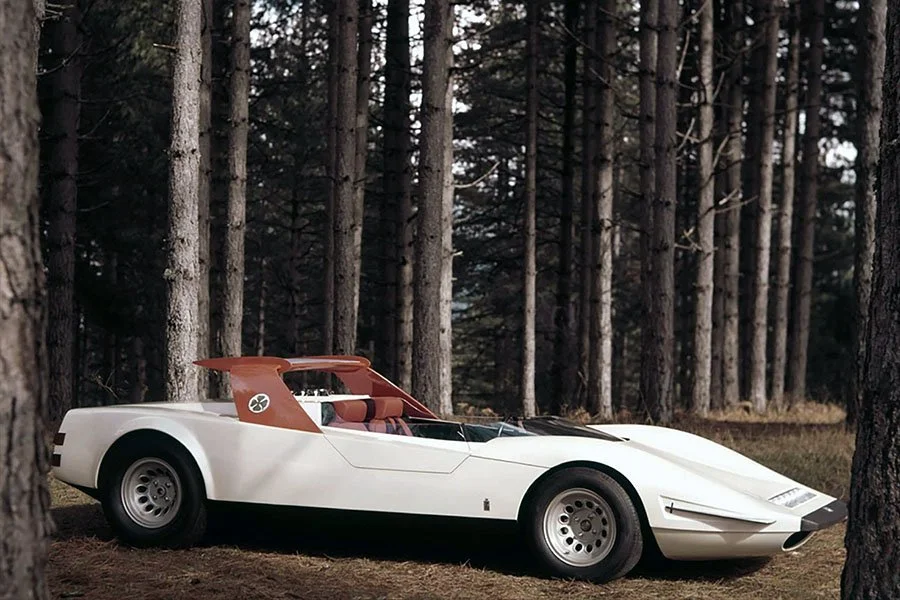
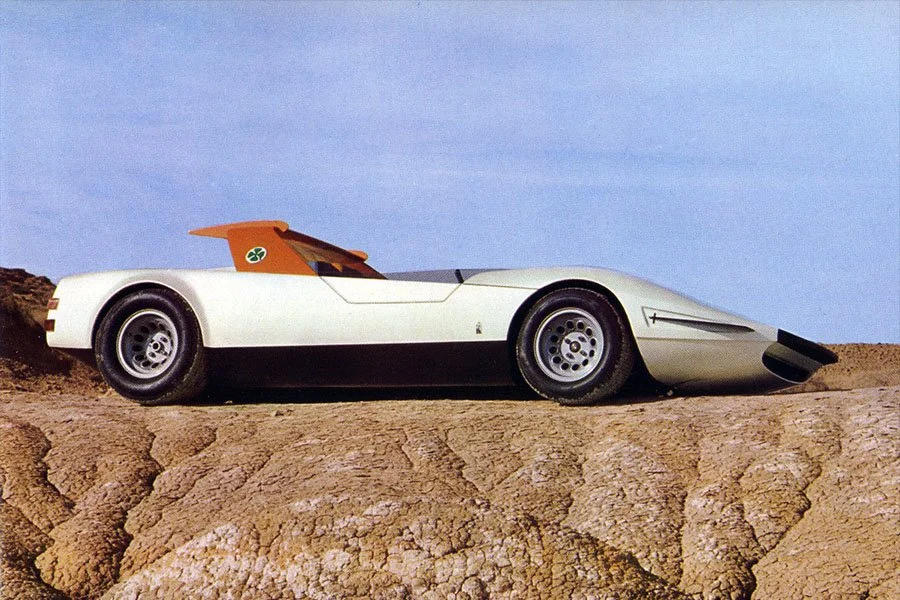
Designed by Paolo Martin, the P33 Roadster emerged as a transitional soft wedge that successfully mixed flat surfaces with complex curves.
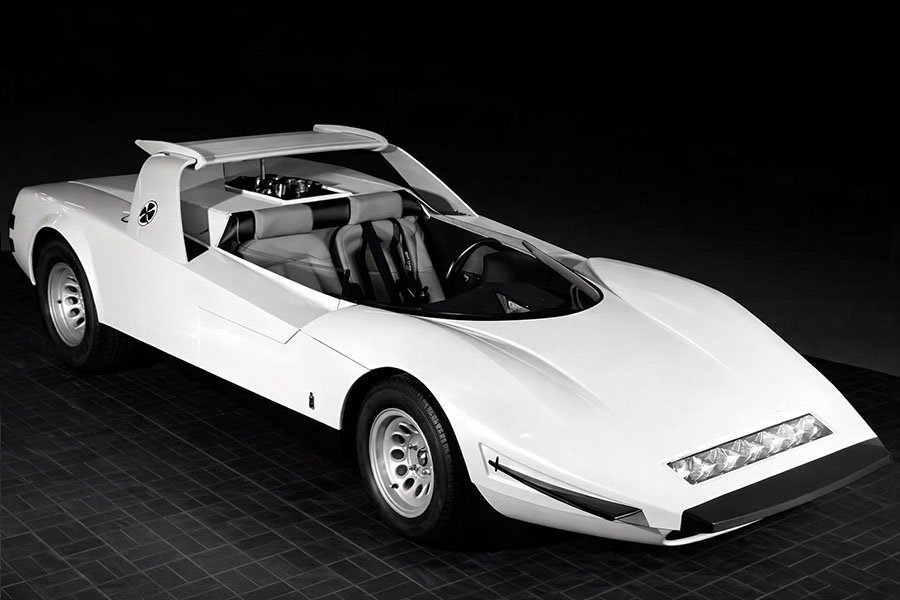
At the leading edge, a black rubber bumper located above a shallow full width intake would have appealed to road safety campaigners - but the enormous downforce-inducing adjustable canards mounted at each corner less so.
Like several Pininfarina show cars of the era, the half dozen headlights were centrally mounted under an etched perspex cover.
Further back, the P33 Roadster featured a wraparound Speedster-esque windscreen flanked by a tiny pair of butterfly doors. Down each flank, satin black sills lent a slender profile and matched a similar treatment applied at the rear.
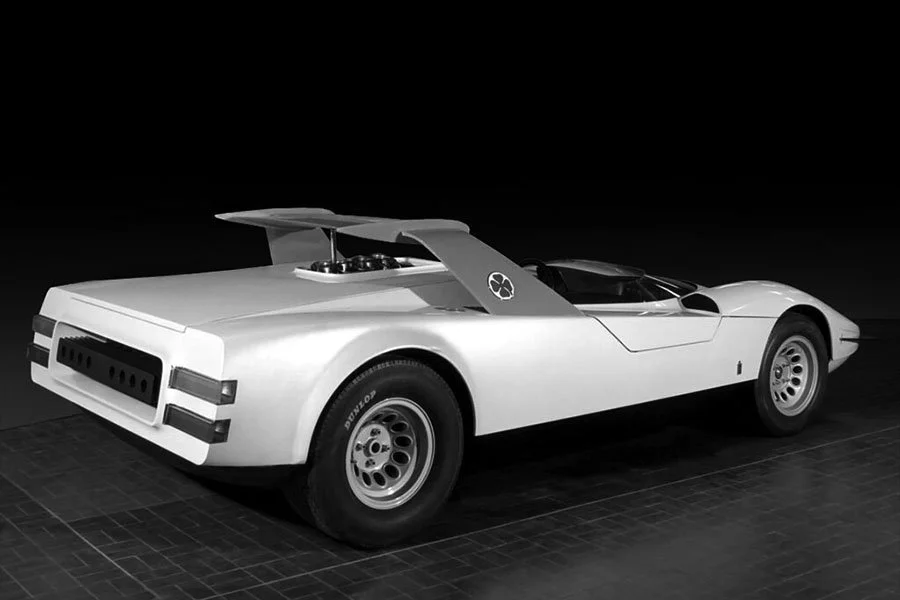
Mounted amidships was the car’s most dramatic feature: an enormous orange basket-handle roll bar with integrated hydraulically-activated spoiler located directly above the partially exposed two-litre V8 engine. Trademark four-leaf clover emblems were added to the side member pylons along with Pininfarina badges on each front fender and an Alfa Romeo badge on the bumper.
Pininfarina kept the rear deck as flat as possible to merge neatly with the boxy truncated tail. Housed within a rectangular cavity on the rear fascia was an elaborate eight-outlet exhaust system encased within a satin black shroud.
INTERIOR
Inside, the two single-piece bucket seats were upholstered in orange fabric.
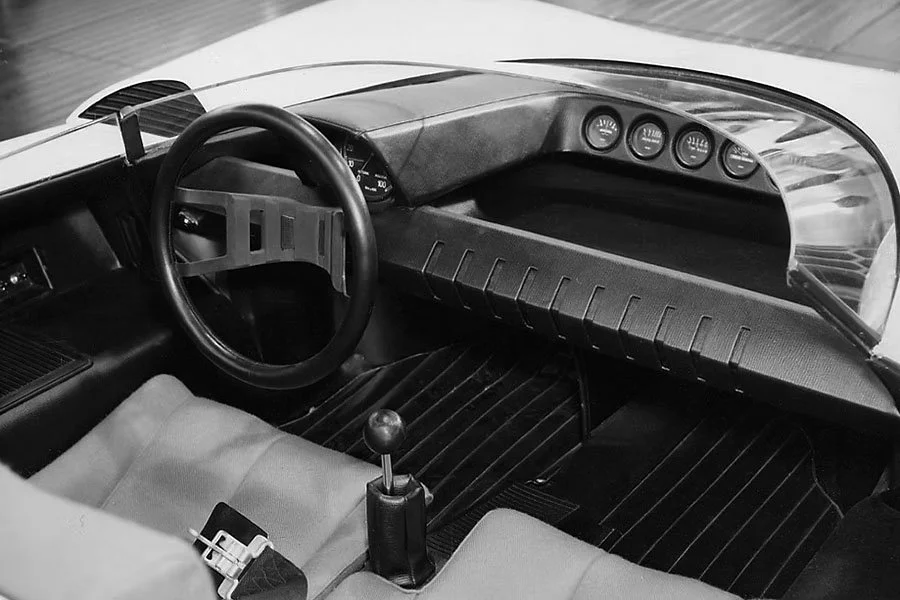
Directly behind the space age four-spoke steering wheel was a 10,000rpm tachometer housed in its own projecting binnacle. Supplementary gauges were located far away and off to the right at the leading edge of the windscreen.
Fluted rubber mats were used instead of carpet as there was no roof of any kind.
Most of the remaining interior surfaces were painted satin black.
CHASSIS
Mechanically the P33 Roadster was based on a standard Tipo 33 Stradale which itself was derived from the big tubed perimeter chassis of the 1967 Tipo 33 racing car. The competition spaceframe comprised two light-alloy side members that doubled up as fuel tanks with front and rear subframes to carry the suspension, engine, gearbox and differential.
Suspension was via wishbones, helical springs and anti-roll bars with radius rods additionally installed at the back. Fully adjustable telescopic dampers were fitted all round along with ventilated disc brakes (mounted inboard at the rear).
13-inch diameter magnesium wheels measured 10-inches wide at the front and 12-inches wide at the back. They were originally shod with Dunlop tyres.
ENGINE / TRANSMISSION
Alfa’s compact and lightweight all-alloy 90° V8 was a highly specialised piece of kit. It featured two chain driven overhead camshafts per bank, four ignition coils, dry-sump lubrication SPICA fuel-injection and twin plug ignition. A capacity of 1995cc was achieved thanks to a bore and stroke of 78mm and 52.2mm respectively.
The compression ratio was 10.0:1 which gave a peak output of 230bhp at 8800rpm.
Transmission was via a five-speed Colotti gearbox with a ZF limited-slip differential and single-plate hydraulic clutch.
CONVERSION TO P33 SPIDER SPECIALE CUNEO
After its show career was over, Pininfarina removed the P33 Roadster’s bodywork and fitted a new design to chassis 108.
The resultant P33 Spider Speciale Cuneo was displayed at the Brussels Motor Show in January 1971.
Text copyright: Supercar Nostalgia
Photo copyright: Alfa Romeo - https://www.alfaromeo.com