Guide: Milanese Mist - a Historical & Technical Appraisal of the Alfa Romeo Scighera Ital Design
/
BACKGROUND
At the 1997 Geneva Motor Show, Ital Design unveiled a fully operational concept in conjunction with Alfa Romeo. Dubbed Scighera after a Milanese mist, this latest high end sports car creation from the studio of Giorgetto Giugiaro was the latest in a series of recent supercar prototypes produced for the likes of BMW, Bugatti and Lamborghini.
The first of these nineties’ classics was the ID 90 that broke cover at the Turin Motor Show in April 1990 and which was Ital Design’s proposal for Bugatti’s new all-wheel drive quad turbocharged offering. Although far prettier than Marcello Gandini’s rival creation, it was Gandini’s controversial design that eventually got the nod for production.
Next to arrive was the Nazca M12 commissioned by BMW as a long overdue potential replacement for the E26 M1. Unveiled at the Geneva Salon in March ‘91, by the time further refinements had been carried out (resulting in the Nazca C2 that debuted in Tokyo the following October), economic conditions had unfortunately soured and BMW abandoned any plans for production. A C2 Spyder subsequently presented at the Monaco Grand Prix in May 1993 failed to reverse BMW’s decision.
By this time, Ital Design had unveiled its second design concept for Bugatti in the shape of the stunning four-door EB112 that went on display at the Geneva Salon in March 1993. However, although this particular exercise got the nod for production, Bugatti went out of business before development had been completed.

Ital Design’s last supercar concept prior to the Scighera was arguably the best of all: the Lamborghini Cala presented at the Geneva Motor Show in March ‘95. Like the aforementioned quintet of concepts for Bugatti and BMW, the stunning Cala appeared almost production-ready, but Lamborghini simply did not have the funds to make it a reality.
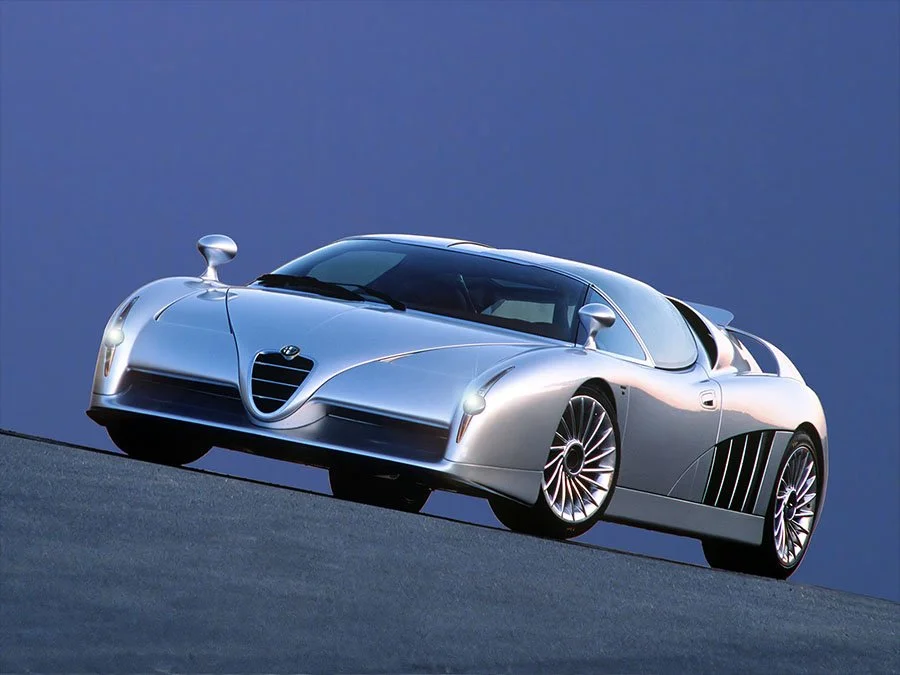
Two years after the Cala, it was time for the Alfa Romeo-based Scighera’s turn to showcase Ital Design’s credentials. An homage to Alfa Romeo’s racing history, it was the most exciting creation to wear the famous four-leafed clover for the best part of a decade and featured an array of innovative details as had come to be expected from one of Italy’s most highly regarded styling houses.
CHASSIS
Little technical data was ever published for the Scighera, but here’s what we do know.
It was based around an aluminium and carbonfibre reinforced polymer composite tub with 2600mm wheelbase.
Suspension was via double wishbones with coil sprung dampers all round while cross-drilled and ventilated brake discs were fitted to each corner.
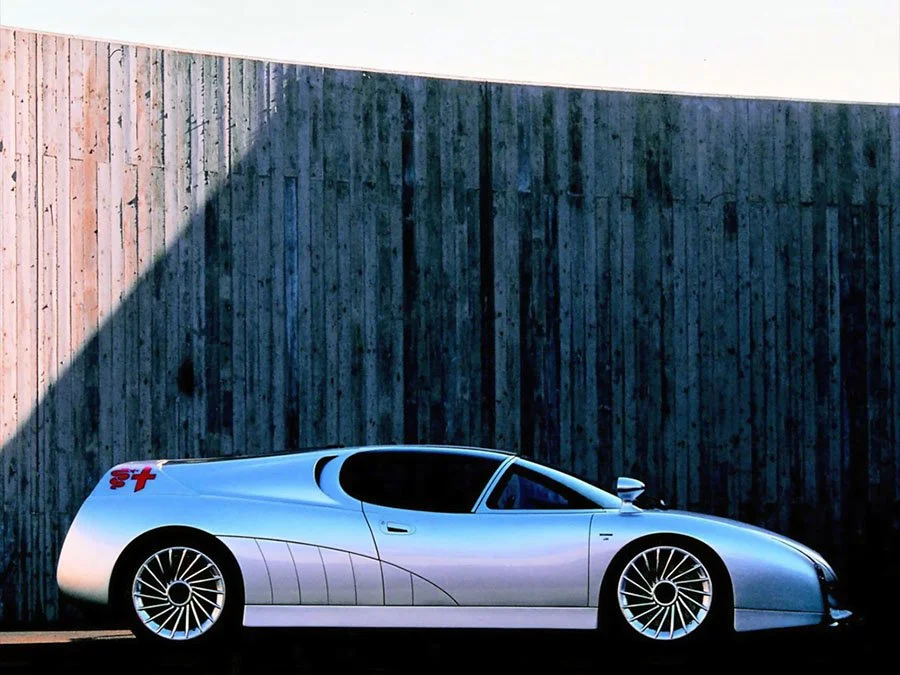
Track was 25mm wider at the front axle (1655mm compared to 1630mm).
Custom 16-spoke centre-lock wheels were manufactured in-house.
ENGINE / TRANSMISSION
In the engine bay was a twin turbocharged version of Alfa Romeo’s legendary Giuseppe Busso-designed 60° V6 that could trace its origins all the way back to 1979.
Mid longitudinally mounted in the chassis, displacement of the all-alloy power unit was an identical 2959cc to Alfa’s normally aspirated iterations of the 3-litre Busso motor thanks to a bore and stroke of 83mm and 72.6mm respectively. Similarly, dual overhead camshafts per bank were employed along with four valves per cylinder and wet-sump lubrication. Details of the compression ratio, engine management and turbo systems for the Scighera’s motor were never published.
Ital Design quoted a peak output of 400bhp at 7500rpm and 327lb-ft at 5000rpm.
For comparison, the top rated normally aspirated three-litre Busso V6 of the time as fitted to the GTV and 164 pumped out out 217bhp at 6300rpm and 199lb-ft at 5000rpm.
Bolted to the front of the engine was a sequential six-speed manual gearbox which fed the power to the wheels through a permanent all-wheel drive system imported from Alfa Romeo’s Q4 iterations of the 164 and 155.
BODYWORK
The Scighera’s bodywork was styled by Giorgetto Giugiaro’s son, Fabrizio, who took inspiration from contemporary racing car philosophy which he mixed with features derived from some of Alfa Romeo’s renowned design concepts of yesteryear.
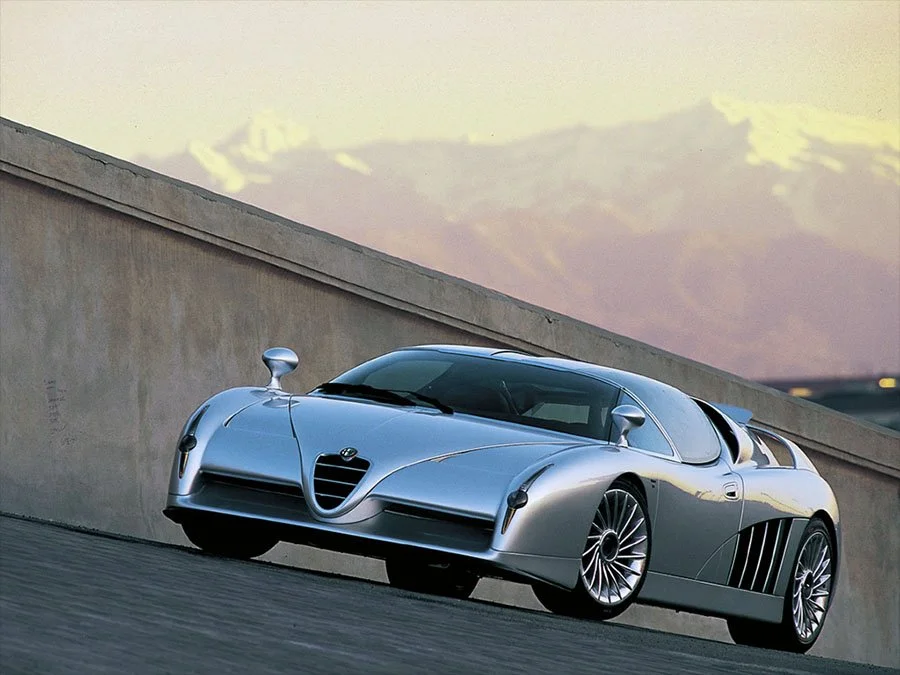
The front end was characterised by dramatically sloped planes located either side of a lift-up V-shaped hood. At the leading edge, an integrated chin spoiler directed air underneath a full width F1-style aerofoil that linked the delta-shaped element to a pair of pontoon fenders. State-of-art ‘clown-eye’ LED headlights further accentuated the dramatic plunging profile.
Another one of the Scighera’s striking features was its cockpit. Either side of the windscreen were wraparound quarter windows that, by virtue of concealed A-pillars, gave the effect of a single-piece canopy.

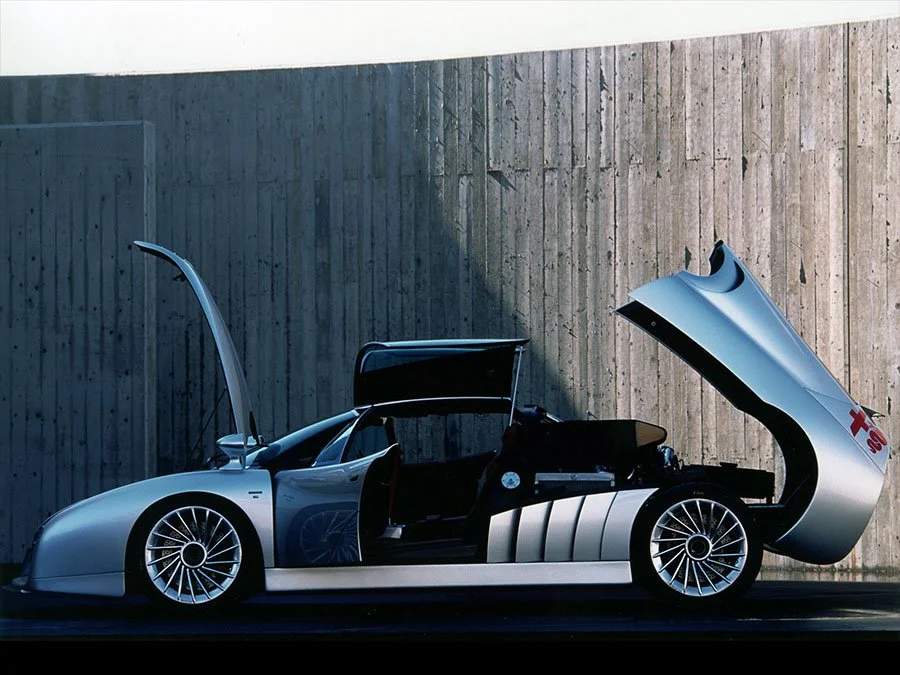
For the side glass, Giugiaro adopted a similar approach to his Nazca line of BMW concepts from earlier in the decade: expansive single-piece windows mounted on a central T-bar lifted electronically into the air while the doors themselves opened in conventional fashion. In order to transform the Scighera into a T-bar Targa, the side windows could be removed entirely.
The Scighera’s side profile was dominated by a bank of active engine cooling vanes carved out from in front of each rear wheel. Fixed intakes were also mounted on the sail panels.
By virtue of a Fastback rear window that was channelled underneath a Ferrari F50-style rear spoiler, Ital Design created a distinctive tunnel-like effect. More innovative lighting solutions saw the entire trailing edge of the aforementioned spoiler adorned with LEDs while the tail fascia housed a pair of full height vertical units at each edge. Exiting centrally between the rear apron were a trio of exhaust tips.
Body panels were fashioned from a mixture of aluminium and carbonfibre.
INTERIOR
Inside, Ital Design elected to equip the Scighera in the manner of a comfortable Grand Tourer as opposed to a pared back street racer.
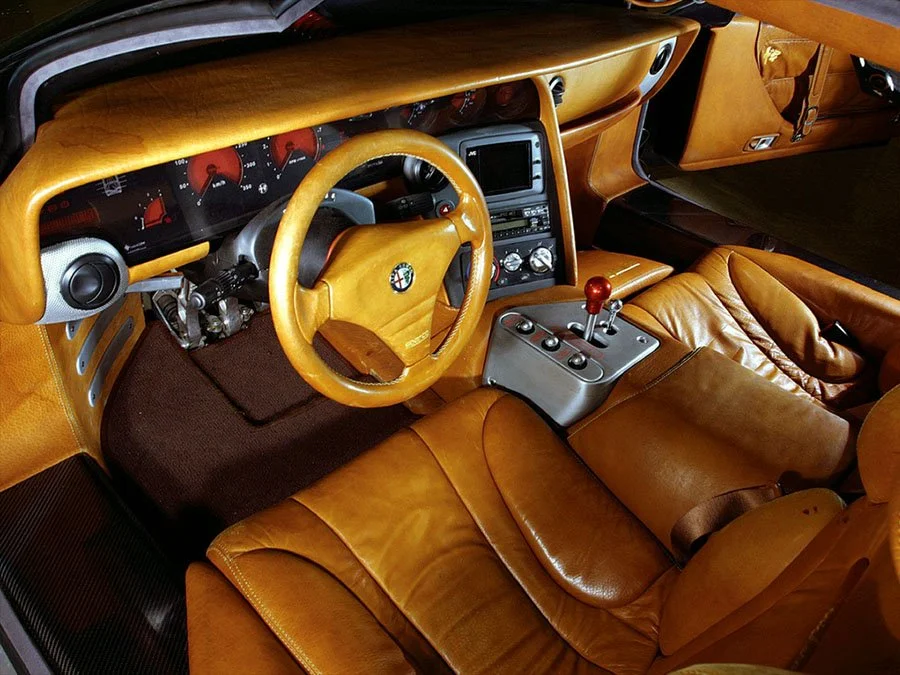
Plush two-piece seats had adjustable backs but the squabs were fixed in position. To tailor an ideal driving position, the steering column and pedal box were made fully adjustable.
Directly ahead of the three-spoke Sparco steering wheel was a flat top dash that housed a mix of analogue and digital read outs. A large 350kmh speedometer and 9000rpm rev counter were located ahead of the driver while off to the sides were an array of smaller instruments to include an overhead schematic that flagged up any technical issues.
Linking the dash to the transmission tunnel was a vertical panel angled towards the driver that contained a JVC screen for the rear-facing camera, the audio system and ventilation system controls. Further back, the gear lever poked through a natural aluminium control panel that also housed a smaller, stubbier lever to engage forward or reverse along with a trio of rotary knobs for alternative drive modes.
Connolly leather was used to cover practically every surface bar the exposed carbonfibre sills, the natural aluminium and satin black fascias and the carpeted floors.
WEIGHT / PERFORMANCE
At 1450kg the Scighera compared favourably with Porsche’s new 996-type 911 Carrera Coupe (1390kg) and the Maserati 3200 GT (1587kg). The Alfa, however, was expected to have been much faster with a quoted 0-62mph time of 3.7 seconds and top speed of 186mph.
PRODUCTION
Only one example of the original Scighera was ever produced which Ital Design retained for their museum in Moncalieri, Turin. However, a push-mobile racing version also emerged that in theory would have been eligible for the FIA’s GT1 or GT2 regulations...
SCHIGERA GT
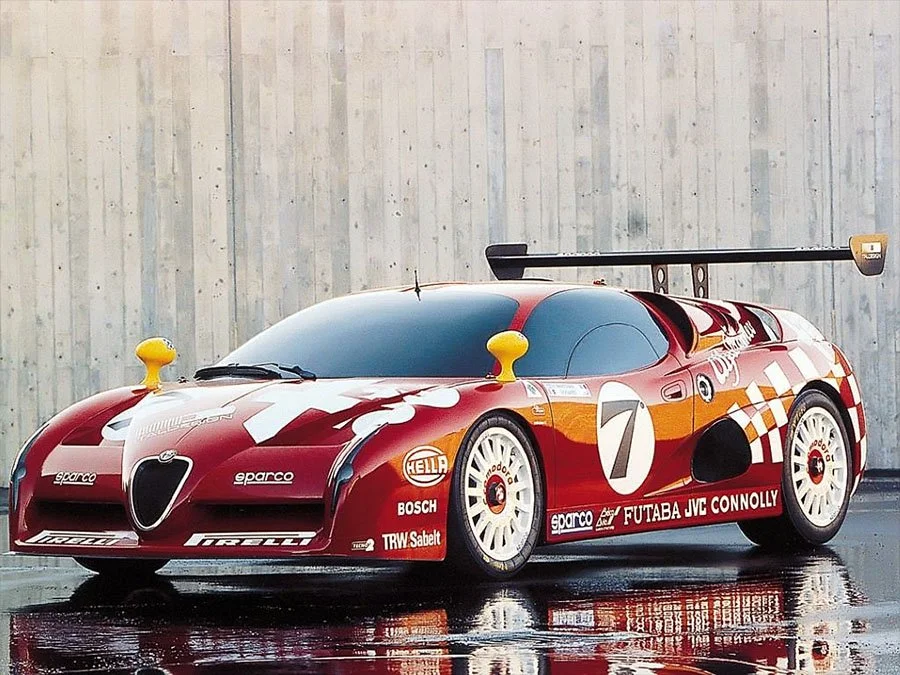
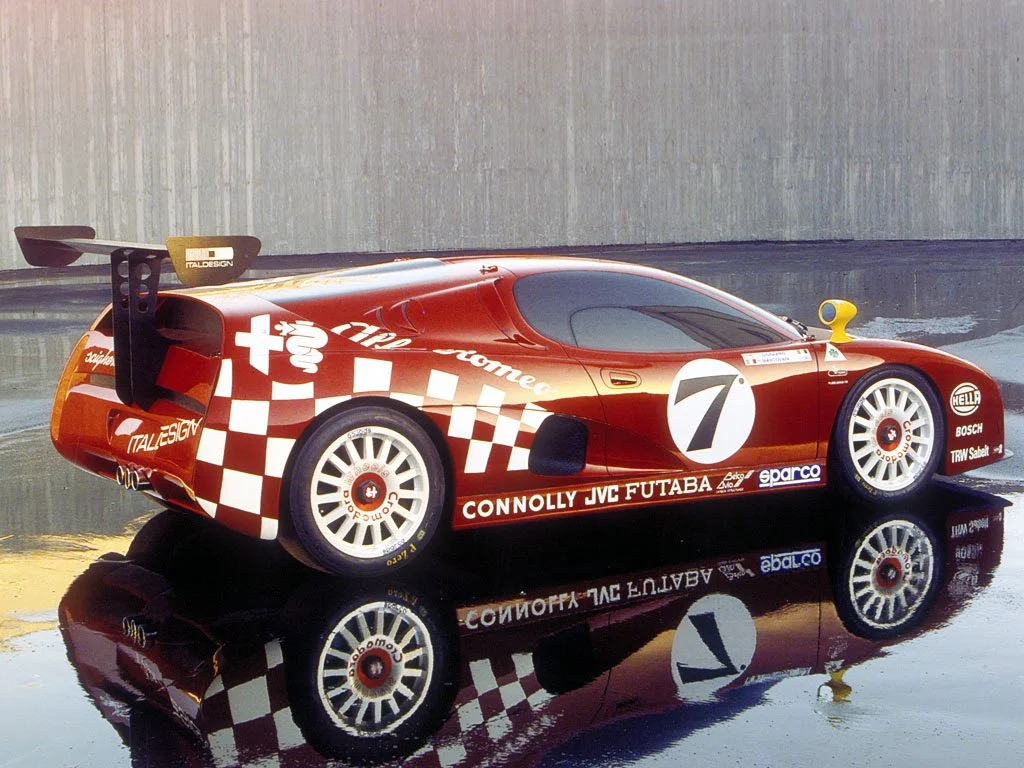
The Scighera GT came with a full composite body that did without the original active aero elements and replaced them with either gaping intakes or fixed spoilers. To further reduce weight, the Gullwing side windows were replaced with conventionally attached two-piece Plexiglass screens and new Cromodora wheels were fitted. Inside, the interior was gutted of all superfluous equipment.
Aside from the red prototype, no further copies were produced.
Text copyright: Supercar Nostalgia
Photo copyright: Ital Design - https://www.italdesign.it/