Guide: Red Pig - a Historical & Technical Appraisal of the Mercedes-Benz W109 300 SEL AMG 6.8 Gr.2
/
BACKGROUND
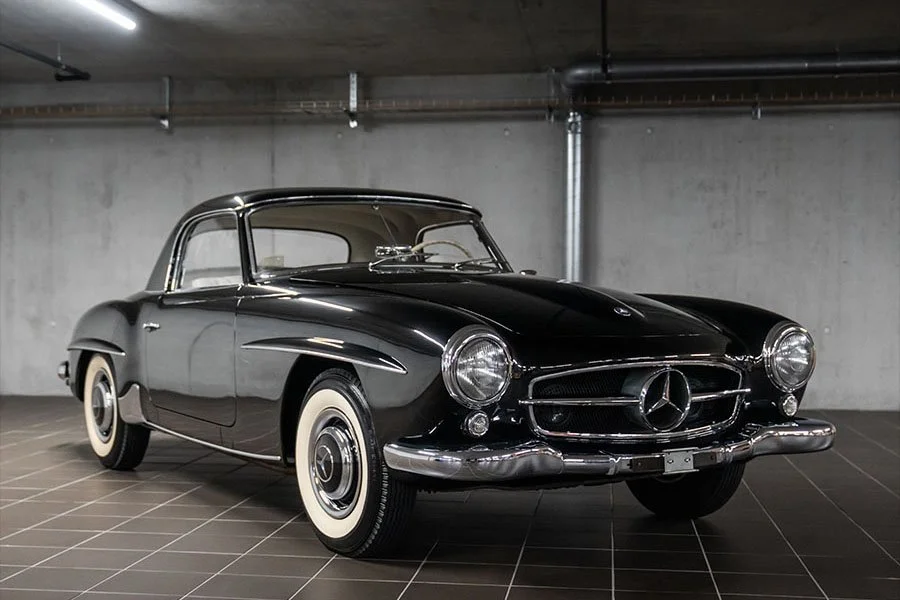
At the Frankfurt Motor Show in September 1963, Mercedes-Benz launched its new super high end 600.
Conceived to rival anything Rolls-Royce or Bentley had to offer, the 600 (model code W100) was offered as a standard four-door Sedan, a long wheelbase four-door Pullman limousine and a spectacular six-door Pullman limousine. In addition, both limousine variants could be ordered in Landaulet trim with a retractable power-operated roof over the passenger compartment.
As expected for what was the most expensive car in the world, the 600 came riddled with advanced features. Among these was Mercedes’ first production V8 (Type M100) which had been developed at vast cost.
A super smooth 6.3-litre single overhead cam V8 complete with Mercedes’ own state-of-art eight-piston mechanical fuel-injection, each of these 247bhp units was carefully hand-built and then bench-tested for nigh on 4.5 hours prior to installation.
Unfortunately, although widely hailed as the world’s finest luxury car, demand for the 600 was subdued and, even during its strongest production year (1965), barely 400 were completed.
To claw back some of the massive expenditure outlaid on development of the M100 engine, Mercedes decided to shoehorn the V8 into its more compact W109 series S class. The resultant 300 SEL 6.3 was launched at the Geneva Motor Show in March 1968 and offered muscle car performance with all the high end luxury customers had come to expect from a Mercedes.
The 300 SEL 6.3 had been the brainchild of Mercedes engineer Erich Waxenberger who had secretly created the first prototype during 1966. Three years later, it was Waxenberger who convinced the Mercedes board to sanction a three-car entry of SEL 6.3s for the Spa 24 Hour saloon car race.
Homologation into the Group 2 Touring Car class was approved on April 1st 1969 and, in preparation for the big race at Spa, on May 18th a pair of SEL 6.3s lined up first and second to contest the Macau 6 Hour race. Partnered by Albert Poon (who only drove for around 20 minutes), Waxenberger took victory while the sister car came home third behind a Porsche 911 S.
Following a 24 hour simulation at Hockenheim in the weeks that followed, three works SELs rocked up to contest the Spa 24 Hours which took place over the weekend of July 26th and 27th. Although on this occasion the Mercedes were pipped to pole position, the SELs showed considerable pace: the Jacky Ickx / Hans Herrmann entry set second fastest time, the Rauno Aaltonen / Dieter Glemser machine qualified fourth and the Kurt Ahrens Jr. / Erich Waxenberger car was sixth.
Worryingly though, the W109s had suffered from severe tyre chunking around the fast Spa circuit and, owing to safety concerns, all three cars were withdrawn from the event before it got underway.
Following this high profile embarrassment, Mercedes aborted any further plans to race the W109.
Meanwhile, back in 1967, ex- Mercedes engineers Hans Werner Aufrecht and Erhard Melcher had established AMG as a manufacturer of racing engines at a former Burgstall mill just down the road from Stuttgart.
Aufrecht and Melcher had first risen to prominence by producing the all-conquering 300 SE engine that powered fellow Mercedes employee, Manfred Schiek, to ten victories in the 1965 German Touring Car Championship.
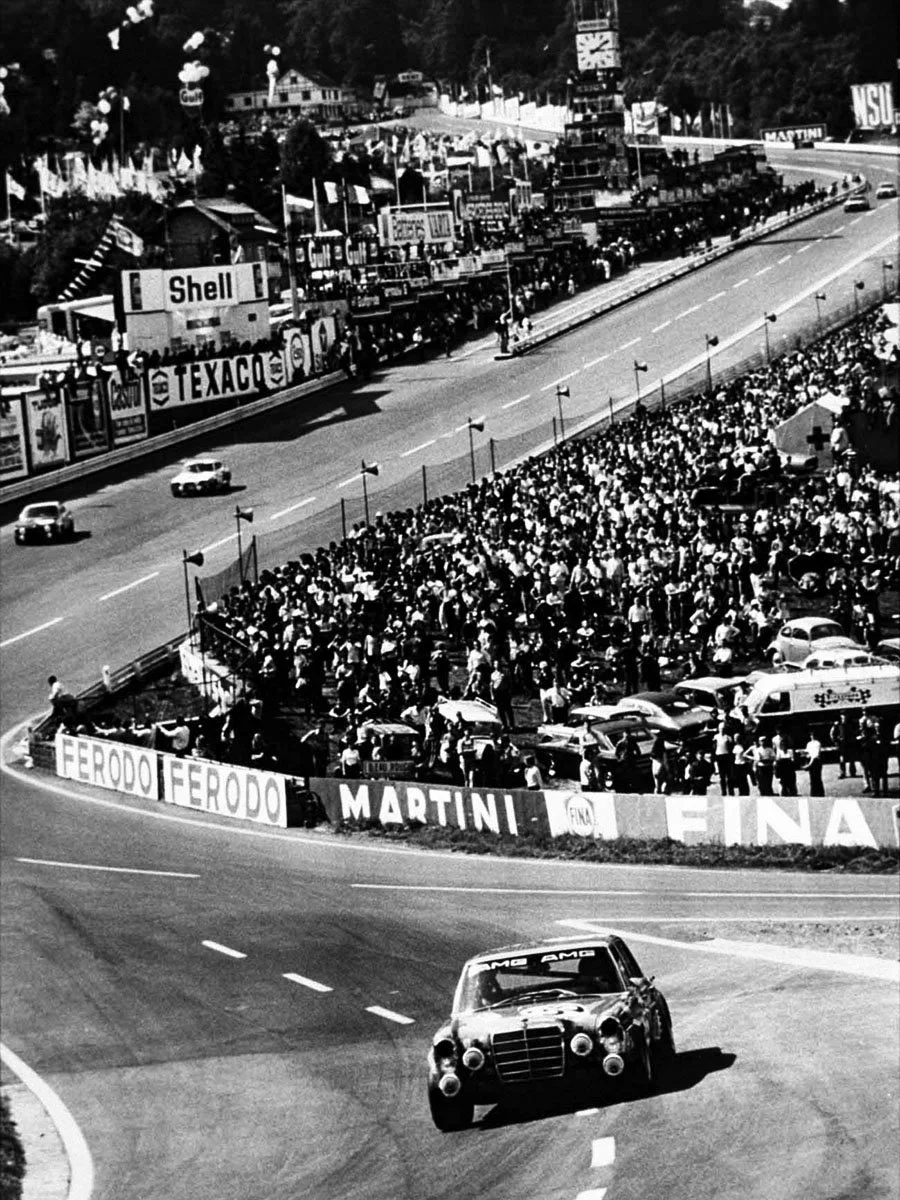
Before long, AMG had established itself as the go-to manufacturer of Mercedes engines for privateer racers.
After four years without change, 1970 saw the FIA’s Group 2 Touring Car regulations revamped. While the category still carried a 1000 car production requirement within a twelve month period, the rules were relaxed to allow much greater freedom when it came to chassis, engine, gearbox and body modifications.
Having witnessed a fairly unimpressive selection of cars contest the 1970 European Touring Car Championship, AMG sensed an opportunity to make a big splash with a heavily modified SEL 6.3 as the new rules would allow them to rectify the W109’s achilles heel of tyre wear by fitting much wider wheels.
With this in mind, AMG set about creating a Group 2 W109 capable of handling the massive output expected from a tuned and enlarged version of the M100 V8. Back door assistance was provided by Mercedes themselves who applied to the FIA to homologate all the latest Group 2 updates and even supplied AMG with a naked bodyshell from which to start.
CHASSIS
Beginning with that brand new W109 steel monocoque, AMG set to work by making an array of reinforcements and adding a custom Matter rollcage. As per the Group 2 regulations, a 105-litre fuel tank from the regular SEL 6.3 was mounted under the trunk floor, but the FIA also granted permission for AMG to install a supplementary 15-litre tank nearby.
Like the standard SEL 6.3, AMG’s Group 2 monster retained Mercedes’ advanced air suspension with its independent double wishbones at the front, low-pivot swing-axle design at the rear, telescopic dampers all round and an anti-roll bar at either end. For racing, smaller, firmer air bellows were installed that simultaneously lowered the ride height. Bilstein racing shocks were also fitted along with beefier anti-roll bars.
The road car’s servo-assisted twin-circuit brake system with its four-wheel ventilated discs was carried over. However, the 273mm diameter front and 279mm rear discs now became thicker. Uprated calipers and grippier Ferodo pads were unique to the Group 2 racer.
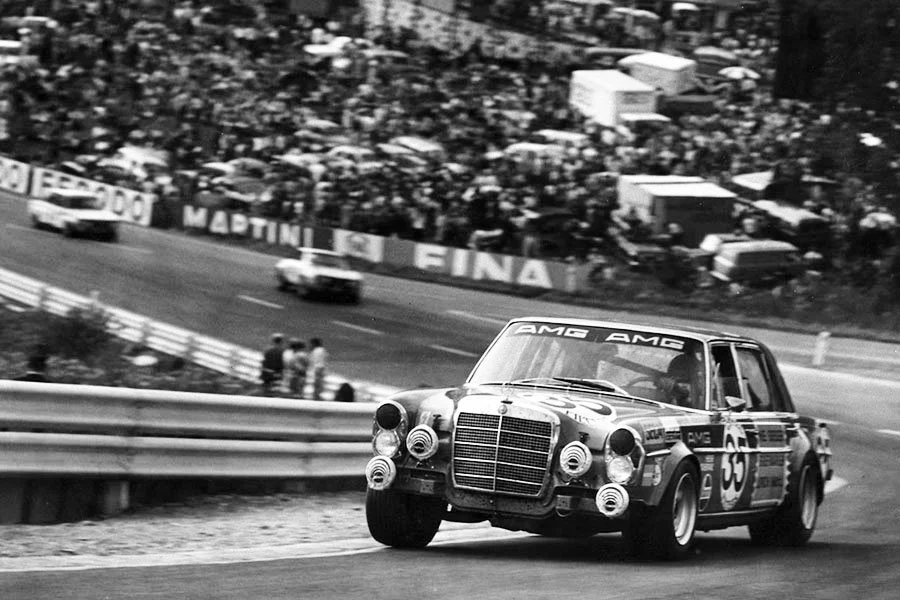
To rectify the W109’s chronic tendency to eat tyres, this latest Group 2 SEL was homologated with the wide five-spoke 15-inch diameter alloy wheels from the experimental Mercedes C111 supercar. These measured 10-inches wide at the front, 12 at the rear and were shod with Dunlop Racing tyres.
The power steering system was kept in place.
ENGINE / TRANSMISSION
Mercedes’ M100 E 63 (100.981) was an enormously impressive power unit that offered considerable potential for both enlargement and tuning.
A single overhead cam 90° V8 with an iron block, alloy heads and wet-sump lubrication, the crankshaft, connecting rods and pistons were all forged steel while the valves (two per cylinder) were sodium filled and set into hardened valve seats. Fuel-injection was via a state-of-art eight-piston mechanical arrangement developed in-house.
Off the production line, the M100 displaced 6333cc thanks to a bore and stroke of 103mm and 95mm respectively. With a compression ratio of 9.0:1 it pumped out 247bhp at 4000rpm and 369lb-ft at 2800rpm.
As there was no engine limit in the over two-litre Group 2 category, AMG elected to substantially enlarge the Mercedes V8 from 6.3 to 6.8-litres. This was achieved by opening the cylinder bores from 103mm to 105mm while stroke remained unchanged at 95mm. Overall capacity came in at 6835cc which represented a 502cc gain.
Other AMG modifications included skimmed cylinder heads that enabled the use of a higher compression ratio, uprated high-lift camshafts, lightweight valves, lightened and polished crankshaft and pistons plus polished inlet and exhaust manifolds (the former with a custom manifold per bank, each of which had its own air mass meter).
The existing fuel-injection system was optimised to reflect the revised engine’s characteristics.
All told, peak output went from 247bhp to 428bhp while the torque rating came in at 449lb-ft.
Instead of the usual four-speed automatic gearbox, AMG installed a five-speed ZF S5-24/2 unit. Transmission was through a Sachs flywheel and clutch assembly, a custom propshaft and 70% locking limited-slip differential.
BODYWORK
AMG made a series of changes to the 300 SEL 6.3’s bodywork as part of the transition to Group 2 trim.
In order to reduce weight the original steel doors were switched to aluminium. The standard side and rear windows were replaced with Plexiglas and the heavy chrome-plated bumpers were left off.
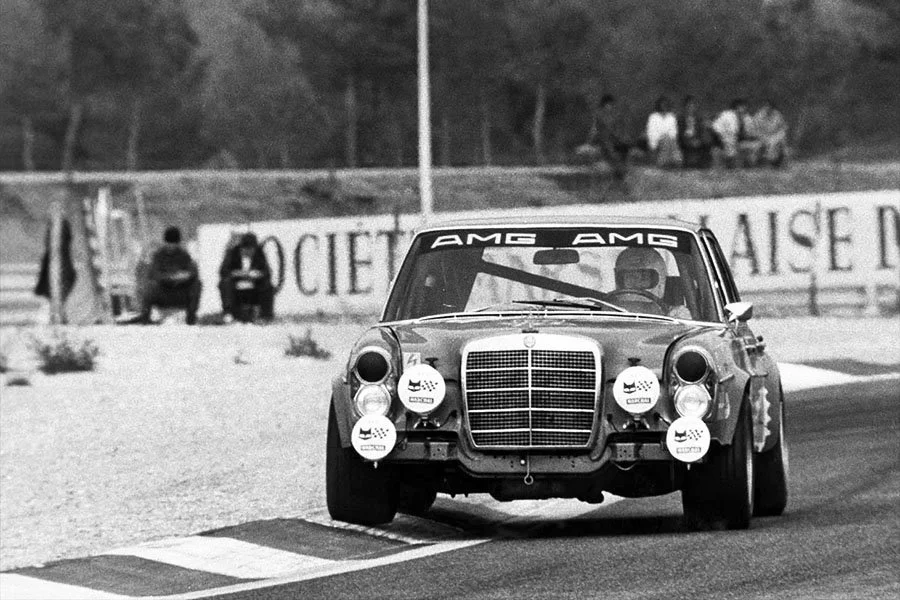
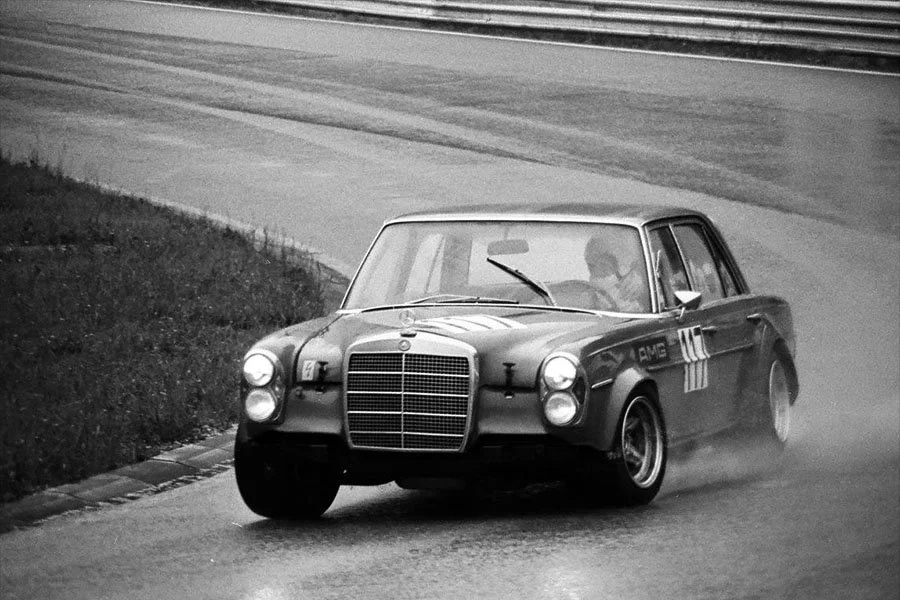
To accommodate the much wider wheels, the arches on all four fenders were substantially flared which, combined with the lowered ride height and lack of bumpers, lent the W109 a much more aggressive appearance.
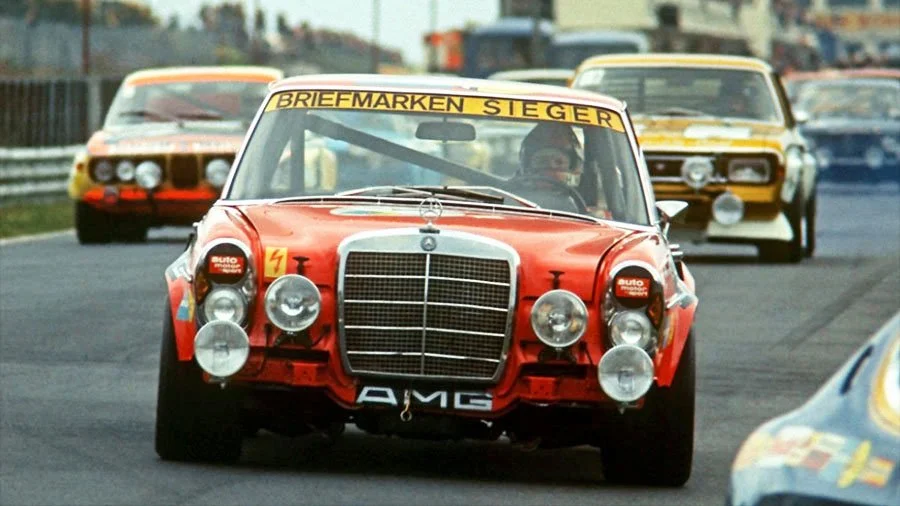
For safety, rubber hood and trunk lid retaining straps were fitted along with a tow hook and an external electrical kill switch. For endurance races, four Bosch spot lights were installed along with night-time ID lights.
AMG opted to go with a bright Cardinal Red paint finish and the Group 2 SEL was quickly nicknamed Rote Sau which translates to English as the Red Pig.
INTERIOR
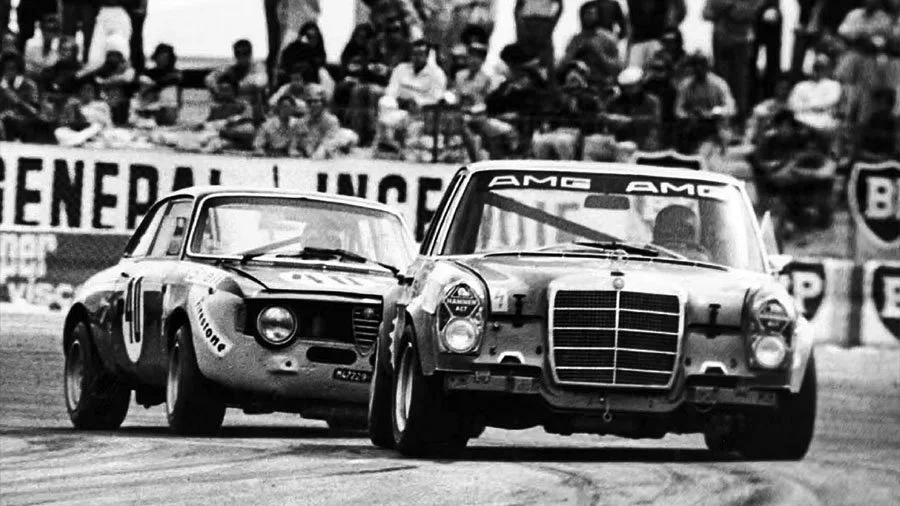
In line with Group 2 regulations, aside from essential safety gear such as bucket front seats with racing harnesses, a small diameter steering wheel, manual instead of electric windows and a fire system, practically everything was carried over from the standard SEL road car.
This meant the dash, all the walnut veneers, the door trim panels, rear seat and most of the carpeted upholstery was retained which gave AMG’s creation a most curious feel.
WEIGHT / PERFORMANCE
As a consequence of the aforementioned weight-saving measures, AMG managed to cut 130kg from the SEL and the Rote Sau tipped the scales at 1635kg as opposed to 1765kg.
The car was geared for a 0-62mph time of 6.1 seconds and theoretical top speed of 175mph.
For comparison, a stock 300 SEL 6.3 had a 0-62mph time of 6.5 seconds and a 137mph top speed.
KLAUS BEHRMANN COPY
In addition to the Red Pig, AMG also assisted in the preparation of a silver 300 SEL 6.3 for Hamburg-based Mercedes dealer Klaus Behrmann who wanted to race in the German Touring Car Trophy.

Behrmann’s example (which had originally been returned to his dealership in a damaged state) was not tuned to quite such an extreme state as the works AMG machine. Most notably it produced around 360bhp and ran an automatic gearbox instead of the ZF five-speed manual. Much of the conversion work was carried out in Behrmann’s own Norderstedt workshop 20km north of Hamburg.
1971 SEASON
The Red Pig made its competition debut on June 20th 1971 when AMG entered Erich Waxenberger for the twelve lap non-championship ADAC Bavaria Rennen at the Salzburgring. Waxenberger qualified second in wet conditions, but failed to start as the SEL was pushed off the grid with an undisclosed mechanical issue.
Helmet Kelleners then took the wheel for the ADAC Solitude Rennen Sudwest, a ten lap non-championship race at Hockenheim on July 4th. Kelleners qualified fourth but crashed out mid way through the event and caused quite significant damage which AMG had to work overtime to repair in time for the car’s next outing three weeks later.
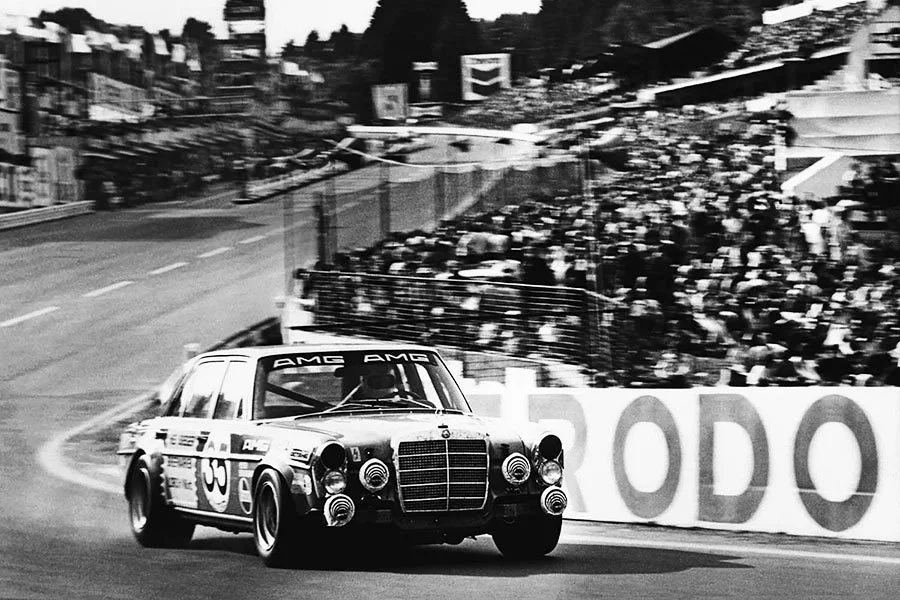
After bad fortune had afflicted the Red Pig at the Salzburgring and Hockenheim, somewhat against the odds everything came good in the most gruelling Touring Car race on the calendar: the Spa 24 Hours.
Held over the weekend of July 24th and 25th, the Spa enduro was round five of the 1971 European Touring Car Championship and attracted a stellar grid of machinery. AMG recruited Hans Heyer and Clemens Schickentanz to drive. They qualified an impressive fifth and held third during the race’s early stages.
Remarkably, despite an unquenching thirst for gas, the big Mercedes ran well throughout and eventually came home second overall (and second in the Division 3 class) behind the works Ford Capri RS2600 of Dieter Glemser and Alex Soler-Roig.
No doubt buoyed by this success which garnered international exposure, AMG subsequently entered the Red Pig for round seven of the European Touring Car Championship, the Paul Ricard 12 Hours, which comprised a six hour heat on September 11th followed by another the next day. For this event, Klaus Behrmann’s silver privateer SEL was also on hand which he co-drove with Jose Dolhem and Jean-Pierre Jabouille.
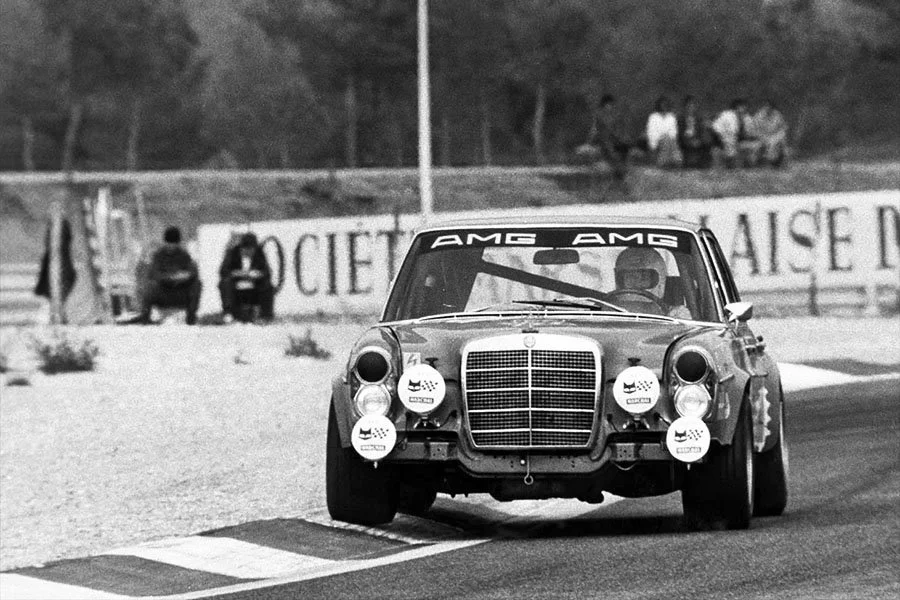
Behrmann’s car qualified 26th of the 40 runners while Heyer and Schickentanz lined up 15th in the Red Pig. Unfortunately, owing to a suspension failure mid way through Heat 1, the AMG entry retired with a rear suspension failure and did not participate in Heat 2.
Meanwhile, despite its disappointing grid position, the silver Behrmann / Dolhem / Jabouille entry finished Heat 1 an impressive fifth overall (fourth in the Division 3 class). However, Heat 2 saw a bearing failure force the car into retirement.
For AMG’s last outing of 1971, the Red Pig was freshened up with a new yellow coat of paint. It appeared at the non-championship 20 lap Hockenheim Season Finale on November 28th where Hans Heyer crossed the line twelfth overall and seventh in the LG3 class.
As for Klaus Behrmann’s other outings in his privateer SEL, he impressively won seven out of eight German national events contested during 1971.
1972 SEASON
For 1972, AMG ambitiously planned to run a turbocharged version of its 6.8-litre Mercedes engine in a McLaren M8F Group 7 car (chassis 4-72). However, after running the McLaren in normally aspirated trim at the Imola Interserie race on May 1st (where it failed to finish with engine problems), the red M8F was not seen again.
Meanwhile, the FIA had introduced a five-litre engine limit for Group 2 cars which meant the 6.8-litre SEL got fairly limited running.
While Klaus Behrmann retired his silver SEL from any further competition, AMG elected to contest a handful of races starting with the Le Mans 4 Hour contest on March 18th which took place after the annual test weekend had concluded. Hans Heyer qualified 18th but retired with just four laps gone.
On May 6th Heyer was back in the now red again SEL to contest the Belgian Touring Car Championship Coupes de Spa but again failed to finish.
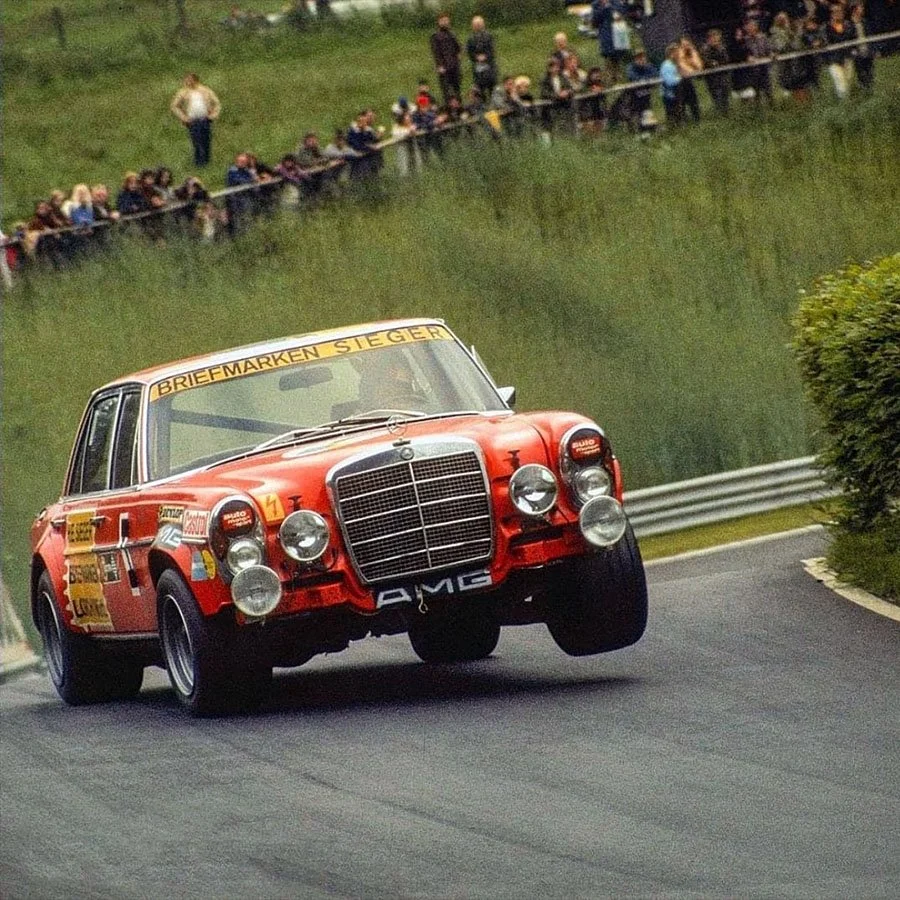
Heyer was then joined by Thomas Betzler for the non-championship Nurburgring 24 Hours which took place over the weekend of June 24th and 25th. Despite the Nurburgring’s tight and twisty nature having seemed an unlikely place for the Red Pig to shine, Heyer qualified fourth and even led early on. Unfortunately though, the Mercedes soon began to suffer from overheating. It later retired when the differential locked solid while stationary in the pits.
The Red Pig’s final outing came on August 6th at a 22 lap support race for the Norisring 200 mile Interserie race. A round of the Deutsche Rundstrecken Pokal, Heyer qualified on pole and won the over 1.3-litre class by over half a minute to bring the career of this iconic machine to a successful conclusion.
SUBSEQUENT HISTORY
At the end of 1972, AMG sold the Red Pig to French industrial conglomerate Matra who, in addition to their motor racing activities, were major players in the world of aerospace and defence.
Matra wanted the Red Pig as a high speed mobile laboratory to test the coefficient of friction on aircraft undercarriages. In preparation for the sale, AMG modified the Red Pig by converting it into a six-door sedan that could accommodate all the required equipment. It was also reconfigured to incorporate an aviation-type landing gear wheel that could be lowered through a hole in the floor onto the runway.
The car was subsequently scrapped at the end of its useful life.
Text copyright: Supercar Nostalgia
Photo copyright: Mercedes-Benz - https://www.mercedes-benz.com & unattributed