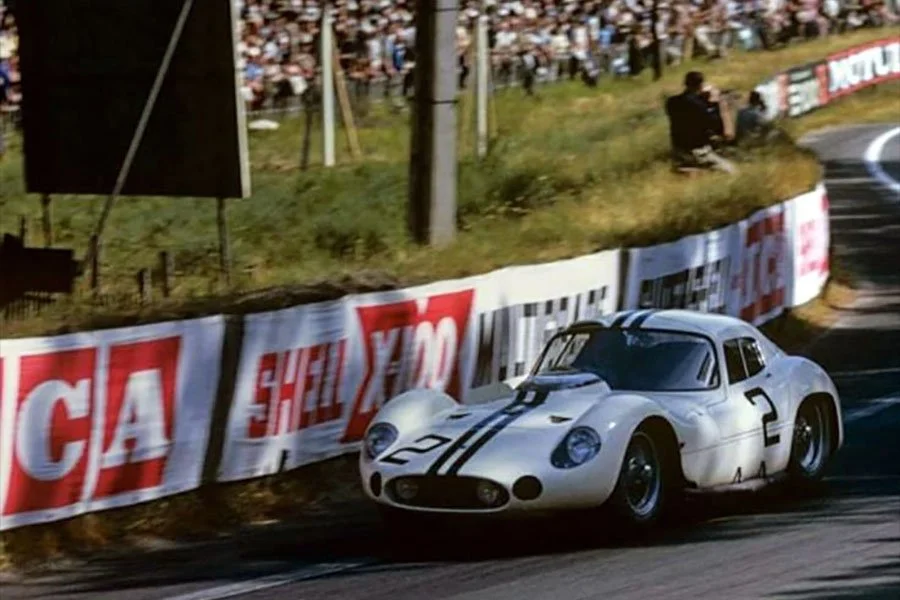
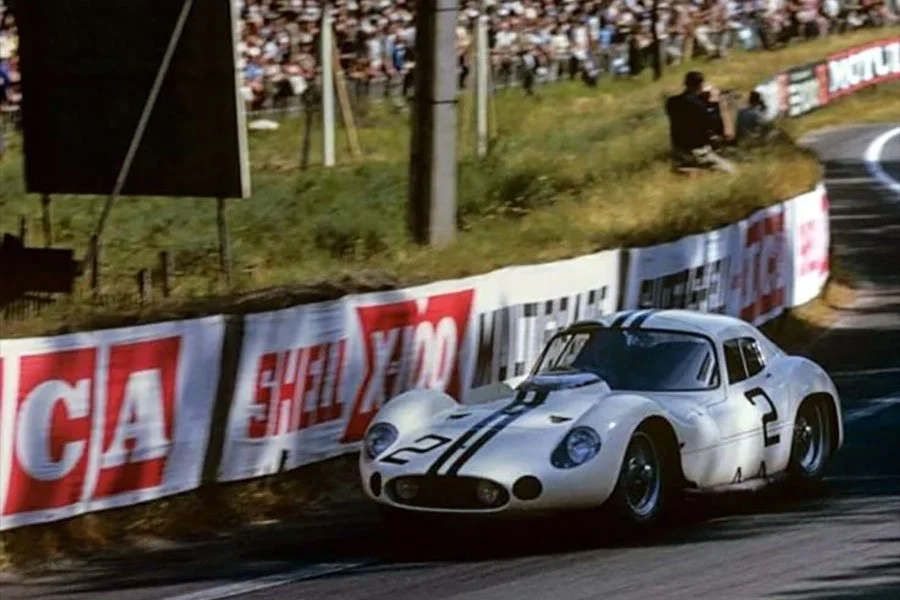
Guide: Destination Le Mans - a Historical & Technical Appraisal of the Maserati 151
/
BACKGROUND
For 1962, the World Sportscar Championship was split into two categories: the International Championship for GT Manufacturers and the Coupe des Sports.
In addition, the calendar was expanded from five events in 1961 to nine for 1962 (ten if you count the double-header at Bridgehampton). Five additional races were organised exclusively for sub 1000cc cars.
As the de facto World Championship of 1962, the International Championship for GT Manufacturers was that year’s big prize. By contrast, although Prototype racing cars (which the FIA now limited to under three-litres) were eligible to run at the majority of World Championship events in 1962, the Coupe des Sports was decided on the outcome of just three races: the Sebring 12 Hours, the Targa Florio and the Nurburgring 1000km.
This shift to GT machinery was an attempt to safeguard the World Championship from a potential fallout of works teams as the growing expense of running out-and-out Prototypes had seen a commensurate drop in manufacturer participation.
Somewhat inevitably, the aforementioned imposition of a three-litre engine limit for Sports Prototypes caused consternation among certain race promoters, most notably the Automobile Club de l’Ouest which organised the Le Mans 24 Hours.
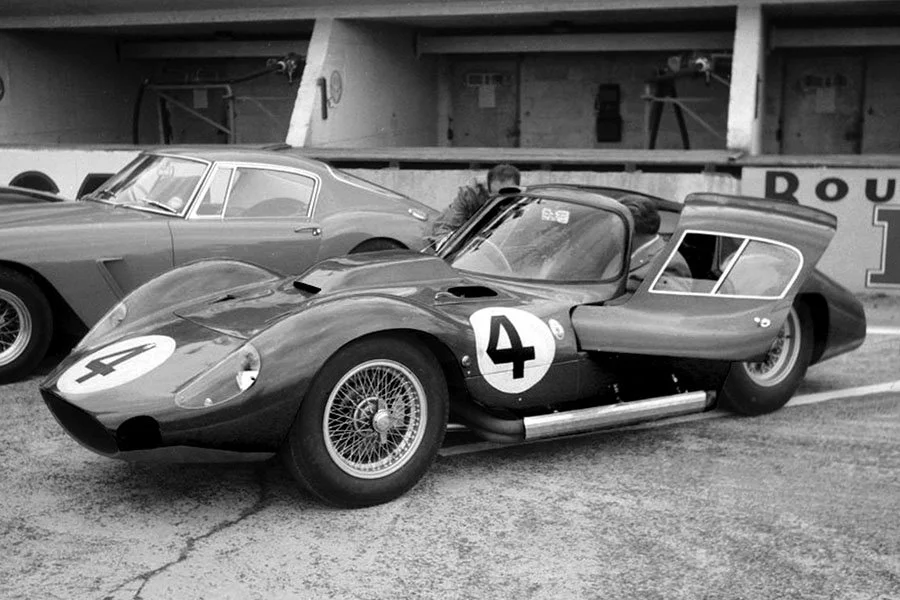
Unhappy at the prospect of fewer big crowd-pleasing Prototypes in attendance, the Le Mans governing body unilaterally decided to add a new Experimental category with four-litre engine limit to their 1962 event.
Aware of the prestige a Le Mans victory would bring (and the advantage of essentially being permitted to run a four-litre Prototype), the Experimental class attracted entries from Aston Martin, Ferrari and Maserati.
In order to give these new cars some track-time ahead of Le Mans, organisers of the Nurburgring 1000km (which took place four weeks earlier in the year) also created a four-litre Experimental Prototype class for their event.
To contest the exciting new category, Aston Martin came up with the DB4 GT-based DP212 and Ferrari built a brace of one-off 330-engined specials: the 330 TRI/LM (a Testa Rossa-based Spyder) and the 330 LM (essentially a four-litre GTO).
In Modena, and with no suitable production model upon which to base a genuine GT class contender, Maserati was convinced to develop an Experimental special by two of its most staunchest supporters: the firm’s French distributor, Colonel Johnny Simone, and wealthy American sportsman, Briggs Cunningham.
With Simone and Cunningham having agreed to fund development, a deal was struck and Maserati, led by Giulio Alfieri, quickly designed a front-engined Berlinetta known as the Tipo 151.
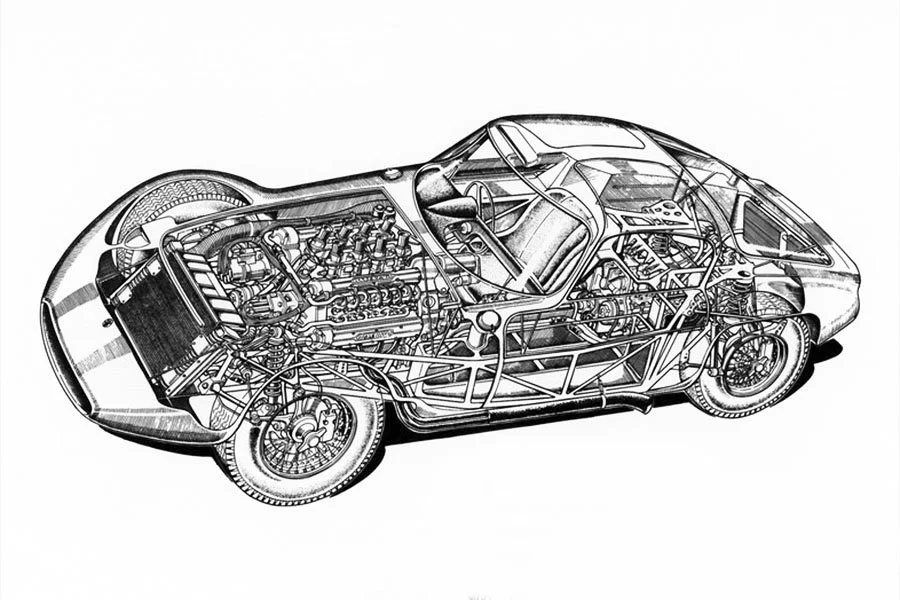
Incorporating as many existing Maserati components as possible, a trio of 151s were built, the first of which (chassis 002) was destined for Maserati France while the second and third (chassis 004 and 006) went to Cunningham.
News of this latest Maserati broke during mid April. All three cars made their public debut at the 1962 Le Mans 24 Hour race which took place over the weekend of June 23rd and 24th.
CHASSIS
Although Maserati had recently made a name for itself with some extremely complex Birdcage-type small-diameter tubular chassis, a beefier, more conventional ladder-type unit was deemed necessary to handle the Tipo 151’s drivetrain.
The wheelbase measured 2300mm.
Front suspension was via double wishbones while at the back was a de Dion-style axle reinforced with extra struts on each side and modified to act like a swing arm (as per the Tipo 64). Coil springs with hydraulic shocks were fitted all round. Early on, Bruce McLaren suggested adding a homokinetic joint to the rear suspension in an attempt to improve handling.
Disc brakes were fitted at either end and an 80-litre fuel tanks was housed in each sill.
16-inch Borrani centre-lock wire wheels measured 6 and 7-inches wide front to rear.
ENGINE / TRANSMISSION
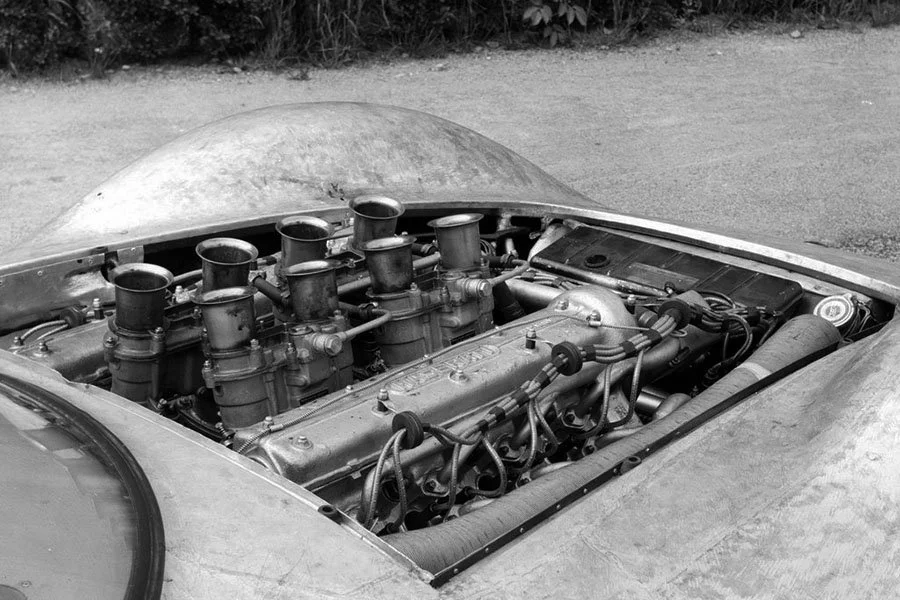
In the engine bay was the latest iteration of Maserati’s fabled all-alloy dual overhead cam 90° V8 as found in the old 450 S sports racer (4.5-litres) and the wickedly expensive 5000 GT road car (5-litres).
To comply with the 4-litre Experimental class limit, the 4.5-litre engine from the 450 S had to be suitably re-sized. Accordingly, the 151 motor had its cylinder bores reduced from 93.8mm to 91mm while stroke was shortened from 81mm to 75.8mm. Cubic capacity dropped from 4478cc to 3943cc as a result.
As per the 450 S motor, a complex gear-driven dual overhead camshaft system was employed along with twin plug ignition, dry-sump lubrication and a bank of four twin-choke Weber 45 IDM downdraught carburettors.
To recover some of the oomph lost from the reduction in displacement, the 151’s compression ratio was hiked from 9.6:1 on the 450 S to 9.7:1.
Peak output was quoted as 360bhp at 7000rpm (compared to 400bhp at an identical engine speed on the 450 S).
Both the 450 S and 151 shared an identical torque rating of 360lb-ft at 5500rpm.
Transmission was through a five-speed Colotti gearbox (mounted in unit with the differential) and dry multi-plate clutch.
BODYWORK
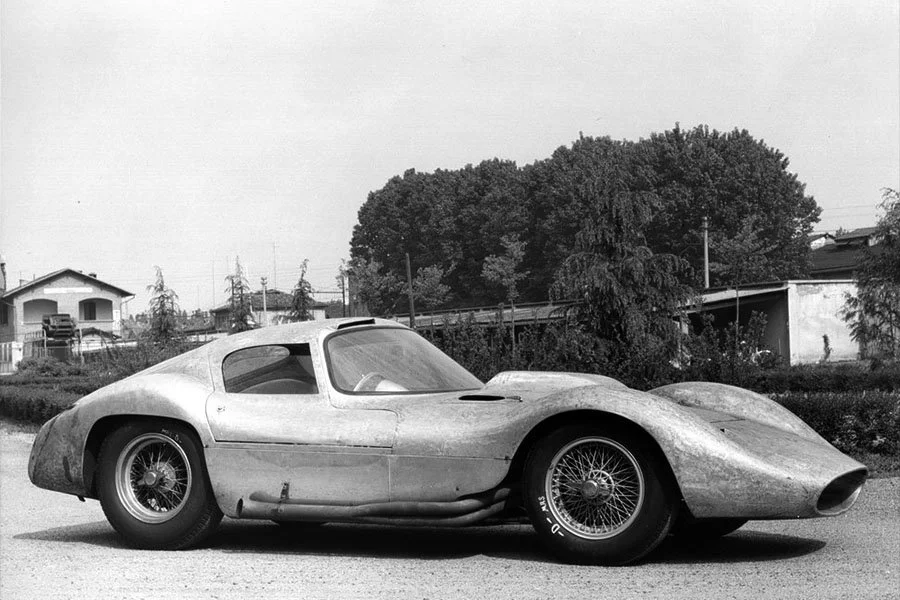
To reflect its status as an ultra high speed Le Mans special, the 151 was draped in a low drag body designed to cut through the air as efficiently as possible.
Styling was taken care of by Maserati’s chief engineer, Giulio Alfieri, who refined the design at the Politecnico di Milano’s state-of-art windtunnel. Body panels were fashioned from super lightweight aluminium by Piero Drogo’s Carrozzeria Sports Cars just down the road from Maserati.
The 151’s slippery body was very much in line with the latest aerodynamic understanding of the day.
An air-piercing nose was home to a large oval primary intake that also shrouded a pair of spot lights. Outboard of the primary intake were circular cutaways that fed air to the brakes. Further back, the headlights were mounted under contoured Plexiglas covers.
To create a super low profile, bodywork between the front fenders and engine power bulge was sunk in a quite extreme fashion.
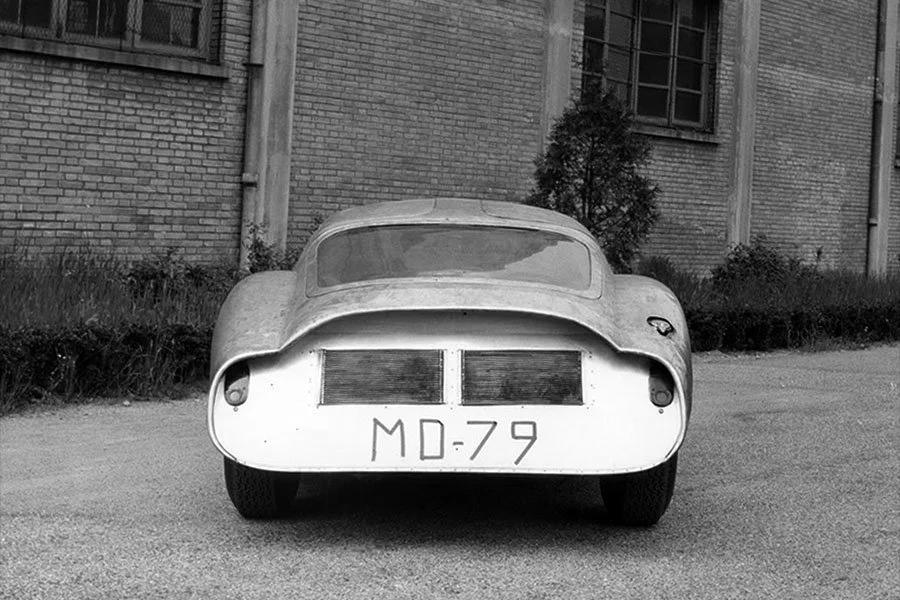
The cockpit was set well back on the chassis which accentuated the 151’s cartoon-ish appearance. A large wraparound windscreen was flanked by small two-piece door windows (only the front of which was operational). In order to clear the tall chassis sidemembers and fuel cells, the doors were mounted high on the body which necessitated cutaways in the roof to permit cockpit access.
At the stubby rear, Alfieri employed a sloping Kamm tail that housed a pair of large rectangular cooling vents.
To comply with the regulations, the 151 featured a full complement of lighting and other such equipment to make it legal for road use.
INTERIOR
Inside, comfort equipment was practically non-existent.
Bucket seats were lightly padded and a little heat insulation material partially covered the forward section of the transmission tunnel. That was the extent of the upholstery provided. As a consequence, the 151’s cockpit was an austere place to be with its mix of exposed aluminium panels and myriad chassis tubes.
Directly behind the wood-rimmed steering wheel with its trio of drilled aluminium spoked was a hooded instrument binnacle, the fascia for which housed an array of gauges and flick switches.
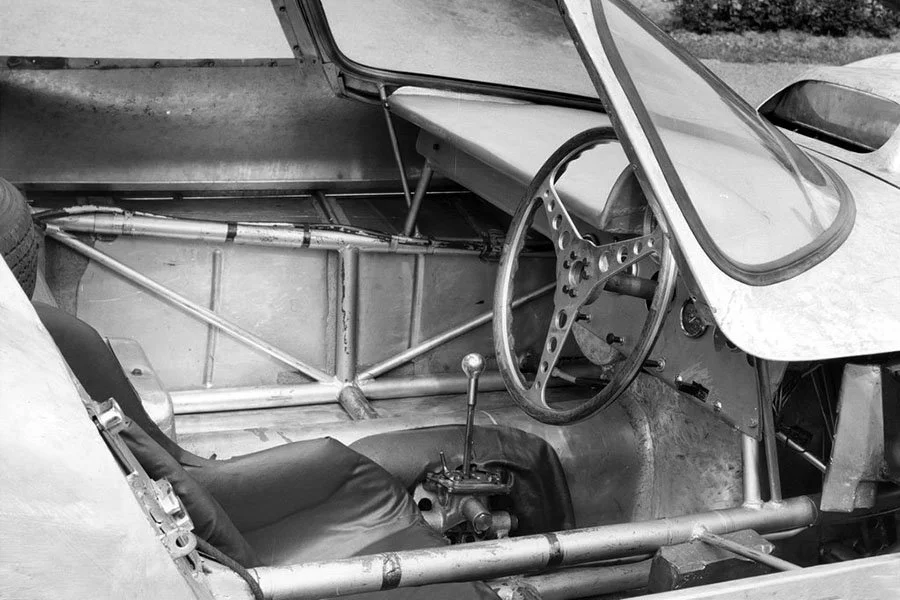
All three 151s were right-hand drive with a central open gate gearchange.
WEIGHT / PERFORMANCE
With long Le Mans ratios, the 151 posted a top speed of 177mph down the Mulsanne Straight making it the quickest car at the 1962 24 Hours. 0-62mph would likely have taken in the region of 4.5 seconds.
Weight was 895kg.
PRODUCTION DIFFERENCES
Inevitably, the second and third 151s (destined for Briggs Cunningham) featured several differences to the original prototype (delivered to John Simone).
Instead of an angular all-metal power bulge, the Cunningham machines featured softer installations with domed Plexiglas canopies.
Cunninham’s cars also came with deeper side sills with revised exhaust hangers, subtly re-shaped rear fenders with extra wheel clearance and revised ductwork for the hood / cockpit.
1962 COMPETITION HISTORY
Maserati had hoped to give the 151 a pre-Le Mans test run at the Nurburgring 1000km on May 26th where Graham Hill and Masten Gregory were entered to drive. However, production delays meant none of the 151s were ready.
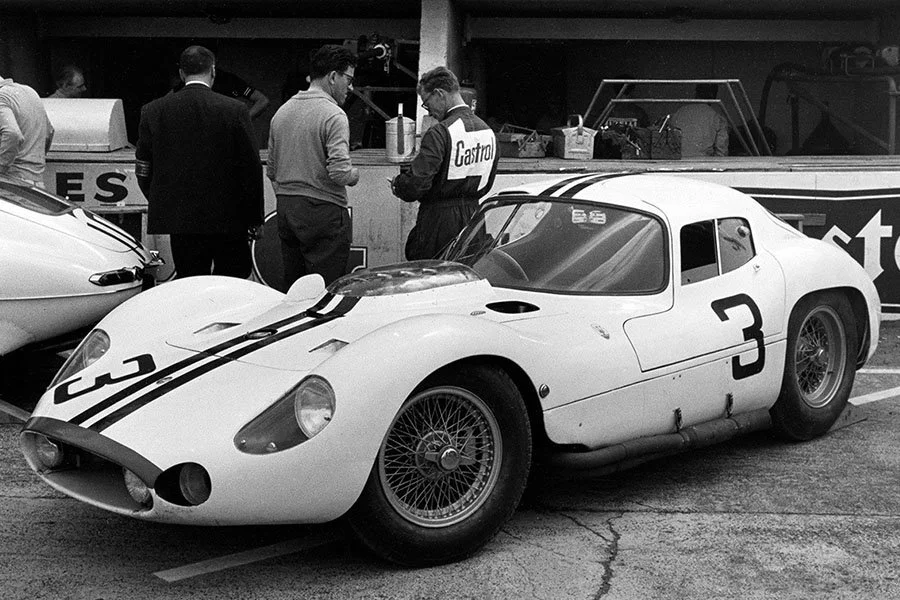
Instead, the trio of unproven 151s made their collective debuts at the 1962 Le Mans 24 Hours where they proved fantastically fast down the straights but difficult to handle in the corners. Unfortunately, having duked it out with the lead Ferraris during the first three hours, all three Maseratis retired with mechanical problems.
After Le Mans, the 151s were refreshed back at the Maserati factory.
John Simone subsequently entered 002 for just one more race in 1962, the Brands Hatch Guards Trophy for Sports and GT cars, but it failed to start owing to a blown oil line and was not seen for the rest of the season.
As for the Cunningham cars, both were shipped out to the US where 004 was equipped with a 5.6-litre Maserati V8 engine. This car was then entered for SCCA Road America 500 mile race but failed to finish owing to wheel bearing failure.
Cunningham’s standard 151 (chassis 006) subsequently ran at the Bridgehampton 400km World Championship race but also failed to make the chequered flag following another mechanical problem.
The Cunningham 151s both then appeared at the big money Los Angeles Time GP which took place at Riverside; Augie Pabst came home seventh while Chuck Daigh was eleventh.
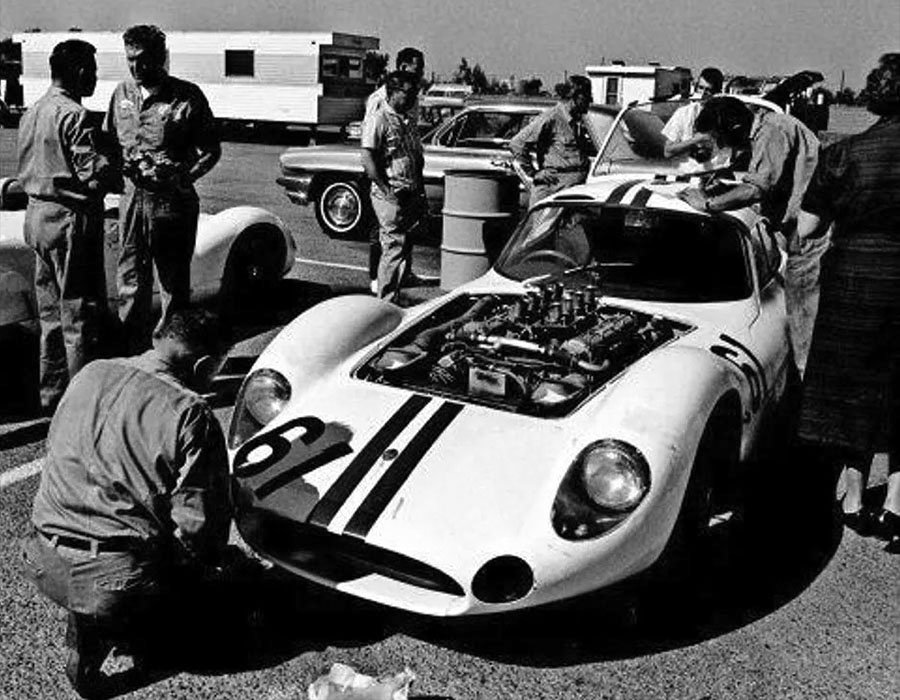
After a disappointing campaign, Briggs Cunningham elected to sell his standard 151 (chassis 006). The car was sold to Bev Spencer, an auto dealer from San Francisco, who entered it for Stan Peterson to drive in the the SCCA Vaca Valley 4 Hours. Unfortunately, Peterson had a crash during practice and 006 failed to start.
Over the close season, Spencer sold 006 to Chuck Jones of Team Meridian.
SUBSEQUENT HISTORIES
For 1963, John Simone had Maserati update chassis 002 with a number of enhancements. Modifications were made to the car’s body and suspension, but most significantly (as a consequence of the 4-litre engine limit being lifted), chassis 002 was equipped with a new five-litre fuel-injected engine. Dubbed 151/2 to reflect its second generation status, the technical aspects of this car along with its racing exploits are covered separately.
In preparation for another season of competition, Briggs Cunningham had his sole remaining 151, chassis 004, switched from the 5.6-litre Maserati V8 which it had run since arriving in the US to a 7-litre Ford V8.
This car was entered for Marvin Panche to drive in the Daytona 250 mile SCCA race on February 16th 1963, however, the NASCAR regular had a massive accident during practice which saw chassis 004 barrel roll and burn to the ground. Fortunately, Panch escaped without serious injury, but 004’s chassis and body were unsalvageable. Cunningham sold what little remained to Chuck Jones who had recently purchased chassis 006 from Bev Spencer.
Chuck Jones arranged for Skip Hudson drive chassis 006 on three occasions during 1963. Hudson placed third overall and second in class at the Cotati SCCA Divisional race and 17th overall (sixth in class) at the USRRC Road America 500 mile race. He failed to finish in 006’s final outing, the Bridgehampton 500km, after which this last 151 to remain in its original guise was retired from competition duty.
Text copyright: Supercar Nostalgia
Photo copyright: Maserati - https://maserati.com & unattributed