Guide: Blue Arrow - a Historical & Technical Appraisal of the Pagani Zonda C12 7.3 Tricolore
/
BACKGROUND
As the 2010s drew to a close, the Zonda market really began to heat up.
In response to a 2008 financial crisis caused largely by irresponsible lenders, central banks elected not to allow most of the institutions that had caused the problem to fail, but instead began money printing at an unprecedented rate to provide fresh liquidity.
The net result should have come as a no surprise; inflation soared as wealthy individuals were showered with practically free bank loans and values for the kind of assets that appealed to such individuals rose exponentially. The whole affair turbocharged a rapid and inexorable devaluation of Fiat currencies that has continued ever since.
Among the beneficiaries of this foolhardy approach to financial management were Europe’s luxury brands including high end car makers that experienced a dramatic rise in demand for their wares.

One such organisation was Pagani Automobili which, having rubbed along quite nicely during its first ten years, began to see an influx of ultra wealthy new customers that enabled the firm to charge ever higher prices for the limited number of vehicles it could produce.
This was demonstrated by the what was expected to have been last official iteration of the Zonda which broke cover at the Geneva Motor Show in March 2010. Priced at €1.3m before local taxes, it cost more than three times what a Zonda S had retailed for less than ten years prior.
Dubbed Tricolore, only one example of this special edition was initially expected, but Pagani ultimately expanded that figure to three.
Afterwards, with Zonda production having officially ended and secondary market values undergoing a spectacular surge, Pagani began to capitalise by more widely promoting the possibility for customers to have their car (at vast expense) completely re-imagined and brought up to the very latest specification.
But back to the Tricolore, the starting point for which was the extreme Zonda Cinque launched twelve months prior that had combined an array of R-inspired mechanical and aero components (to include a sequential transmission) with a new carbon-titanium tub.
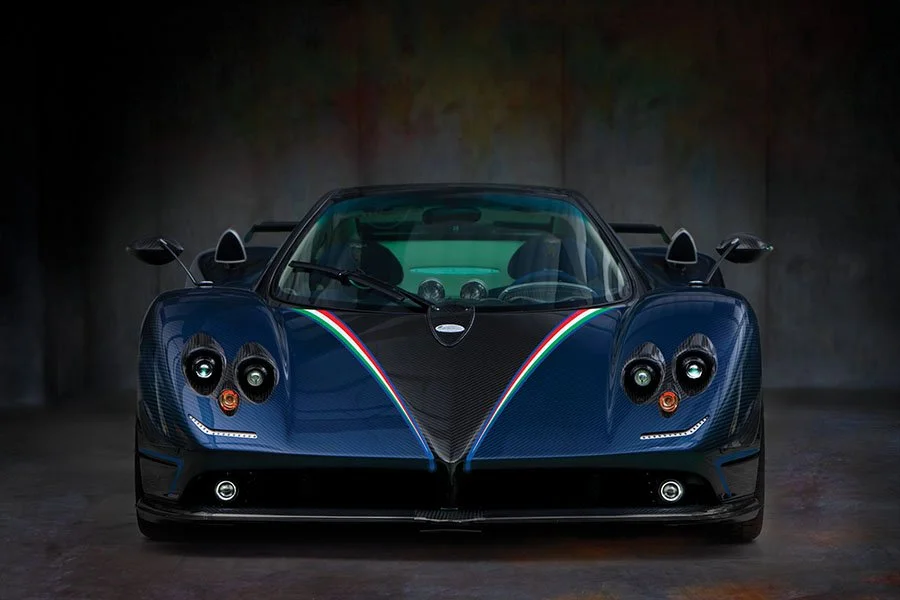
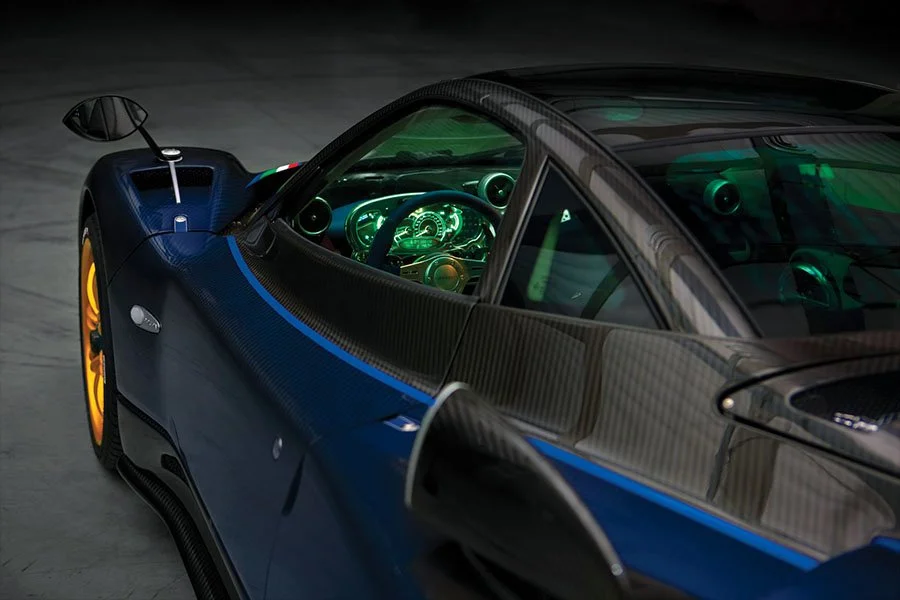
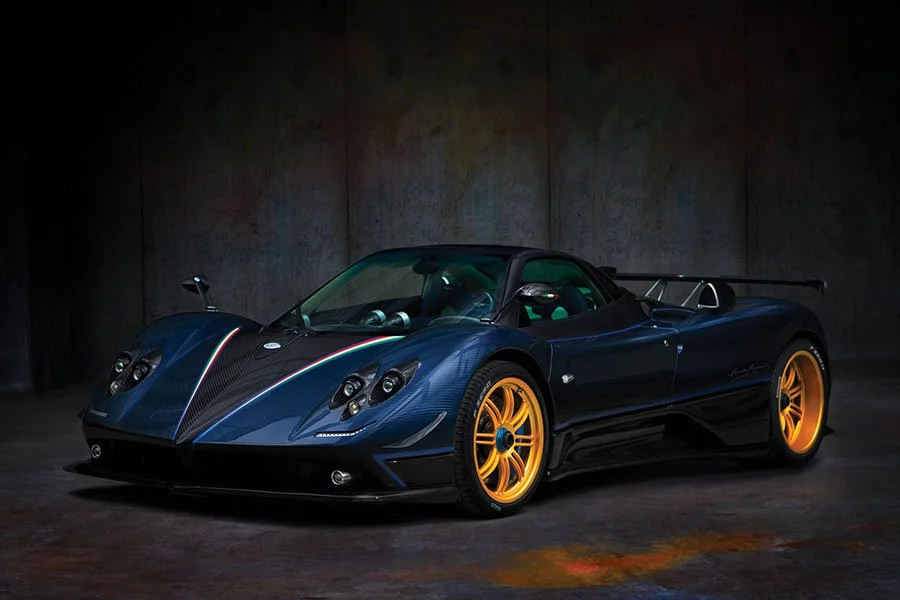
For the Tricolore, Pagani revised the Cinque theme by going for a more street-oriented specification and adding some unique exterior details. Each of the three cars was finished in a stunning duo-tone natural and blue tinted exposed carbonfibre livery.
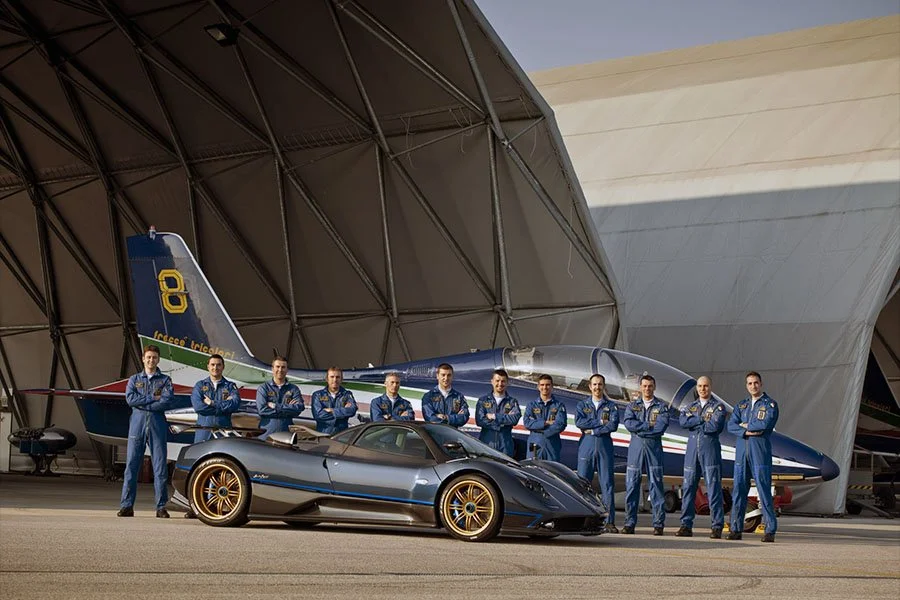
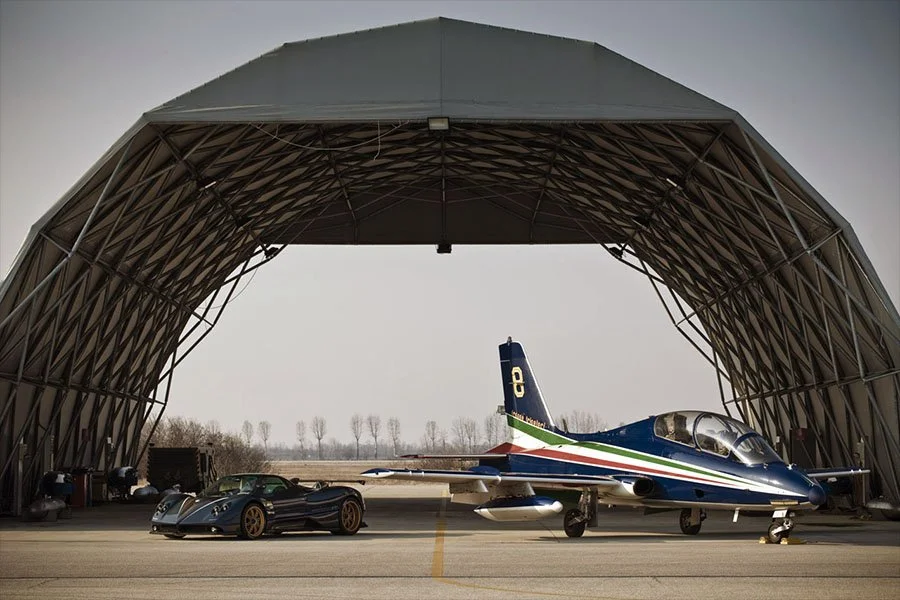
The handsome colour scheme (and the Tricolore in general) was Pagani’s tribute to the Frecci Tricolore, Italy’s National Aerobatic Team, which in 2010 was celebrating its 50th anniversary.
BODYWORK
As most of the differences between the Cinque and Tricolore concerned exterior details, let’s start there.
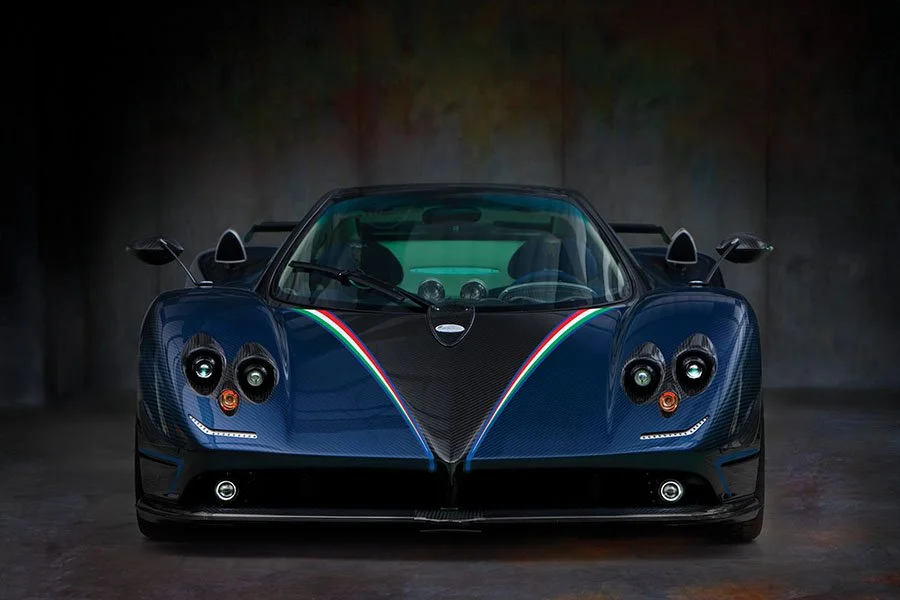
Up front, Pagani introduced a set of ticked LED daytime running lights at the leading edge of the fenders.
Lower down, the spot lights housed in each corner of the front intake aperture were mounted in natural aluminium instead of black bezels (as per the Zonda F). The tail light bezels were finished to match.
Instead of the Cinque’s dramatic roof-mounted snorkel, the Tricolore utilised the normal Zonda’s glass roof and rear screen. To compensate, snorkel-type air scoops mounted atop the rear fenders were enlarged.
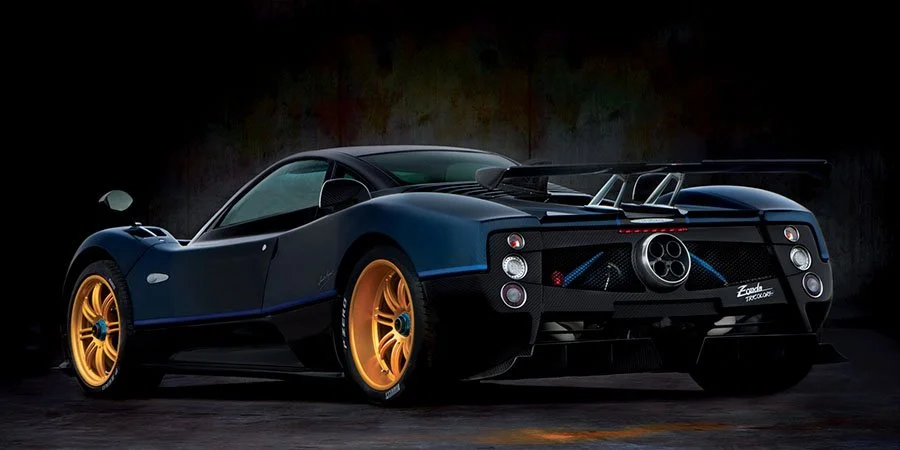
Further back was a custom vented engine cover with vertical shark fin-style stabiliser inspired by the Aermacchi MB-339-A/PAN flown by the Frecci Tricolore.
Imported from the Zonda F was that model’s simplified sill treatment and split instead of single-piece front fender vents.
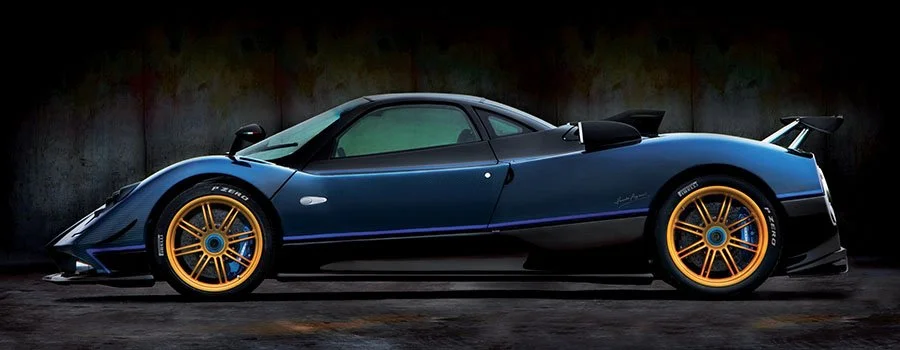
Cosmetically, Pagani left the Tricolore largely unpainted. Instead, it was finished in a mix of blue tinted and natural exposed carbonfibre. To this, red white and green stripes were painted on the nose and rear spoiler along with blue coachlines down each flank. The colour scheme was offset by plain gold wheels, blue brake calipers and blue wheel nut rings.
Finally, a natural aluminium Zonda Tricolore script was added to the tail fascia.
INTERIOR
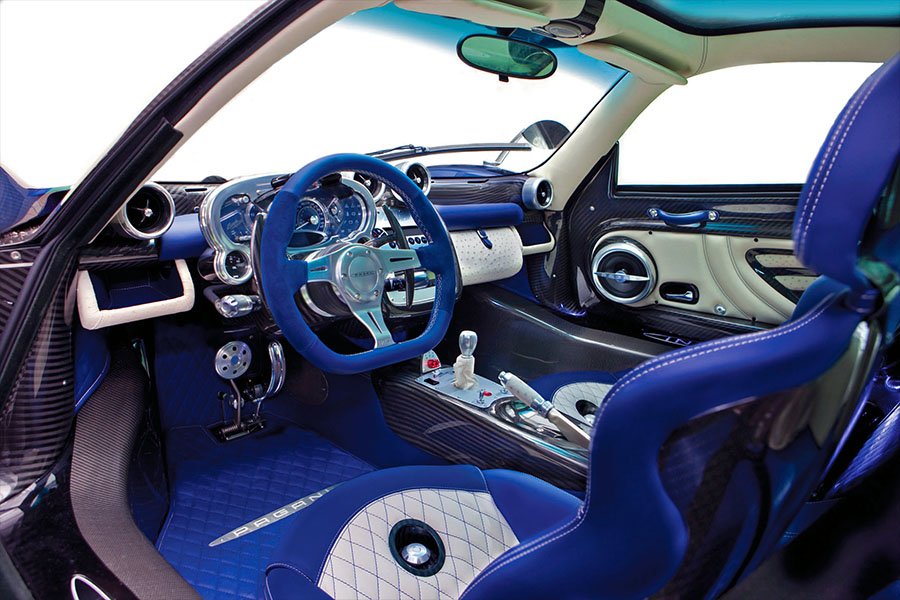
Inside was a largely Cinque-spec interior albeit with the natural aluminium brightwork used by most Zondas as opposed to the black effect found on the Cinque. This applied to the shrouds for the instrument binnacle, centre console and gear shift, the inboard sections of the steering wheel plus the bezels for the air vents and speakers.
In terms of the upholstery, Pagani opted for a two-tone blue and ivory combination with contrast stitching and diamond pattern quilting for the seat inlays and floor mats. The seats themselves were standard Zonda items as opposed to the Cinque’s bucket-type units.
Instead of a carbonfibre steering wheel trimmed in pure alcantara (as per the Cinque) the Tricolore’s aluminium steering wheel had its rim upholstered in a unique combination of leather and alcantara. Mounted either side of the steering column were the same exposed carbonfibre F1-style gear shift paddles found on the Cinque.
Like the Zonda F, the transmission came partially upholstered in leather whereas the Cinque unit had been fully exposed carbonfibre.
On top of the transmission tunnel was a gear shift lever for the sequential ‘box (forwards for downshifts, backwards for upshifts), a toggle switch for the three alternative drive modes, an engine start button and a simplified handbrake.
Air-conditioning, electric windows, electric mirrors, a high end audio system and a pair of suitcases that could be stowed in exposed carbonfibre luggage bins ahead of the rear wheels were included as standard.
All three Tricolores came with a numbered plaque mounted on the leather band above the glovebox door (added after the photographs of this first car were published).
Instrumentation comprised large analogue read outs for road and engine speed flanked to the left by a fuel gauge and to the right by a water temperature dial. At the base of the instrument binnacle was a digital screen that provided the driver with all kinds of additional diagnostic information.
CHASSIS
The Zonda Cinque had been the first car of any type to feature a monocoque tub inlaid with carbon-titanium composite fibre which added titanium into the carbonfibre weave for increased strength and rigidity. The exact same arrangement was adopted on the Tricolore.
Like all Zondas, the wheelbase measured 2730mm.
As per the F and Cinque, the Tricolore used chrome molybdenum steel subframes that had been honed a little thinner than earlier Zondas. The front subframe supported the suspension, power-assisted steering box and various auxiliary systems. It was also deformable in the event of a frontal impact. The rear subframe carried the engine, gearbox and suspension.
An 85-litre fuel tank located in the lower section behind the cockpit was retained.
Suspension-wise, the Cinque and Tricolore incorporated greater use of magnesium and titanium that other Zondas. Ergal shock absorbers and titanium springs developed by Ohlins were specific to these variants.
Like earlier Zonda road cars, ride height was electronically adjustable from within the cockpit.
As usual, the suspension layout comprised double wishbones all round along with an anti-roll bar at either end. Anti-dive and anti-squat geometry was installed as well.
Automatically fitted as standard to the Cinque and Tricolore was the carbon ceramic brake disc pack offered as an option on the Zonda F. 380mm discs were present at both ends with six-piston calipers up front and four-piston items at the rear.
Both the Cinque and Tricolore used R-style forged monoblock APP aluminium-magnesium alloy wheels that measured 9 × 19-inches at the front and 12.5 × 20-inches at the rear. They were shod with special Pirelli P Zero tyres (255/35 R19 and 335/30 R20 respectively). The rims were held in place with titanium centre-lock bolts instead of the five-bolt arrangement used by other Zonda road cars.
ENGINE / TRANSMISSION
In the engine bay was a Cinque-spec. version of the Mercedes-Benz Type M120 AMG 7.3-litre power unit which featured custom mapped Bosch engine management. Peak output went from 641bhp at 6200rpm (on the Club Sport-spec. F with its more radical camshafts) to 669bhp at an unchanged 6200rpm. The torque rating was once again 575lb-ft at 4000rpm.
These formidable Mercedes-Benz engines were longitudinally-mounted 60° V12s with wet-sump lubrication, an aluminium alloy block and heads, dual overhead camshafts and four valves per cylinder.
Having previously been installed without any further modification, that had changed with the Zonda F and was also the case for both the Cinque and Tricolore. The cylinder heads were uprated for improved flow, hot camshafts were installed and the ECU was re-tuned.
The intake and exhaust systems also came in for attention: a specific F / Cinque / Tricolore-type induction system featured larger intake manifolds and a hydroformed aluminium alloy intake plenum with reduced 1mm wall thickness replaced the standard Mercedes-Benz unit.
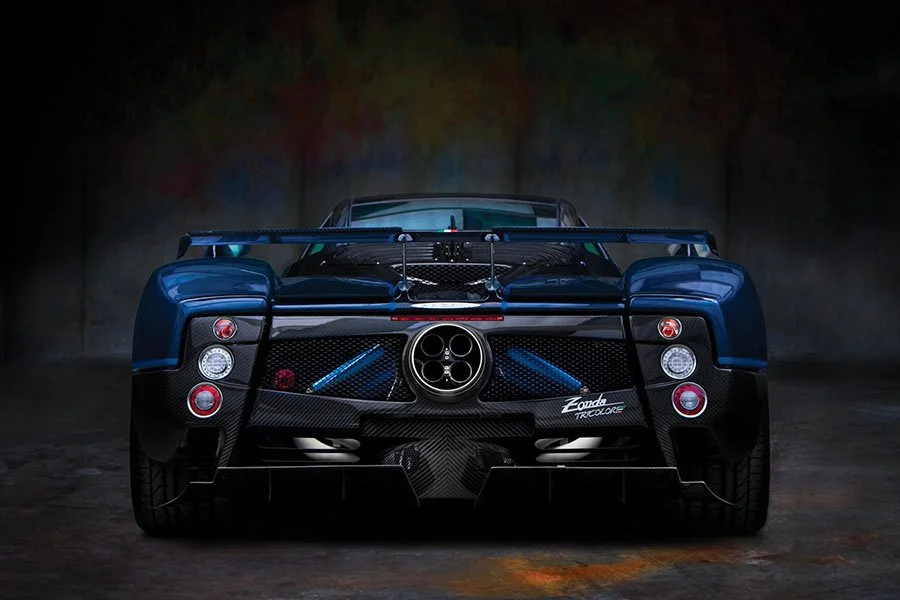
The exhaust manifolds were hydroformed as well; instead of the 1mm thick stainless steel arrangement, the Cinque and Tricolore got the normally optional 0.7mm Inconel superalloy system as standard. The exhausts and silencers were made by MHG in Germany; equal length pipes on the manifold were bent F1-style and ceramic coating was employed to keep temperatures down.
Displacement was an unchanged 7291cc thanks to a bore and stroke of 91.5mm and 92.4mm respectively. A 10.0:1 compression ratio was also retained.
Instead of the usual Pagani-built six-speed manual gearbox, among the major new features found on the Cinque and Tricolore was a sequential automated manual unit supplied by Cima and robotised by Automac Engineering. One of three alternative drive modes could be selected: Comfort, Sport and Race. In Race mode, shift times took less than 100 milliseconds and the traction control was automatically disabled.
OPTIONS
As the Tricolore came with practically everything imaginable as standard, no optional upgrades were officially offered although further personalisation would most likely have been possible given sufficiently deep pockets.
Unlike every road-going iteration of the Zonda since the 7.3-litre engine was introduced in 2002, the Tricolore was manufactured exclusively in Coupe format with no Roadster variant offered.
WEIGHT / PERFORMANCE
Quoted weight and performance figures were identical to the Cinque which in turn had been the same as the Zonda F in Club Sport trim.
Accordingly, the Tricolore had a published weight of 1210kg, a 0-62mph time of 3.4 seconds and top speed of 217mph.
PRODUCTION
Although Pagani had originally only expected to produce one Tricolore, three copies were eventually built, all of which were completed during 2010.
Text copyright: Supercar Nostalgia
Photo copyright: Pagani - https://www.pagani.com/