Short: The Miami Vice Ferrari Testarossas
/ Ben Tyer

Created by Anthony Yerkovich and produced by Michael Mann for NBC, Miami Vice ran for five seasons between late 1984 and early 1990.
The show starred Don Johnson and Philip Michael Thomas as vice cops, Sonny Crockett and Ricardo Tubbs.
Most episodes focused on the fight against drug trafficking and prostitution. The choice of music, fashion and cinematography borrowed heavily from New Wave culture of the 1980s.
Nearly all filming took place in Miami. Many episodes were filmed around Palm Beach and the South Beach section of Miami Beach, an area which, at the time, was blighted by poverty and crime.

During the first two seasons and two episodes of season three, Crockett drove a replica Ferrari 365 GTS/4 based on a Chevrolet Corvette C3 with McBurnie Coachcraft kit.
However, once the car gained notoriety, Ferrari filed a lawsuit that demanded McBurnie cease production owing to infringement of the Ferrari name and styling.
As Ferrari did not want to miss out on the massive publicity being generated by Miami Vice, the Italian firm donated two US-spec. 1986 Testarossas to the production company.
Chassis 63259 and 63631 were a matching pair of metallic black Testarossas with cream upholstery and the early single wing mirror configuration.

Producer Michael Mann was famously obsessive about the colours portrayed in the show. going so far as to ban earth tones such as red and brown. To make the Ferraris more visible when filming at night, both were repainted white soon after they arrived in the US.
The Testarossas starred from mid way through the 1986 season until the show’s demise.
Thanks to the use of a De Tomaso Pantera stunt car equipped with Ferrari panels, both Testarossas survived filming intact.
They were sold off by the production company when a sixth season of Miami Vice was cancelled.

Text copyright: Supercar Nostalgia
Photo copyright: NBC Universal: http://www.nbcuniversal.com/
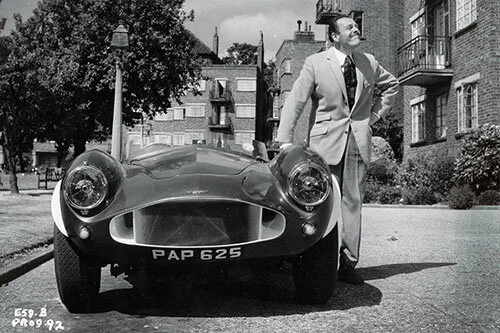
Aston Martin chassis DB3S/5 was one of five DB3S constructed in 1953. Built to contest a domestic and World Sportscar Championship programme, the new DB3S wore a beautiful Frank Feeley…

Chassis P/1018 was one of two Mk1 GT40s built to race trim for promotional use. It was commissioned by Ford on behalf of Carroll Shelby whose firm had undertaken much development…
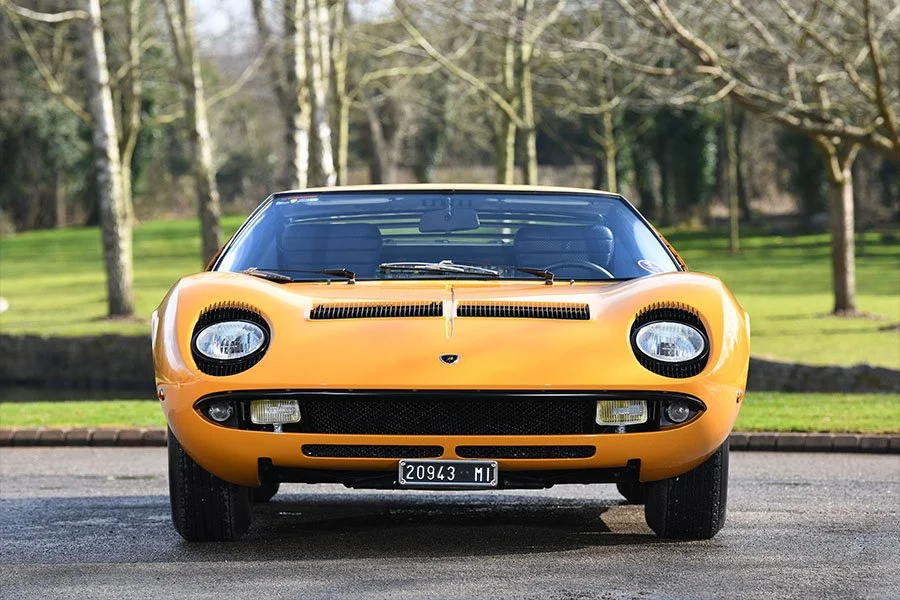
Had Lamborghini’s favoured coachbuilder, Touring of Milan, not gotten into financial difficulties, the car builder from Sant’Agata could have travelled a very different path. As it transpired, design…

In order to get the GT40 homologated into the new-for-1966 Group 4 Sports car class, Ford had to complete a minimum of 50 copies. Without sufficient demand for that number of racing variants, the…

In terms of the cars Ferrari should have officially offered during the 1980s, perhaps the best candidate was a Spider version of the iconic Testarossa. We use the phrase ‘officially offered’…

On January 18th at Mecum’s Kissimmee auction in Florida, one of the most famous movie cars of the modern era will be going under the hammer: Austin Powers’ Jaguar E-type 4.2 OTS Roadster…

Chassis M10003 started life as the last of three Mirage M1s built by John Wyer Automotive Engineering who had acquired the GT40 production rights from Ford. The M1 was a significantly…

As a consequence of having to build at leat 25 917s in order to qualify for the up to five-litre Group 4 category, Porsche ended up with many more 917s than they really needed. Following the FIA…

Chassis 4381 SA was the first of four cars built to 330 LMB specification for the 1963 racing season as successors to the solitary GTO-bodied 330 LM campaigned at the Nurburgring and Le Mans in 1962…

Chassis 5139 SA was the last of 22 400 Superamericas built to Series 2 specification, 14 of which were completed with Pininfarina’s Coupe Aerodinamico bodywork and covered headlights. It was…

Chassis DB5/2017/R was one of four DB5s built in period to Q-branch specification for Eon Productions. The first pair (DP/2161/1 and DB5/1486/R) were used in the making of the 1964 smash…

After a brief dalliance with Lotus in The Spy Who Loved Me and For Your Eyes Only, EON Productions decided upon a return to Aston Martin for the 15th James Bond movie, The Living Daylights. At the…

With its uprated short wheelbase chassis, tricked-out 302bhp engine and close-ratio four-speed gearbox, the DB4 GT was the fastest Aston Martin yet seen upon its launch at the London Motor…

Following his acquisition of Aston Martin, David Brown decided to embark on an international competition programme to raise the company’s profile. Production-based DB2 racers were…

Soon after Aston Martin had unveiled the DB5 at the London Motor Show in October 1963, movie producers Harry Saltzman and Albert ‘Cubby’ Broccoli approached the company about the loan of…

As its DP chassis moniker would suggest, DP/2161/1 began life as an Aston Martin Design Prototype. It initially emerged from the Newport Pagnell factory as a Fiesta Red DB4 Series 5 with black…

Chassis 6114 was a Type 45 Elan S3 DHC supplied new to Associated British Productions in Teddington, London. It was the second Elan destined for use in the popular TV show, The Avengers…

For many, the 427-engined wide-bodied Competition Cobra remains the definitive incarnation of the collaboration between AC and Carroll Shelby. Shelby had originally hoped to produce 100…

The World Is Not Enough was the 19th film in the James Bond franchise and the third to start Pierce Brosnan as secret agent 007. The plot saw Bond assigned to protect the daughter of an oil magnate…

Chassis SL76/149 was sold to 28-year old English privateer, Mike de Udy, for his 1969 campaign. Prior to this latest T70, in 1967 de Udy had purchased a new first generation Mk3 GT (chassis SL73/105)…

Chassis SL76/145 was sold to Lola’s US distributor, Carl Haas, of Lincolnshire, Illinois. Together with the sister cars of Roger Penske and John Love, SL76/145 was expected to form part of a three-car…

Chassis 1004 was one of eight 512 S campaigned by Scuderia Ferrari during the 1970 World Sportscar Championship. It debuted at the opening race of 1970 - the Daytona 24 Hours - as part of a…

Chassis 024 was one of the rare Porsche 917s that never raced in period. The car made its debut appearance at the 1970 Le Mans Test which took place over the weekend of April 11th and 12th.

Chassis 013 was one of the eight 917s raced on Porsche’s behalf by the Gulf-backed John Wyer Automotive Engineering crew during 1970. 013 first appeared as a T-car for the Daytona 24 Hours…

Chassis 1121208 was a left-hand drive European-market Countach LP400 S built during the Series 2 era. These Series 2 derivatives retained the low body configuration of the Series 1 variant and added…

Chassis DB5/2008/R was one of four DB5s built in period to Q-branch specification for Eon Productions. The first two examples (DP/2161/1 and DB5/1486/R) were used in the making of the 1964…

Chassis 1016 was the first of two Ferrari 512 S supplied to Scuderia Filipinetti in 1970. Scuderia Filipinetti was the racing team owned by the Ferrari distributor for Switzerland, Georges Filipinetti.

The Living Daylights was the 15th film in the James Bond franchise and the first to star Timothy Dalton as Roger Moore’s replacement. Unlike Moore’s light-hearted style, Dalton successfully…

Of the 50 Zagato-bodied V8 Vantages built between 1986 and 1987, only two were originally painted Swift Azure. One was right-hand drive with Dark Blue upholstery (chassis 20015) while the other was…

Chassis 1121112 was one of 105 Countach LP400 S built to Series 2 specification between autumn 1979 and summer 1981. Compared to the Series 1, the second iteration of the LP400 S came with…