VIN: the works Shelby Cobra Daytona chassis CSX 2601
/ Ben Tyer
HISTORY OF CHASSIS CSX 2601
Along with CSX 2602, CSX 2601 was one of two Cobra Daytonas built for the 1965 season after Shelby’s fleet of four 1964 cars had narrowly missed out on that year’s World Championship.
CSX 2601 was used ineight of the nine races contested in 1965 and emerged with class wins in four of them.
Its debut was at the Daytona 2000km. In the hands of Bob Johnson and Tom Payne, it qualified sixth with the sister cars fifth, seventh and eighth. However, at mid distance, the engine blew and the car was retired.
The same two drivers were in CSX 2601 for the Sebring 12 Hours a month later where it qualified slowest of the four team cars in 17th. However, problems for some of the other Cobra Daytonas saw Johnson and Payne take the GT class lead.
After surviving the famous thunderstorm on Saturday night, they came home seventh overall and second in class.
For the rest of the season, CSX 2601 was prepared by Alan Mann Racing.
At the Monza 1000km, it was driven by Bob Bondurant and Allen Grant who qualified fastest of the two Cobra Daytonas and started ninth. Up against limited opposition, Alan Mann told his drivers to take it easy and ensure they collected maximum points. Bondurant and Grant drove conservatively to eighth overall and collected the class win.
Bondurant raced single-handedly at the Spa 500km and, with only a small number of Prototype entries, he qualified fifth. John Whitmore was second in the sister car.
On lap eight, Bondurant’s machine started running on seven cylinders. With Mann’s squad unable to detect where the problem lay, CSX 2601 was sent back out. Remarkably, Bondurant not only completed the race, but finished fifth overall and secured another class win.
At the Nurburgring 1000km a week later, Alan Mann ran three Cobra Daytonas and they proved by far the quickest GT cars in the event. On this occasion, Bondurant was joined by Jochen Neerpasch and qualified CSX 2601 in eleventh with the sisters cars lining up 18th and 20th.
The American machines romped home to victory in the GT category; Bondurant and Neerpasch placed seventh overall and took another class win.
Le Mans one month later saw CSX 2601 run under a Ford France entry in its normal Shelby colours. It was driven by Jo Schlesser and Allen Grant, one of five Cobra Daytonas that started the race.
Schlesser and Grant lined up 23rd on the grid (second slowest of the quintet).
Around midnight, the car had a half shaft replaced. Clutch problems then forced it out of the race after 111 laps.
The penultimate event for CSX 2601 came two weeks later. Entered for Bondurant and Schlesser to drive at the Reims 12 Hours, the car qualified ninth with the sister machine tenth.
A largely trouble-free run saw Bondurant and Schlesser finish fifth overall to secure another GT class victory.
CSX 2601’s final period outing was at the Coppa Citta di Enna, a 500km race for GT cars. The Cobra Daytonas headed to Italy with the championship already secure. Bondurant qualified third behind a pair of Ferrari 250 LMs.
Although not homologated as GT cars by the FIA, the LMs were permitted to run in a special GT class by the Italian organisers.
Bondurant looked to be heading for outright victory, but two pit stops put him out of the running. He eventually finished third and took the over three-litre GT class win.
With the Cobra Daytonas obsolete from 1966 because of rule changes, CSX 2601 was retired from active duty.
It was flown back to Los Angeles, refreshed and sold to Bob Bondurant who retained it until 1969.
Notable History
Shelby American
Guardsman Blue Metallic with White stripes
28/02/1965 WSC Daytona 2000km (B. Johnson / T. Payne) DNF (#12)
27/03/1965 WSC Sebring 12 Hours (B. Johnson / T. Payne) 7th oa, 2nd GT5.0 class (#14)
25/04/1965 WSC Monza 1000km (B. Bondurant / A. Grant) 8th oa, 1st GT3.0+ class (#48)
16/05/1965 WSC Spa 500km (B. Bondurant) 5th oa, 1st GT5.0+ class (#20)
23/05/1965 WSC Nurburgring 1000km (B. Bondurant / J. Neerpasch) 7th oa, 1st GT3.0+ class (#54)
20/06/1965 WSC Le Mans 24 Hours (J. Schlesser / A. Grant) DNF (#12)
04/07/1965 WSC Reims 12 Hours (B. Bondurant / J. Schlesser) 5th oa, 1st GT3.0+ class (#26)
15/08/1965 WSC Coppa Citta di Enna (B. Bondurant) 3rd oa, 1st GT3.0+ class (#24)
Sold to Bob Bondurant
Text copyright: Supercar Nostalgia
Photo copyright: Ford - https://www.ford.com
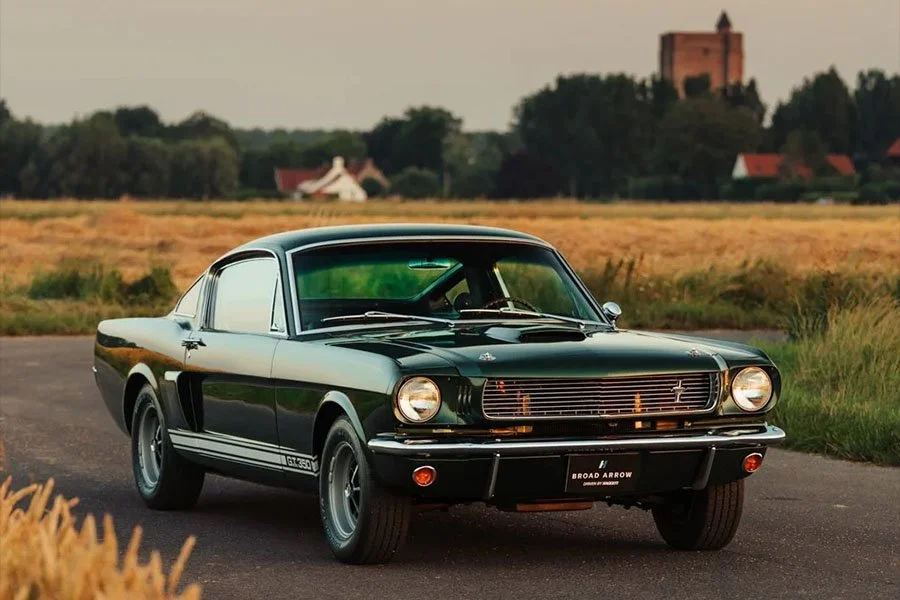
Only a tiny fraction of Shelby’s Ford Mustang-based GT350s made their way across to Europe in period, one of which was chassis SFM6S775 whose first owner was a key player in the GT40…

CSX2174 was one of 453 Cobra road cars built with the 289-engine. Completed in left-hand drive with a Vineyard Green exterior, the new car was famously loaned to the actor, Steve McQueen, for a…

Of the myriad Cobra variants, one of our favourites here at Supercar Nostalgia is the comparatively little known AC-badged, 427-chassis’d but 289-engined iteration sold by AC Cars in Great Britain…
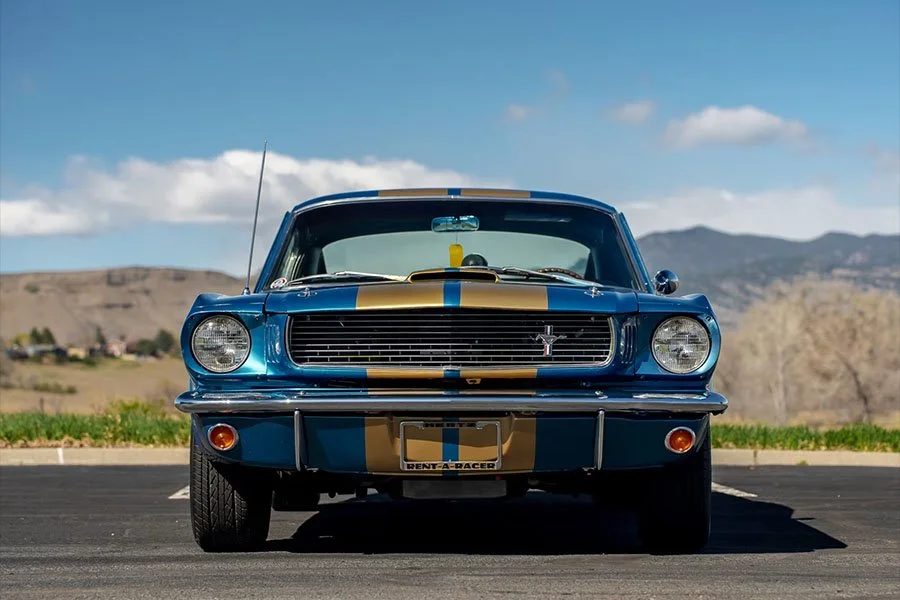
In September 1965, Ford signed an agreement with Hertz Rental to supply 1000 special copies of the Shelby Mustang GT350. The resultant GT350H would be available to Hertz Sports Club members for…
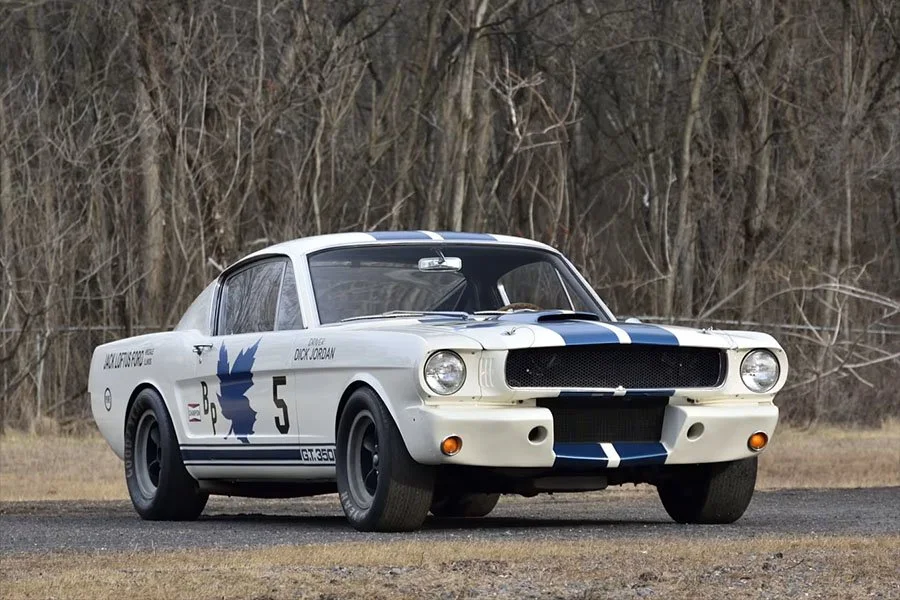
To pave the way for an attack on the SCCA B Production Championship, Ford commissioned Shelby to create the GT350 Mustang, at least 100 of which would have to be manufactured in order to…
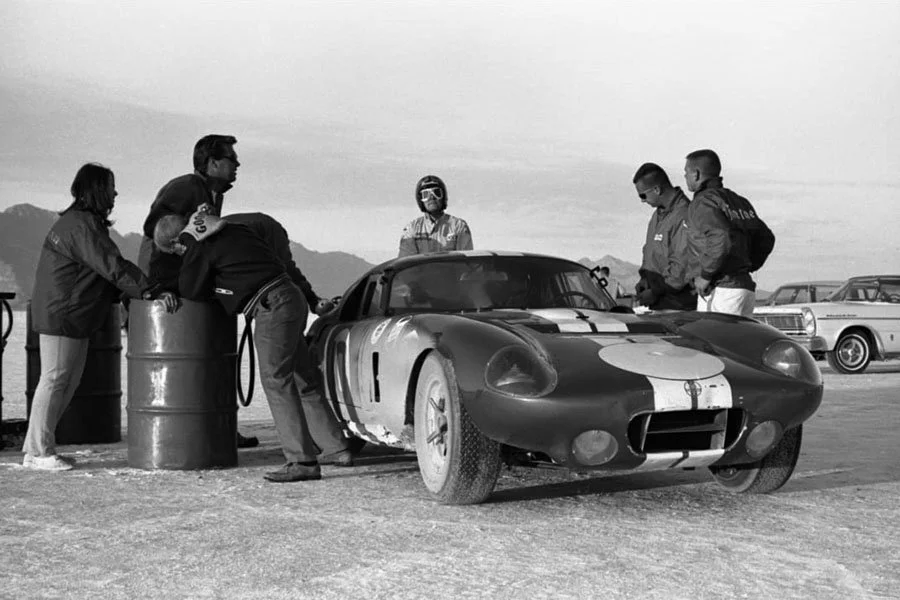
Chassis CSX2287 was the first Cobra Daytona completed and the only one whose panels were fabricated by California Metal Shaping in Los Angeles. Assembly took place at Shelby’s workshop in…
One of the rarest Cobra options offered by Shelby was the Dragonsnake pack. Conceived with drag racing in mind, it included items like modified rear fenders to accommodate slick-shod American…

Ford’s Total Performance programme of the 1960s spawned some legendary machinery of which the four-time Le Mans winning GT40 is particularly revered. The company’s engines were also…

Chassis P/1018 was one of two Mk1 GT40s built to race trim for promotional use. It was commissioned by Ford on behalf of Carroll Shelby whose firm had undertaken much development…

To get his exciting Cobra project off the ground ahead of any potential financial input from Ford, Carroll Shelby teamed up with professional racing driver and high end European car dealer, Ed…

Having retired from a successful driving career that most notably yielded outright victories at the 1959 Le Mans 24 Hours and Goodwood Tourist Trophy (both under the employment of the Aston…

In order to get the GT40 homologated into the new-for-1966 Group 4 Sports car class, Ford had to complete a minimum of 50 copies. Without sufficient demand for that number of racing variants, the…

In addition to the revered Shelby Cobras, AC Cars in Great Britain, who had done much development work and still handled the lion’s share of the assembly process, sold Cobras…

Since 1962, various iterations of the AC and Shelby Cobra had been used to win myriad races and championships. However, the one title that had proven elusive was the World Sportscar…

Having narrowly been defeated by Ferrari in the fight for the 1964 World Sportscar Championship, Shelby returned for another crack in 1965. By this time, the American team’s fleet of Cobra Daytonas…

With Ferrari having so far completely dominated the Group 3 Grand Touring era of the World Sportscar Championship, the Ford-backed Shelby outfit with its trick new Cobra Daytonas went…

In 1965, the Essex Wire Corporation went public on the New York Stock Exchange and embarked on a marketing partnership with Ford that saw the firm go racing with the GT40, Shelby Cobra and…

Because Ford had commissioned Shelby to produce the GT350 as a hot Mustang to contest the SCCA B-Production championship, it was no surprise that a good number of privateer owners…

In 1963, half a dozen 289-engined GT class Shelby Cobras were built to Competition Le Mans trim. This small batch of cars were inspired by a pair of Cobras that had contested the Le Mans 24 Hour…

Conceived as a more compact replacement for previous models like the Mk9 and Mk10, the Lotus Eleven went on to become arguably the most successful small displacement sports racing car of its…

Having dabbled in a variety of motor sport disciplines since his company’s 1959 inception, Alejandro de Tomaso’s first production model, the Vallelunga Coupe, entered the final throes of development…

For many collectors and enthusiasts, the ultimate incarnation of the legendary AC / Shelby Cobra is the seven-litre 427 Competition. Produced between 1965 and ‘67, just 23 of these legendary…

Chassis P/1004 was an early Mk1 GT40 allocated to Ford’s six-car attack at the 1965 Le Mans 24 Hours. Following preparation by Shelby in California (completed May 5th 1965), it ran at Le Mans in…

Chassis GT/104 was one of twelve Ford GT Prototypes manufactured prior to the subsequent Mk1 and Mk2 variants. GT/104’s debut appearance came alongside a brace of sister cars at the 1964 Le…

Chassis P/1031 was one of eleven GT40s either built up or converted to seven-litre Mk2 trim and campaigned during the 1966 season. These top flight cars were created for ultra high speed tracks…

As a consequence of its lusty 260 cubic-inch V8 engine, light weight construction and excellent handling characteristics, the Mk1 Shelby Cobra was a fast and reliable entry for all manner of motor…

Chassis CSX2136 was the first of six 289-engined GT class Shelby Cobras built to Le Mans Replica trim. This small batch of cars was inspired by a pair of Cobras that had contested the Le Mans 24…

In addition to the GT40 and Cobra programmes, Ford commissioned Shelby to create an uprated Mustang to compete in the SCCA B-Production Championship. The resultant Shelby GT350 was…

Chassis P/1047 was one of twelve GT40s raced in seven-litre Mk2 trim during the 1966 season. It made its competition debut as part of an eight-strong Mk2 contingent that attended the Le Mans 24…

For many, the 427-engined wide-bodied Competition Cobra remains the definitive incarnation of the collaboration between AC and Carroll Shelby. Shelby had originally hoped to produce 100…