One to Buy: Briggs Cunningham's 1953 Fiat 8V Ghia Supersonic
/ Ben Tyer
Launched at the Geneva Motor Show in March 1952, the 8V utilised Fiat’s new two-litre overhead valve all-alloy V8 that had originally been conceived for use in a large Berlina (Saloon).
The rakish light weight two-door platform boasted independent suspension all round and engines rated at between 105bhp and 125bhp. With its spritely performance, the 8V went on to record an enviable competition record that included a succession of Italian GT Championship titles.
Each 8V was bodied by the customer’s coachbuilder of choice with Fiat’s special in-house department clothing around a third of the production run. Unfortunately though, with just 114 made by the time production ended in 1954, the 8V was a commercial flop for Italy’s biggest car manufacturer.
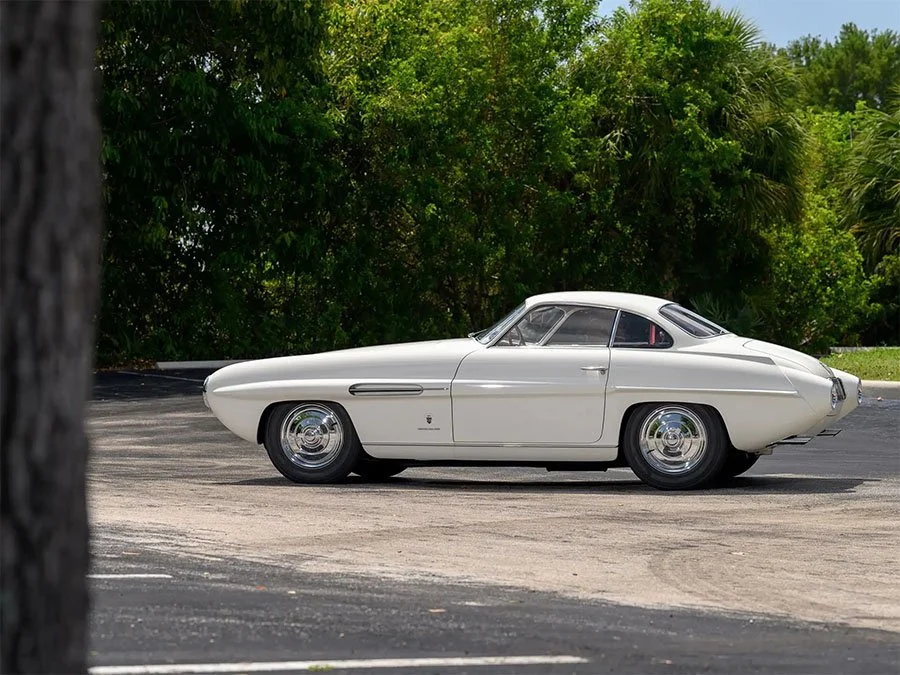
14 8Vs were dispatched to Carrozzeria Ghia where they were equipped with the Turin firm’s Supersonic design created by stylist Giovanni Savonuzzi,
One of these, chassis 043, will be going under the hammer at RM Sotheby’s Monterey auction taking place between August 17th and 19th.
This particular example was part of a two-car order placed by New York dealer Howard Darrin during the summer of 1953. Darrin received his pair of Supersonics that December; chassis 39 was sold to Hollywood actress Lana Turner while 043 went to American industrialist and sportsman, Briggs Cunningham.
Subject to a restoration completed by marque experts in 2014, chassis 043 is presented in exceptional condition throughout.
For more information visit the RM Sotheby’s website at: https://rmsothebys.com/
Although the Stratos had it all and then some, the Fiat Group’s replacement was derived from more mainstream fare and proved you didn’t need bona fide supercar characteristics to become the era’s…
While certain aspects of Pininfarina’s stunning 206 P-based Dino Berlinetta Speciale that appeared at the 1965 Paris Motor Show were adopted for Ferrari’s mid-engined Dino road car, the…
The 1968 Le Mans 24 Hours is arguably best remembered because of the five lap victory achieved by Pedro Rodriguez and Lucien Bianchi in their Gulf Oil-backed Ford GT40 campaigned by John Wyer…
Tuscany has all manner of public roads doing a laudable impressions of a tarmac rally stage, and if you’re going to drive an Italian homologation special around for a day you’d struggle to find a better area to get lost in on purpose.
Having commissioned its newly acquired Abarth competition department to create a Group 4 homologation special based on the 124 Sport Spider, Fiat’s new-for-1973 special stage challenger…
The 124 was launched by Fiat in 1966 as its mid-range offering and replacement for the outgoing 1300 / 1500 line which had been in production since 1961. Originally unveiled as a four-door Sedan at…
Unveiled at the Paris Motor Show in October 1958, Abarths new dual overhead cam 750 Bialbero Record Monza instantly became the car to beat in the sub 1-litre GT racing categories. Based on…
Having already created a 594cc version of Fiat’s eponymous 500 back in 1963 (the 595), Abarth elected to take the four cylinder engine’s capacity out to just under 700cc with the 695 SS of 1964.
Although Fiat had not offered a particularly sporting model since the commercially unsuccessful 8V back in the early 1950s, the FIA’s decision to implement new Formula 2 racing regulations for the…
Alongside Abarth’s high performance conversions, the Jolly beach cars coachbuilt at the Ghia works from 1957 remain arguably the most sought after iteration of Fiat’s ubiquitous 600.
The Dino-badged Fiats and Ferraris of the late 1960s were created in order to homologate a V6 Formula 2 engine. As Ferrari did not have the capacity to build the 500 engines required, a…
Having commissioned arguably the most radical rally car ever to tackle the special stages in 1971 (the Lancia Stratos), for marketing reasons the Fiat Group decided its replacement should be more…
Launched at the Geneva Motor Show in March 1952, the 8V utilised Fiat’s new two-litre overhead valve all-alloy V8 that had originally been conceived for use in a large Berlina (Saloon). The rakish…
For three straight season between 1974 and 1976, Lancia set the World Rally Championship alight with the purpose-built Stratos, the like of which had never been seen before. However, while the…
In October 1969, the struggling Lancia concern was purchased by Fiat. Abarth followed in July 1971 and became Fiat’s competition department. Despite the fact that both firms were owned by the…
At the Turin Motor Show in October 1974, Fiat launched the new 131. Available as a two or four-door saloon as well as a five-door estate, the 131 replaced the 124 as Fiat’s mid-range model.
After World War 2, jet engine technology developed rapidly. By the early 1950s, combat aircraft were almost universally jet-powered and civilian air liners had started to follow suit. No power…
Although production of the two-litre Fiat Dino Spider was discontinued in December 1968, an improved version with enlarged 2.4-litre engine entered production in September 1969. Freed…
When the commercially unsuccessful 8V was discontinued in 1954, Fiat focused their attention on mass production models. An informal arrangement with Abarth was satisfactory for the Fiat board…
When Fiat decided to build a mid-engine sports car, they invited proposals from Bertone and Pininfarina. The less expensive Bertone X1/9 was selected for production while Pininfarina’s bigger…