VIN: the works / Rusty French De Tomaso Pantera Gr.4 chassis 2872
/ Ben Tyer
HISTORY OF CHASSIS 2872
Chassis THPNMR02872 was one of 14 Group 4 Panteras built.
Aside from the prototype (completed in December 1971), the remaining cars were assembled in 1972.
2872 was signed off on June 27th. It was one of the last four examples constructed, none of which raced that season.
Three of these Panteras subsequently embarked on a competition career in 1973. Two went to Jolly Club while chassis 2872 was retained as a works car.
2872 made its competition debut at Imola for round three of the European GT Championship.
Mike Parkes was recruited to drive and showed he had lost none of his old touch as he qualified on pole, posted fastest lap and won both 20 lap heats. Only the Kremer Porsche 911 2.8 Carrera RSR of Clemens Schickentanz managed to stay in touch but it never looked like getting ahead.
Parkes was then recalled for the next European GT Championship race which took place at Nivelles. He again qualified on pole despite not participating in the second practice session as a result of a suspect engine.
Parkes fluffed his start in the first heat and almost immediately picked up a puncture. He pitted at the end of lap one and emerged five laps down. 2872 retired on the 19th lap with a burnt piston and did not appear for the second heat.
The car’s third and final appearance of 1973 came at round seven of the championship which took place at Hockenheim. For this event, BRM team leader, Clay Regazzoni, was behind the wheel.
Only the third and final practice session was dry. Regazzoni took 2872’s third consecutive pole and, in the first 20 lap heat, he won from Schickentanz by nearly half a minute. Regazzoni’s margin of victory in the second heat was twelve seconds which meant he took a fine aggregate win.
Chassis 2872 subsequently returned to Modena where it sat unused for nearly two years.
In late 1975, it was sold to amateur Australian driver, Rusty French.
The French family own Skye Sands in Carrum Downs, Victoria. To this day, Skye Sands extracts sand, soil and clay which is supplied to the construction industry.
Rusty French began racing in 1966 with an Austin Seven-based machine. He subsequently moved up to a Chevrolet Impala which was followed by Hillmans and Valiants. French took a break from racing in the early 1970s to run a prestige import dealership in Sydney.
He returned to the track with the Pantera which, once landed in Australia, was converted to full dry-sump lubrication and McGee mechanical fuel-injection. The fuel tank was also repositioned and a weight reduction programme was undertaken.
2872 was soon switched to the black and gold livery French has since became famous for.
Rusty French raced 2872 in the Australian Production Sports Car Championship from 1976 to 1981. The series was thereafter switched to a GT championship for which French purchased a Porsche 935.
Rusty French still retains chassis 2872 today.
Notable History
De Tomaso Automobili, Modena, Italy
Red & Black livery
03/06/1973 EGT Imola (M. Parkes (#111) 1st overall, 1st in GT3.0+ class (#111)
24/06/1973 EGT Nivelles (M. Parkes) DNF (#35)
26/08/1973 EGT Hockenheim (C. Regazzoni) 1st oa, 1st in GT3.0+ class (#1)
1975 sold to Rusty French, Victoria (Holley Performance)
Raced in the Australian Sports Car Championship from 1976 to 1981
Text copyright: Supercar Nostalgia
Photo copyright: Ford - https://www.ford.com
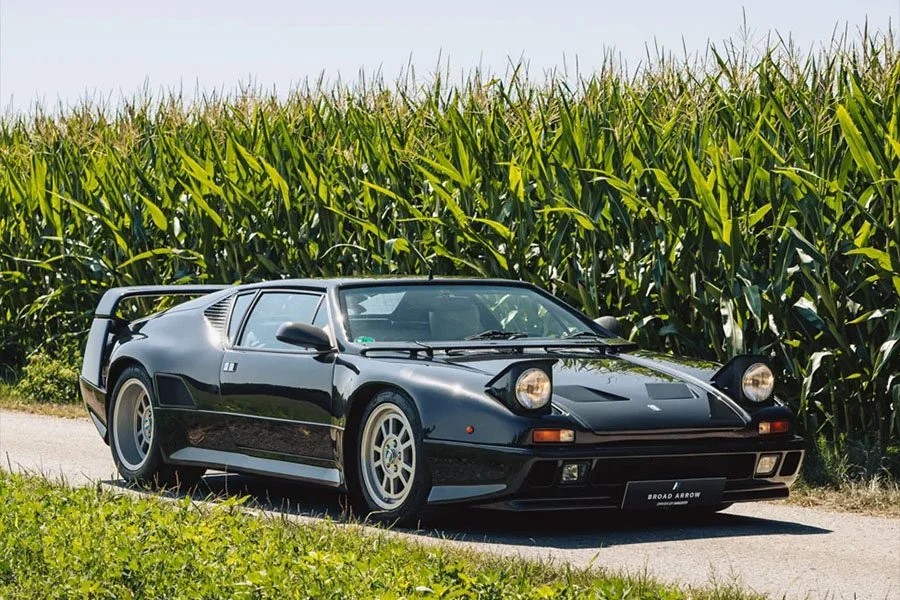
In the midst of a booming collector car market, De Tomaso must have been pretty confident that its final iteration of the long-running Pantera, the SI, would be a commercial hit on its Turin Motor Show…

Having raced a variety of cars in his native Argentina, Alejandro de Tomaso departed for Italy in 1955. De Tomaso hailed from a politically prominent family and his move to Europe was reputedly…

Although the Mangusta propelled De Tomaso to international fame, the Pantera was the firm’s breakthrough model. Several thousand Panteras were built, most of which left the factory between…

As part of the deal that saw Ford take a controlling stake in De Tomaso Automobili, the US giant funded development of a Group 4 racing Pantera that would go head-to-head with the Ferrari…

One of the last two Gr.4 Panteras built, both of which were completed in December 1972, chassis THPNMR02873 was allocated to the Jolly Club in Milan who would run the car on De Tomaso…

Having been the second manufacturer to offer a mid-engined production car (the four cylinder Vallelunga), Alejandro de Tomaso took his company into the big league when he launched a V8…

The wide-bodied Pantera GT5 unveiled at the Turin Motor Show in November 1980 ushered in the kind of fat arches, deep side skirts and massive spoilers that were so in vogue at the time.

Chassis THPNMR02860 was one of 14 Panteras built to Group 4 racing specification. Completed on April 13th 1972 and dispatched to De Tomaso’s Belgian distributor, Claude Dubois in Brussels, it…

Having dabbled in a variety of motor sport disciplines since his company’s 1959 inception, Alejandro de Tomaso’s first production model, the Vallelunga Coupe, entered the final throes of development…

Introduced at the Turin Motor Show in November 1980, the GT5 was De Tomaso’s new range-topping iteration of the Pantera and became one of the few supercars of the Countach era that could match…

Flush with Ford cash, De Tomaso decided to take the Pantera Group 4 motor racing where it would go head-to-head with Ferrari’s 365 GTB/4C, the Porsche 911 Carrera RSR and Chevrolet’s Corvette.

Having acquired De Tomaso to get their hands on the Pantera and beat domestic rivals GM and AMC to be the first to offer a mid-engined model, Ford also financed a high profile Group 4 racing…

De Tomaso focused their maiden Pantera campaign in 1972 on Group 4 racing. Here, the wide-arched and circa 470bhp Pantera Gr.4 had the speed to match anything in its class. To qualify for…

Chassis THPNLM02263 was the first of 14 Panteras built to Group 4 specification and the only example manufactured in 1971. It was completed on December 2nd of that year in the trademark…

The late eighties supercar boom proved a blessing for De Tomaso as an influx of speculators led to dramatically increased demand for all kinds of collectable and exotic motor cars. As a result, the…

When De Tomaso unveiled the Pantera GT5 at the Turin Motor Show in November 1980, sales of the existing narrow-bodied Pantera began an inexorable decline. The GT5 tapped into the zeitgeist for…

Chassis THPNMR02872 was one of 14 Group 4 Panteras built. Aside from the prototype (completed in December 1971), the remaining cars were assembled in 1972. 2872 was signed off on June 27th. It…

Ever since Alessandro de Tomaso established his own company in 1959, he had sought the investment of a major motor manufacturer. That dream finally came true in 1969 when the Ford Motor…

Chassis THPNLM02824 was one of the works-prepared Group 4 Panteras allocated to De Tomaso’s official motor sport partners in 1972. It was supplied to the French De Tomaso distributor, Franco…

Chassis THPNMB02344 was one of 14 Group 4 Panteras built, twelve of which were assembled in 1972. 2344 was completed on March 16th 1972 and painted two-tone Red and Black. It was…

Alessandro de Tomaso’s early days as an auto manufacturer focused on the production of single seat and sports racing cars. The period 1959 to 1962 was generally spent trying to compete at a level…

Despite early teething troubles, by 1972, De Tomaso had transformed the Pantera into the kind of well built and reliable package that the Ford Motor Company originally expected. Ford had…

Since his company’s 1959 inception, Alejandro de Tomaso had skipped from one project to the next. Myriad Formula, Sports and concept cars had emerged, but it was not until the Ghia-built Vallelunga…

Completed on May 15th 1972, chassis THPNMR02859 was one of 14 Panteras built to Group 4 competition specification. It was sold to Swiss racing driver, Herbert Muller. Having spent many years…

Chassis THPNMR02823 was one of twelve Group 4 Panteras built for the 1972 season. A further two cars were assembled at the end of the year which took total production to 14 units. Completed on…

Ford’s Total Performance programme of the 1960s proved a remarkable success. It extended to practically every facet of motor sport and most famously yielded four straight wins at the Le Mans 24…

The Competizione 2000 was one of several De Tomaso racing concepts produced during the mid 1960s. Few saw competition use but, along with myriad experimental engines, they illustrated De…

Although the solitary P70 that later evolved into the Sport 5000 failed to secure De Tomaso the hoped-for partnership with Carroll Shelby, the underpinnings from this experimental sports…

After producing models like the Pantera, Longchamp and Deauville for nearly 20 years (all originally bankrolled with Ford money), by the early 1990s, safety and emissions legislation had finally caught…

Shortly before he acquired Carrozzeria Ghia from Ramfis Trujillo in 1967, Alejandro de Tomaso commissioned the company to build an open two-seat concept on a stretched Vallelunga chassis.