Guide: BMW Art Car #13 - BMW E36 325i C1 DTM Prototype 'Sandro Chia'
/ Ben Tyer
BACKGROUND
After BMW commissioned just two Art Cars between 1980 and 1988, a glut of seven arrived between 1989 and 1992.
The last of these seven cars and the only example produced in 1992 was the work of Italian painter and sculptor, Sandro Chia.
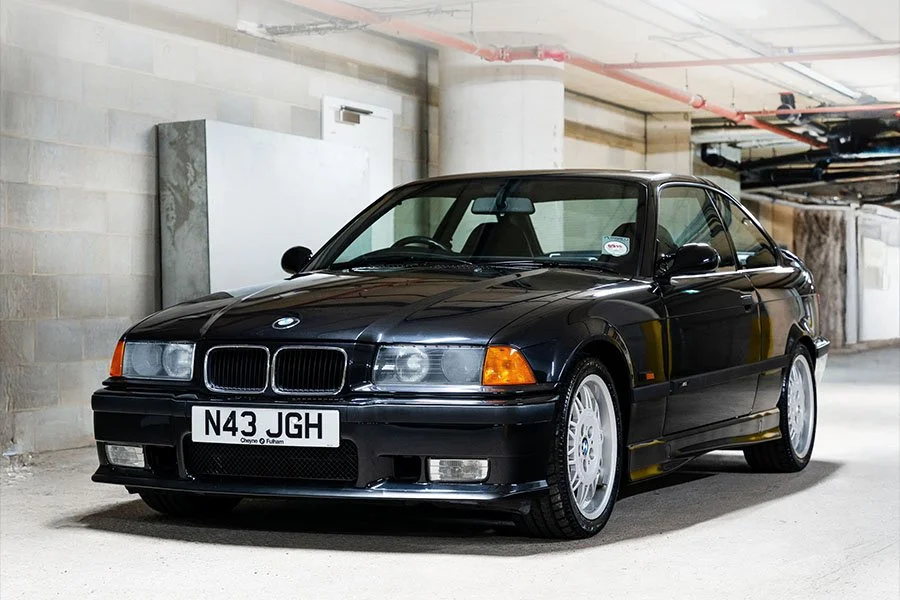
Chia’s spectacular creation was based on a unique E36 Coupe that had been conceived as a prototype Class 1 Touring Car for use in a new era of the Deutsche Tourenwagen Meisterschaft (DTM).
BMW E36 325I DTM PROTOTYPE
The Class 1 Touring Car regulations came into effect for 1993 to replace the Group A category that, in is later years, had been dominated by brutish V8-engined cars like the Nissan R32 Skyline GT-R and Audi V8 Quattro.
The new regulations restricted engines to production-based units with a maximum of six cylinders, a capacity of 2.5-litres and no more than four valves per cylinder. However, greater freedom was permitted in terms of aero kits and wheel size. All-wheel drive, traction control, ABS and electronically controlled differentials were also allowed.
With the E30 M3, BMW Motorsport had played a major role in the Group A Touring Car era. In anticipation of a similar effort for the new Class 1, an E36-based machine was developed during the course of 1992.
At the heart of the Class 1 prototype was a highly tuned iteration of the 325i straight six that revved all the way to 10,000rpm. Displacement was kept at 2494cc, but thanks to an array of trick parts, output leapt from 189bhp to 370bhp. This screamer of an engine was coupled to a six-speed manual gearbox and dropped into a lightened, seam-welded and wide-arched bodyshell.
Weight was cut to 1040kg and top speed was 186mph.
Unfortunately, Alfa Romeo, Mercedes and Opel all created Class 1 machinery powered by V6 engines that offered much better weight distribution than BMW’s long straight six. BMW had no such engine in their portfolio and were left at an obvious disadvantage.
With the DTM organisers unwilling to hand BMW any technical concessions, the Class 1 E36 project was abandoned in December 1992.
An unhappy BMW would play no part in the DTM for over 20 years.
Rather than forget about the expensively developed E36 Class 1 Prototype, BMW chose to use it as the basis for their 13th Art Car.
SANDRO CHIA
Sandro Chia was born in Florence on 20th April 1946. Here he spent his childhood, during which Chia became familiar with the city’s many great works of art.
After leaving school in 1962, Chia spent the next seven years studying at two Firenze art colleges (the Istituto d’Arte di Firenze followed by the Accademia di Belle Arti di Firenze).
Chia subsequently travelled throughout Europe, Turkey and India before settling in Rome in 1970. He began to show his early Conceptualism-based work from 1971. From the mid 1970s, Chia shifted towards a more figurative approach and, by the early 1980s, he had come to be regarded as one of the most significant artists of the Transavanguardia neo-expressionist movement that marked the revival of Italian figurative art.
His paintings showed influences by Carlo Carra, Giorgio de Chirico, Pablo Picasso, Andrea Montegna and Giorgione. By 1982, Chia’s work was being shown at top exhibitions around the world to include the Guggenheim Museum in New York.
CHIA’S E36 325I DTM PROTOTYPE
Sandro Chia completed the commission from BMW in October 1992.
He applied portraits on the paintwork to challenge the observer to consider looking at himself in the mirror. Chia explained that, as a car is exposed to the stares of observers “I decorated the surface of this car to represent these stares. I have created both a picture and a world. Everything that is looked at closely turns into a face. A face is a focus, a focus of life and the world."
Text copyright: Supercar Nostalgia
Photo copyright: BMW - https://www.bmw.com
Although BMW’s Formula 1 programme of 2000 to 2009 did not deliver on championship-winning potential, it did pave the way for an F1-inspired V10 to find itself in the 2004-2010 M5 and the 2005…
During the mid-to-late 1980s, arguably the most elegant sporting Coupes offered by Europe’s high end manufacturers were the Aston Martin V8 and BMW’s E26 M635 CSi. While in Vantage trim the…
Owing to tighter emissions legislation, E36 M3s bound for North America had to be fitted with lower compression engines that did not feature the same radical cylinder head, variable valve timing…
After a five-year spell campaigning the E36 M3 GTR, BMW’s North American competition partner, Prototype Technology Group (PTG), switched focus to the new E46-based Motorsport 3-series.
To promote its highly anticipated M1, the first mid-engined road car in BMW’s history, a fleet of three early examples were retained for promotional use. Of these, just one was finished in Blue, chassis…
Produced for just 16 months between March 2011 and June 2012, BMW shifted a little over 6000 copies of its E82-based 1M Coupe. By contrast, the contemporary M3, manufactured from 2007 until…
Although it never wore the familiar ‘M’ moniker that graced most of BMW Motorsport’s road cars, the E31-based 850 CSi featured even more performance enhancements than many M-badged…
Despite having been up against much newer and more highly developed opposition, BMW’s iconic E30 M3 still proved itself a winning platform during the car’s sixth and final season in the Deutsche…
Perhaps the least well known BMW Motorsport product to emerge during the 1990s was the E31 850 CSi built in limited numbers between 1992 and 1996. Despite its lack of an “M” moniker, practically…
Although BMW’s Group 4 M1 is best remembered for the Procar series from which it took its name, once a much-delayed homologation process had been rubber stamped, the model did go on to…
Having commissioned the first two instalments of its burgeoning Art Car theme in time for the 1975 and ‘76 Le Mans 24 Hour races, BMW went on to order a third machine that would appear at the…
Perhaps counter-intuitively, the lightest body style from BMW’s V8-powered M3 line produced between 2007 and 2013 was the four-door E90 Sedan which tipped the scales at 50kg less than a…
Although France was among the last major European nations to organise a national Touring Car championship, the Gallic series saw an explosion of interest during the mid-to-late 1970s when it…
When it comes to hot executive Saloons of the 1980s, Alpina’s B7 Turbo has it all. Starting with a BMW E28 535i, Alpina added its familiar blend of uprated suspension, wider wheels, a limited-slip…
In addition to the examples sold to customers, BMW Motorsport retained a good stock of M1 Procars for its own requirements. Of these, some were destined for works use in the Procar series while a few…
As the most successful F1 driver on the grid with 17 victories and two Drivers’ titles, Niki Lauda would already have been among the favourites to walk away with the 1979 Procar Championship.
At the Paris Motor Show in October 1972, BMW unveiled a styling concept with a turbocharged version of the two-litre M10 engine. The Paul Bracq-designed E25 Turbo had a mid-mounted…
Considering just how unbelievably ugly most BMWs from the modern era have become, it may surprise some of our younger readers that, from the late 1960s through to the early 2000s, the…
Although the 3.2-litre E36 M3 Evolution has the most powerful engine fitted to BMW Motorsport’s compact 90s offering, our favourite iteration of the second generation M3 was the limited run GT…
Even though an oil crisis caused by a 1973-1974 war in the Middle East massively curtailed its works career, BMW’s E9 CSL remained the best top flight Group 2 racing car throughout the remainder of…
By dropping a close relative of the M1’s dual overhead cam 24 valve straight six into the elegant Paul Bracq-designed 6-series bodyshell which was then further enhanced with uprated…
For 1995, BMW decided to run its E36-based M3 GTR in IMSA’s popular GTS-2 category for GT racing cars. The programme was managed on BMW’s behalf by Tom Milner’s Prototype…
Having been conceived with the primary intention of serving as the basis for a Group 4 and 5 racing programme, the prospect of a multi-year homologation delay owing to production issues meant…
When it came to an off-the-shelf mid-sized super saloon during the first half of the 1980s, nothing in the Mercedes-Benz, Jaguar or Alfa Romeo arsenal could touch the BMW Motorsport-enhanced…
With a bigger bodyshell and more refined six cylinder engine than the outgoing E30 M3 (which had used a racey four cylinder motor), in many ways BMW’s E36-based expression of the M3 theme felt…
The 1980s really was a great time for large-engined German Grand Tourers with Audi, BMW and Porsche all taking a divergent approach with the Quattro, M635 CSi and 928 respectively. For an…
Unfortunately, owing to poor trading conditions caused by a global economic recession, over the winter of 1991-1992 BMW elected to abandon its plans for an M1 successor after Ital Design had…
The earliest Alpina-tuned variants of the Paul Bracq-styled E12 arrived very soon after this, the first generation 5-series, made its debut at the Frankfurt Motor Show in September 1972. Having initially…
Although the radical M8 never made it into production, BMW Motorsport did work their magic on another iteration of the E31 8-series: the 850 CSi. Unusually, the 850 CSi did without the familiar…
Following the launch of BMW’s range-topping E31 8-series at the Frankfurt Motor Show in September 1989, the Munich firm’s Motorsport department began work on a pair of high…