VIN: the Mecom Racing Team Lola Mk6 GT chassis LGT-2
/ Ben Tyer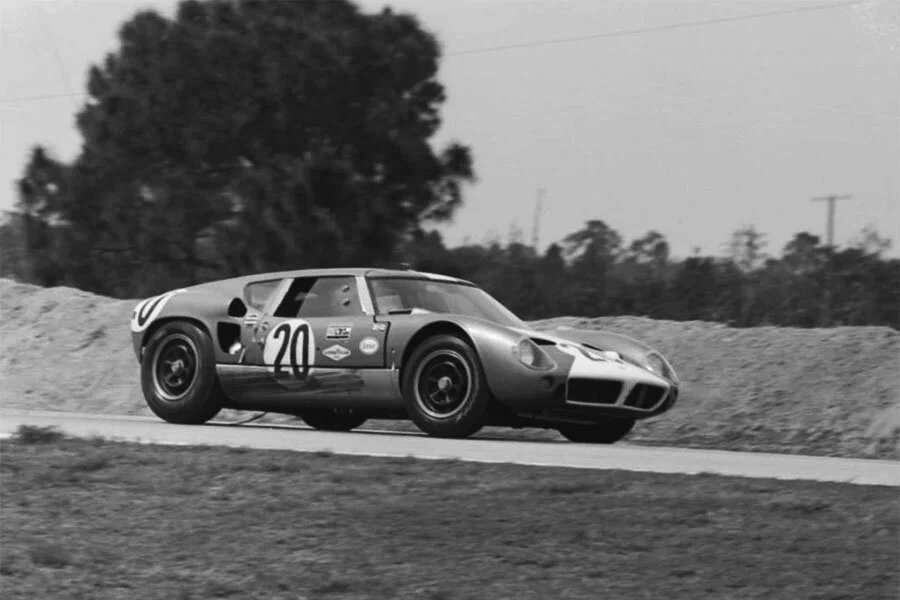
HISTORY OF CHASSIS LGT-2
Chassis LGT-2 was one of the two Mk6 GTs fitted with an aluminium monocoque after the prototype (LGT-P) had been completed with a steel monocoque.
LGT-1 was retained by Lola as a works car and LGT-2 was sold to millionaire Texan industrialist, John Mecom Jr.
The son of John Mecom Sr. (one of America’s top independent oilmen), John Mecom Jr. was only 23 when he acquired the Lola. Nevertheless, his privateer Mecom Racing Team already boasted an enviable stable of machinery and a fine roster of drivers.
Perhaps most famously, it was Mecom’s Lola T90 that won the 1966 Indianapolis 500 with Graham Hill at the wheel.
John Mecom Jr. took delivery of LGT-2 in time for the Guards Trophy at Brands Hatch on August 6th 1963.
Like most of Mecom’s sports cars, the Lola was painted metallic blue with a white centre stripe. However, it arrived late and Augie Pabst started from the back of the grid after he missed practice.
Pabst’s race only lasted four laps before the Ford engine lost oil pressure and expired.
Mecom took the car back to the US where it was fitted with a six-litre Traco-tuned Chevrolet V8. In this configuration, Pabst won the end-of-season Nassau Tourist Trophy at the Bahamas Speed Week.
Thereafter, success was limited.
In 1964, LGT-2 failed to finish at Sebring, did not start the Player’s 200 at Mosport, took seventh in an SCCA National race at Road America and then placed eleventh overall at the Brands Hatch Guards Trophy.
After Brands, it was returned to Lola for some modifications. By this time, Eric Broadley had quit his two-year contract with Ford to develop the GT40 and was back at Lola full-time.
LGT-2 was uprated with new wide track suspension, bigger brakes with better cooling, improved driver ventilation, Cobra-style FIA wheels and GT40 hubs. The wider wheels also required all four wheelarches to be dramatically flared.
Back in America, LGT-2 was entered for the US Road Racing Championship finale; a 500 mile contest at Road America on September 14th. Once again, Pabst was forced to retire, this time after 30 laps with a radiator issue.
The car’s next outing should have been the 200-mile Los Angeles Time Grand Prix at Riverside on October 11th. However, a sticking throttle in practice saw the Lola crash heavily into a guard rail. Pabst was lucky to escape with his life as the top of the aluminium canopy was nearly shorn off.
Rather than have LGT-2 repaired, John Mecom Jr. decided to cut his losses and put the damaged Lola into storage.
He eventually sold the partially repaired car in 1986.
Notable History
John Mecom Jr. (Mecom Racing Team), Texas
Metallic Blue with White centre stripe
Temporarily registered on British trade plate 0142 KE
06/08/1963 IND Brands Hatch Guards Trophy (A. Pabst) DNF (#3)
4.7-litre Ford V8 replaced with a 6-litre Traco Chevrolet V8
01/12/1963 BSW Nassau Tourist Trophy Preliminary (A. Pabst) 1st oa, 1st GTP class (#00)
01/12/1963 BSW Nassau Tourist Trophy (A. Pabst) 1st oa, 1st GTP class (#00)
21/03/1964 WSC Sebring 12 Hours (A. Pabst / W. Hansgen) DNF (#20)
06/06/1964 CSC Mosport Player's 200 (A. Pabst) DNS (#9)
21/06/1964 SCA National Road America (A. Pabst) 7th oa, 2nd CM class (#2)
03/08/1964 IND Brands Hatch Guards Trophy (A. Pabst) 11th oa, 7th SP2.0+ class (#8)
Returned to Lola and modified with wide track suspension, bigger brakes with better cooling, improved driver ventilation, Cobra-style FIA wheels, GT40 hubs and flared wheelarches
13/09/1964 USR Road America 500 mile (A. Pabst) DNF (#1)
11/10/1964 IND Riverside 200 mile (A. Pabst) DNS (#24)
Damaged in Pabst’s practice crash at Riverside
1986 sold partially repaired to Gordon Gemball, Seattle
Text copyright: Supercar Nostalgia
Photo copyright: The Henry Ford Museum - https://www.thehenryford.org/
Relive one of the most dramatic chapters in Daytona endurance racing with this classic film from the 1969 24 Hours of Daytona. Porsche was widely expected to dominate again, but in a stunning turn of events the Sunoco-liveried Lola T70 Mk.3B GT Chevrolet took overall victory.
Automotive royalty pays a surprise visit to the garage when Allen Grant stops by with his newly restored 1963 Lola Mk6 GT, the prototype vehicle that led to the legendary Ford GT.

Lola were great beneficiaries of the FIA’s decision to restrict engine capacity of top flight Group 6 Prototypes to three-litres for 1968. Like Ford’s GT40, the Lola T70 Mk3B GT was, on account of a…

During an enormously successful maiden campaign in 1965, Lola’s new Group 7 class T70 won major races in the UK, United States and Canada with international stars like John Surtees, David

Chassis SL76/153 was the T70 Mk3B GT supplied new to privateer Terry Croker for the 1970 season. The yellow car appeared under an A&J Motors entry which was the garage run by Croker’s father in…

Chassis SL76/147 was dispatched on May 20th 1969 to Lola’s European distributor, Jo Bonnier. Bonnier in turn sold the car to renowned Swiss tuner, Louis Morand, who planned to race it with an…

For 1967, Lola created a Coupe version of the highly successful T70 which for the previous two seasons had proven so effective in Can-Am, the Unites States Road Racing Championship and the…

Chassis SL76/151 was the second T70 Mk3B GT sold to the Swiss Ferrari distributor, Georges Filipinetti. It followed chassis SL76/145 which incurred heavy damage on its debut outing at the…

Chassis SL76/149 was sold to 28-year old English privateer, Mike de Udy, for his 1969 campaign. Prior to this latest T70, in 1967 de Udy had purchased a new first generation Mk3 GT (chassis SL73/105)…

Chassis SL76/145 was sold to Lola’s US distributor, Carl Haas, of Lincolnshire, Illinois. Together with the sister cars of Roger Penske and John Love, SL76/145 was expected to form part of a three-car…

Chassis SL76/144 was sold to 32 year old privateer racing driver David Preston of Bosworth, Leicestershire. Between 1964 and 1968, Preston had competed with a Lotus Seven, a Brabham BT14…

Chassis SL76/148B was built around a brand new chassis and body using the engine and gearbox from Picko Troberg’s wrecked T70: chassis SL76/148A. The red Lola was supplied to British privateer…

Chassis SL76/148A was the second T70 Mk3B GT supplied to Swedish privateer, Picko Troberg. It replaced Troberg’s earlier example, SL76/148, which had been wrecked by Bjorn Rothstein during…

Chassis SL76/148 was sold via Lola agent, Jo Bonnier, to Swedish car dealer and privateer racing driver, Picko Troberg. Troberg began racing in the Swedish Formula Junior series. In addition he…

Chassis SL76/146 was sold new to John Woolfe. Woolfe was a British privateer who, together with his business partner, Arnold Burton, ran John Woolfe Racing, a major UK retailer of high performance…

Chassis SL76/138 was sold to Irish racing driver and team owner, Sid Taylor. Taylor hailed from Rathfarnham in south Dublin. He ran Taylor’s Grange Hotel (located on his family’s extensive farm)…

Chassis SL76/150 was one of 16 Lola T70 GTs built to Mk3B specification. It was originally sold to renowned British privateer, David Piper. David Piper was among the best known sports car entrants…

Chassis SL76/139 was the first T70 Mk3B GT. Completed by Lola on December 30th 1968 and dispatched to the USA the next day, its destination was Roger Penske Racing in Philadelphia. Penske…

Chassis SL70/143 was one of the 16 B-spec. T70 MK3 GTs constructed by Lola. It was supplied new to Swedish Formula 1 driver, Jo Bonnier, whose Grand Prix career included spells at BRM, Porsche and…

Chassis LGT-2 was one of the two Mk6 GTs fitted with an aluminium monocoque after the prototype (LGT-P) had been completed with a steel monocoque. LGT-1 was retained by Lola as a works car and…

After the Mk6 GT prototype (LGT-P) had been completed with a steel monocoque, two additional examples were built with aluminium monocoques. The first was LGT-1 which Lola retained for use as…

Chassis LGT-P was the original Mk6 GT prototype. It was the only Mk6 GT built with a steel as opposed to aluminium monocoque. Lola took it to Olympia in January 1963 for the London Racing…

Lola’s first sports racing car, the Mk1, had proven an enormous success. Powered by an 1100cc Coventry Climax engine, it won multiple titles including the BRSCC Sports Car Championship in…

Considered among the best sports car drivers of his time, Australian Paul Hawkins was variously employed by the works Porsche and Ferrari teams as well as Carroll Shelby and the Gulf-backed…

Ulf Norinder was a wealthy Swiss privateer whose grandfather manufactured Lakerol pastils and lozenges. By 1968, Norinder had owned and raced a variety of cars to include a Maserati 200 S, two…